Testing Google's AI itinerary generator in search
Google’s new AI-powered trip planner promises personalized dream vacations – but how well does it handle complex requests? We put Gemini to the test with a 6-month historical reenactment itinerary. Here’s how it performed, where it excelled, and where it fell short.
Image by Cybernews

 Follow us
Google’s new AI-powered trip planner promises personalized dream vacations – but how well does it handle complex requests? We put Gemini to the test with a 6-month historical reenactment itinerary. Here’s how it performed, where it excelled, and where it fell short.
Artificial intelligence (AI) agents have come on leaps and bounds since the turn of the year, and last week, Google announced they’ve embedded trip planning into how its AI conducts searches.
It begins by creating a dream draft – brainstorming a trip based on your general preferences, suggesting places you’d appreciate.
Then Gemini (Google's AI model) does a reality check by going over all the logistics to make sure the trip is actually possible.
Then, like a puzzle, it shuffles the pack and fine-tunes the details for your perfect stay—well, so they say. Cybernews puts it to the test. We gave it what we thought were three daunting tasks.





The tasks at hand
The first prompt was:
Plan a 6-month historical reenactment around-the-world trip. I don't want to feel like I am in 2025 anywhere, no matter what I do. Give me everyday plans including food, activities, hotels, and unique experiences. Thoroughly research it all for me.
The AI did well, as it opened up with complete honesty, detailing the complexity of the task at hand – which I appreciated.
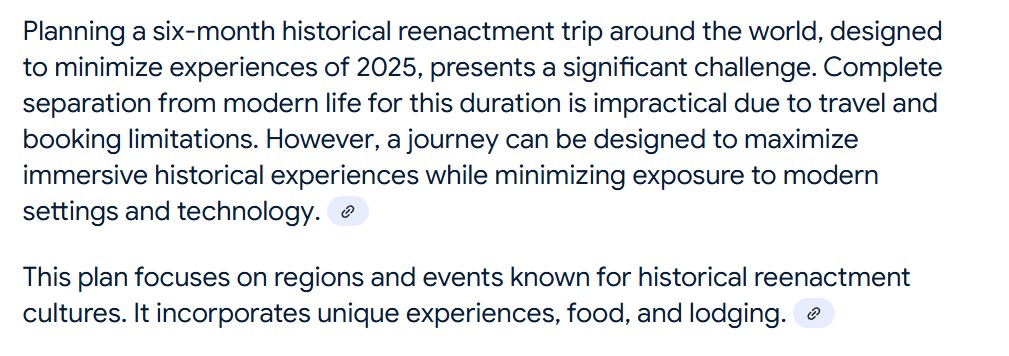
First stage passed, as removing 2025 is an astute choice for someone seeking a break from modernity.
The first tip it gave me was to use actual maps instead of GPS. Good one.
For accommodation picks, it suggested Monasterium PoortAckere in Ghent, Belgium (a former 13th-century monastery), and even Hotel Antiche Figure in Venice, Italy (a 15th-century structure).
It shied away from making suggestions every night for half a year, though—probably down to the computational power it would take, as opposed to the complexity of the task.
To be fair, when I asked Gemini itself directly to go into the micro details, it reasoned with me that the word “historical” is too broad, that an AI or human would struggle to book for so long, that availability rapidly changes, that my pacing was unclear, and that I might get travel fatigue.
As a human travel agent would surely have a “no can do” retort, Gemini was encouraging me to offer more specific and realistic prompts, as well as offering to brainstorm a concept-based six-month itinerary. I was impressed.

A six-month historical enactment trip
For the timeline itself, the large language model (LLM) decided to break down my hypothetical trip into month-long segments.
Month one would be spent in the UK and Northern Europe, visiting medieval castles and heading to Gosport, UK – a historical reenactment village – as well as traveling to Belgium and Germany for historical sites.
It was quite non-specific for these, but I trust that with more prompts, it would be able to flesh it out better.
For the second and third months, it had me sampling colonial and revolutionary America, followed by the Civil War – with visits to places of settlement like Williamsburg, Virginia, and battlefields like Gettysburg, Pennsylvania.
Month 4 was held for Renaissance and medieval Europe; it recommended Carcassonne and Prague, and an impressive Albergo Diffuso in Italy.
The main disappointment came at the end, where it kind of sputtered out.
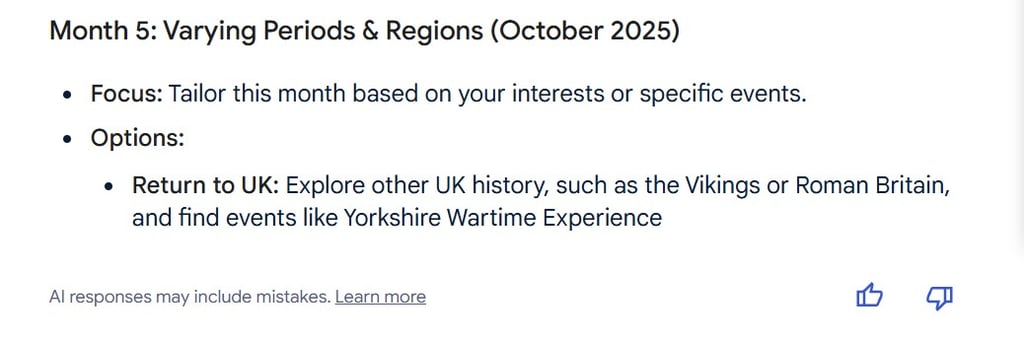
Overall, great potential here, despite the obvious drawbacks. We also asked it to condense the idea of Renaissance Europe into two weeks, and it gave some shrewd recommendations: Rome and the Vatican, Florence, Venice, Paris, Versailles, and London.
This feature is only going to get more efficient and nimble-fingered, and I certainly learned it’s good to be specific about what you want – but there’s no need to be a difficult customer.