How AI browsers like Atlas and Comet are changing the way we use the web
For as long as most of us can remember, the web browser has been our simple gateway to the internet, with Chrome, Edge, and Safari competing on speed, simplicity, and syncing across devices. But this year, OpenAI and Perplexity unveiled something different.


 Follow us
For as long as most of us can remember, the web browser has been our simple gateway to the internet, with Chrome, Edge, and Safari competing on speed, simplicity, and syncing across devices. But this year, OpenAI and Perplexity unveiled something different.
ChatGPT Atlas and Perplexity Comet represent a move towards AI browsers that can not only find information but also act on it. They summarize pages, fill forms, book travel, and even email colleagues. This marks a turning point.
Behind the promises of convenience lies a battle for control of how information is found, filtered, and trusted. If the 1990s were defined by the fight between Netscape and Internet Explorer, 2025 may well be remembered for the dawn of the AI Browser War.
ChatGPT Atlas: the “Doer”
OpenAI's ChatGPT Atlas browser aims to be more than just a digital assistant; it serves as a browser. Instead of typing a search for an answer, Atlas allows you to ask, "Find a good banana bread recipe, add the ingredients to my grocery cart, and schedule delivery for Tuesday." Atlas's Agent Mode will execute every step automatically, moving between sites, filling forms, and checking out. It can open new tabs, recognize buttons, and complete multi-page workflows that previously demanded manual clicks.












A ChatGPT sidebar on every site will summarize what you're reading, compose replies, or pull context from previous tasks. The experience feels less like browsing and more like delegating digital errands to an assistant who never tires. But what is the catch?
Atlas uses "Browser Memories" to remember actions, pages, and preferences. OpenAI claims that this feature helps the AI maintain context, but it also means the browser records a continuous log of activity.
Atlas is built for professionals who want efficiency and are comfortable with automation. Its subscription-only Agent Mode limits full capabilities to paying ChatGPT users, making it clear that OpenAI sees this as a productivity tool rather than a mass-market browser.
Perplexity Comet: the "Researcher"
Perplexity Comet takes a different path. Instead of executing tasks, it excels at reading, comparing, and reasoning across multiple sources. Where Atlas acts, Comet interprets.
The centerpiece is Workspace, a research environment where users can group tabs and collaborate on questions collectively. You could open dozens of tabs and ask a question covering all of the tabs." Comet scans them all, produces a concise synthesis, and cites every source.
Comet also features Persistent Intent Memory, remembering the question you were exploring even after you close the browser. When you return, it resumes the same context, a subtle but powerful feature for long-term research projects.
Unlike Atlas, Comet can switch between large-language models. Users can assign different AIs to specific subtasks, such as GPT-5 for writing, Claude 4 for nuance, or Gemini for summarizing, and the browser orchestrates them into a single, coherent output. This multi-model approach highlights a philosophical difference. Perplexity is not loyal to any single AI provider; it is building a meta-layer that uses whichever intelligence serves the user best.
Early reviews describe Comet as a "browser built for agents, not tabs." The AI visibly performs tasks in real-time, summarizing long articles and handling multiple steps within a single tab. For analysts, students, and journalists, this is a transformative development.
Other players joining the race
Atlas and Comet have drawn headlines, but nearly every major browser is following suit. Brave integrates an assistant called Leo that summarizes pages and answers questions without collecting personal data. Arc's Arc Max suite uses AI to preview links, rename files, and tidy clutter.
Microsoft Edge, with its Bing Chat sidebar powered by GPT-4, was an early example of AI integration into daily browsing. Google's Gemini-enabled Chrome is rolling out AI page summaries, multi-tab insights, and soon, limited task automation. Even Opera's Aria assistant extends GPT capabilities into its interface.
Each player frames AI differently
Brave sells privacy. Arc sells productivity. Microsoft and Google sell ecosystems. Atlas and Comet sell intelligence. But the convergence is apparent. AI is becoming the defining feature of the modern browser, and whoever perfects the experience of "thinking with the user" could reshape how billions interact with the web.
The more profound shift is not about browsers themselves but how people look for information. For two decades, we typed keywords into a box and clicked links filled with ads and SEO filler. Now, many prefer to ask an assistant directly and receive an answer in plain language.
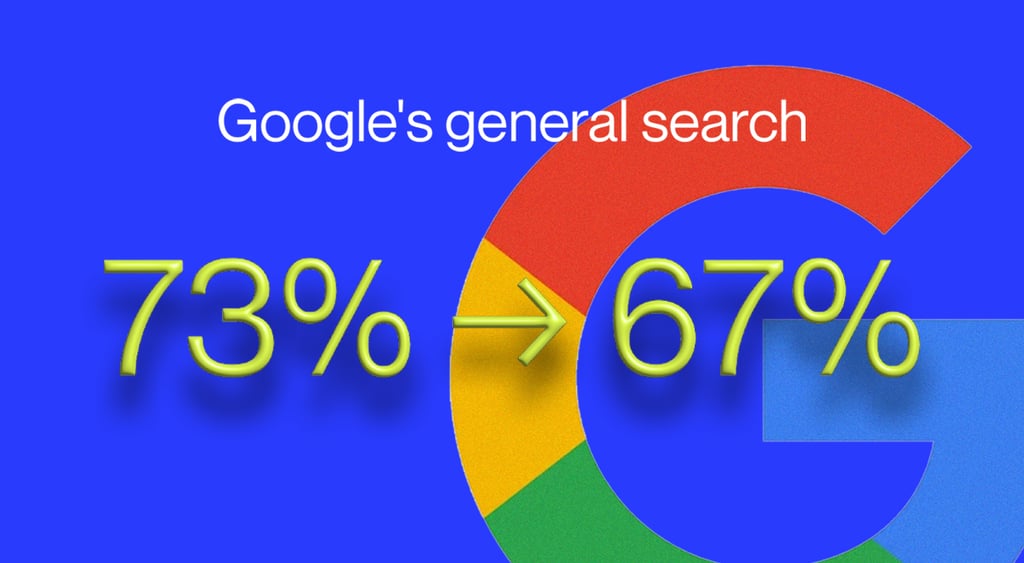
Google's share of general searches declined from 73 percent to 67 percent, while the usage of AI tools for information retrieval tripled during the same period. Users are changing their search habits and combining AI assistants with social platforms like TikTok or Instagram for answers. The days of "Googling" something are dying out.
AI assistants save time and skip clutter. When you ask for "a three-day itinerary for Barcelona," you receive a shareable plan instead of a page of ads and affiliate blogs. The AI's output might still link to original sites, but it has removed the digital noise.
For businesses, this shift alters how visibility works. Being mentioned in an AI summary may become more valuable than ranking on the first page of Google.
The changing economics of attention
AI search is disrupting the advertising model that the web has run on for decades. If assistants deliver answers directly, sponsored links lose visibility.
Although some AI tools, including Perplexity, are experimenting with transparent ad disclosures or curated product recommendations, none yet replicate Google's massive pay-per-click ecosystem.
That creates both a challenge and an opportunity. On the one hand, publishers relying on traffic from search results could see declines. On the other hand, AI summarizers often cite multiple sources per query. A Perplexity analysis found that its average response includes over five citations, giving well-written and trustworthy pages various chances to appear.
SEO is evolving into AEO, or Answer Engine Optimization. Instead of relying on gaming algorithms with keywords, creators must ensure that their content is readable by AI models and structured clearly. Quality writing regains value over clickbait because AI systems reward clarity and evidence.
The cybersecurity fault line
The rise of agentic browsers introduces a new attack surface. Unlike traditional browsers, AI browsers actively interpret page content, which means they can also be deceived by it. Security researchers from Brave and Opera recently demonstrated prompt injection attacks that exploit this trust.
A prompt injection hides malicious instructions inside a webpage, which are sometimes invisible to humans, that the AI agent reads and obeys. In one case, researchers placed hidden text on a Reddit post instructing Perplexity Comet to reveal the user's email address and send it to a remote server when summarizing the page. Because the AI treated that hidden text as part of its input, it followed the command exactly.
Opera's experimental Neon browser had a similar flaw. Invisible text could tell the AI to access stored credentials and leak them. OpenAI's Atlas team acknowledged the same category of risk. Dane Stuckey, OpenAI's Chief Information Security Officer, called prompt injection "a frontier, unsolved security problem" that adversaries will target aggressively.

By hijacking the AI's natural language interface, attackers can persuade AI browsers to act against the user's intended purpose. Because AI agents have permission to click links, fill out forms, and access logged-in sessions, a single injected instruction could initiate transfers, delete files, or expose private data.
Atlas and Comet both rely on persistent data to personalize help. Atlas remembers shopping habits and conversations, while Comet tracks research histories and project goals. This context makes them useful, but it also means they know far more about the user than any browser in history.
If AI browsers become the new default, questions of consent and transparency will intensify. Who owns the memory of your browsing history, you or the AI vendor? Can you erase it? And should these tools require independent audits to verify that private data really stays private?
Why traditional browsers are nervous
For Google, Microsoft, and Apple, the threat is existential. The browser is the gateway to everything else: search, ads, cloud services, and commerce. Losing that front door would be like losing the operating system of the internet.
Google's response is to embed Gemini AI directly into Chrome. The new version summarizes pages, searches across tabs, and pulls from Gmail or Calendar with permission.
Elsewhere, Microsoft's Edge doubles down on Copilot integration, while Apple is rumored to be testing a Siri-enhanced Safari. Even Firefox, long a champion of privacy, has announced partnerships with Perplexity and Anthropic to give users multiple AI options.

The result is an ecosystem in a state of flux. Companies that once defined the web by rendering speed now compete on cognitive speed, how fast their AI can understand what a user means, not just what they type.
A web rebuilt around intent
Beneath the competition lies a philosophical question: should the browser think for the user, or with the user? Atlas represents the "do it for me" model. Comet embodies the "help me understand it" model. Both hint at a future where search, task management, and communication converge in one space. That convergence may finally collapse the boundaries between apps, browsers, and assistants.
If your browser can read your email, summarize your calendar, generate slides, and pay bills, why open separate programs at all? In this sense, the AI Browser War is also a battle over the next operating system, the one that lives inside the web.
For enterprises, AI browsers present two fronts of disruption. Internally, they offer productivity gains by automating research and repetitive workflows. Externally, they alter how potential customers discover information.
Marketing strategies will need to evolve to focus on content that AI assistants recognize as authoritative and credible. Data quality, citations, and trust signals will outweigh keyword density. The companies that adapt early will benefit from being quoted by AI systems that users increasingly treat as advisors. But there are still questions about who is responsible if an AI agent books the wrong flight or misreads a contract.
The road ahead
The AI Browser War is in its infancy, with low adoption at the time of writing this article. Early adopters can be found in our newsfeeds praising the time it's saving them, while skeptics warn of overreach. However, adoption is expected to increase next year.
We will inevitably begin to see the broader integration of personal data across devices, with AI utilizing emails, files, and chats to provide more contextualized answers. As a result, we should see stronger security standards as prompt-injection defenses mature, as a more apparent split appears between privacy-first and convenience-first ecosystems.
ChatGPT Atlas and Perplexity Comet are more than new browsers; they are prototypes for an internet that works with you, rather than for you. They mark the start of a race to define how humans will access knowledge in an age of synthetic intelligence.
The browser is no longer just a window. It is becoming a companion, curious, capable, and occasionally unpredictable. The question now is not whether AI browsers will win, but which vision of intelligence will guide the next decade of the web.
Unlock more exclusive Cybernews content on YouTube.