AI-powered military drones and the future of warfare
The advanced capabilities of AI-based navigation in military drones mean they will no longer require human training. They will rely on near-instantaneous sensor data from cameras, LiDAR, and radar to identify obstacles that will inform their future navigation, such as mountains, structures, and other aircraft.

Image by Cybernews.

 Follow us
The advanced capabilities of AI-based navigation in military drones mean they will no longer require human training. They will rely on near-instantaneous sensor data from cameras, LiDAR, and radar to identify obstacles that will inform their future navigation, such as mountains, structures, and other aircraft.
Small quadcopters in Ukraine were equipped with AI navigation packages, enabling them to complete their mission even after Russian troops had jammed their GPS signals.
Programs in the US, such as DARPA EVADE, are deploying Sikorsky's autonomy MATRIX software in vertical takeoff drones, which nominally have the capabilities of flight and fight without communication with an operator, share situational awareness, and continue to achieve their objectives.
A drone that flies, reroutes, and avoids threats without human interaction does not operate as a remote-controlled vehicle. Instead, it acts independently in combat.






From identification to strike: AI at the targeting level
The most contentious application of AI in targeting military drones is the recognition of targets. Using deep learning models trained on massive amounts of image data, drones can recognize vehicles, artillery, or even people.
The AI models utilize visual patterns and infrared signatures to help identify and distinguish between an enemy armored vehicle on a battlefield, hidden in a field, and a civilian tractor, also hidden in the same spot. For example, Russia's KUB loitering munition features an AI visual identification module designed to enhance its search range and accuracy.
The Bayraktar TB2, arguably the most well-known drone, features onboard targeting systems that provide unified target designation and tracking. The TB2's follow-on munition, the Kamankeş loitering munition, is advertised to have AI-guided optics that enable it to loiter, identify, and autonomously kill any targets.

The ramifications are staggering. A drone that could do that could loiter for hours, detect a missile launcher or armor target, and kill without verification of human input at any point. Ukraine's advances in AI are even more unprecedented when factoring in that they are using modular AI kits to sever the "last mile" of the target kill chain, reducing the time from hours to minutes.
AI proponents argue that accuracy enables speed and precision with minimal risk of unintended consequences. Critics caution that algorithmic-driven lethal decisions can go terribly wrong if an object is incorrectly identified, leaving the laws of armed conflict with challenging and fuzzy questions of moral, legal, and professional liability.
Survival in war: Recognizing and avoiding
There is some benefit in combat drones, but they are vulnerable to surface-to-air missile (SAM) systems, electronic warfare, and enemy airpower. AI will give drones the capability to identify, monitor, and autonomously react to threats.

AI can also fuse sensor data from radar, infrared, and electronic signals to determine whether a drone is being tracked. Reinforcement learning, trained on thousands of computer simulations, will instruct drones on how to respond by firing countermeasures or altering their radar signature to remain undetected.
The Marine Corps has developed the Marine Air Defense Integrated System (MADIS), which leverages AI to process data from radar and cameras, designate a threat, and select the correct countermeasure, whether that is electronic jamming, a kinetic interceptor, or a directed energy weapon. The thought process is straightforward: the quicker the process, the better the chances of survival.
On the battlefield, you can go from soldiers having one mission and being killed, to a drone with fifty missions unscathed before being eliminated. AI gives a surge in survivability comparable to that of productivity.






Swarm intelligence
If one drone is disruptive, a swarm of twenty, or even a hundred, acting in unison will prove even more effective. Swarm intelligence is when multiple drones can communicate, share information, and cooperate in their actions without direct human direction.
China is already conducting large-scale swarm tests with hundreds of drones, including tests involving hundreds of small drones launched from trucks and aircraft. The US is leveraging the OFFSET program through DARPA to envision platoons of soldiers commanding swarms of drones for surveillance or assault in urban warfare.
Ukraine and Russia have each employed smaller, persistent swarms of loitering drones to overwhelm their defenses, demonstrating how quickly these concepts can translate into battlefield practice.
Swarming with drones entails designating one drone as a sensor, another as a jammer, and the others as shoot drones. The swarm flexibly readjusts its tasks on the spot: if one drone is compromised, the others reallocate the task.
The effects that were once only realized by a large air force are now scaled down to less expensive platforms. Conversely, an adversary facing a concentrated swarm is more difficult than dealing with a single drone target.
Adaptive and resilient AI
Many of these drones, unlike conventional weapon systems, employ onboard AI that is incrementally improved. The drones adapt to new threats and tactics using a reinforcement learning approach, drawing on experience gained from each encounter.
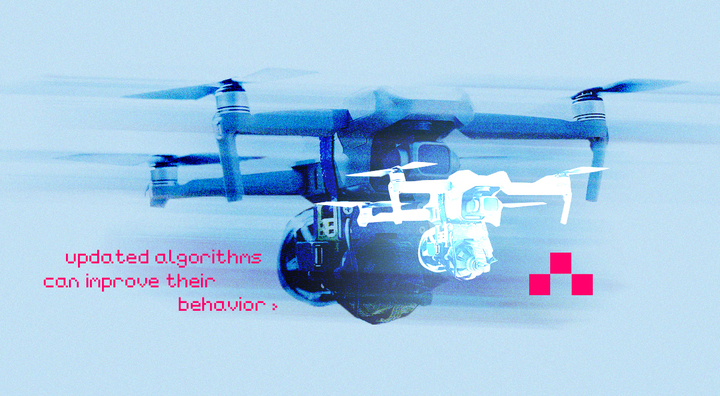
After being jammed electronically or fooled by decoys, drones with updated algorithms can improve their behavior. This type of adaptive learning experience is crucial for fast-moving battlefields where both sides of the conflict are engaged in constant battles.
Additionally, resilience is another key characteristic of drone capabilities. Several drones are envisioned to complete their targets even if they lose their connection to the operator. They combine steps of cached instructions, local sensors' sensor analyses, and AI decision-making to reach the target regardless. This capability of operating "cut off" from humans highlights both the power and the peril of autonomy.
The countries and companies leading the way on AI-enabled drones
The US is still the leader in advanced military drones. General Atomics, Northrop Grumman, and Lockheed Martin are in various stages of developing AI capabilities for their drones, including navigation, targeting, and swarm coordination.
Startups, such as Anduril Industries and Shield AI, are actively working on research and fully autonomous reconnaissance and strike drones. but Israel's Elbit Systems and Turkey's Baykar are leaders in loitering munitions and affordable autonomous systems, with experience in integrating combat actions into warfare.
Ukraine has rapidly adapted to the use of commercial drones with AI-enabled targeting applications. Russia continues to field higher operating autonomy with the Lancet and KUB loitering munitions.
Countries such as the UK, France, India, and South Korea are investing significant amounts. Competition is global, and the distance from advanced research and battlefield operations is decreasing rapidly.
How AI drones change the character of war
The impact of AI drones extends beyond capabilities and technology, also influencing tactical-level actions and even grand strategy and geopolitics. Wars take place at machine speed. The time from detection to engagement has been shortened to minutes or seconds, leaving little time to deliberate with human judgment.
Low-cost drones equipped with AI enable smaller states and non-state actors to engage the militaries of powerful states. For example, the Houthis' engagement with drone swarms to disrupt maritime traffic in the Red Sea demonstrates that low-cost actors can impose disproportionate effects.
For militaries, drones reduce the risk to soldiers and perform some of the most dangerous actions. However, there is also a need to create new defensive measures, including, but not limited to, AI-driven interceptor-type platforms and laser systems. Each growth in drone autonomy creates a pseudo-offensive capability in an ongoing algorithmic arms race.

Copenhagen and Oslo airports were recently halted for several hours due to drone sightings, resulting in a broad range of flight interruptions that affected tens of thousands of passengers.
The implausibly rapid race to implement AI-powered drones is underway. All eyes are on whether regulation and International Law can keep up. Do we allow machines to conduct lethal warfare? Can we create alternatives that guarantee human cognition and preferred autonomy?
These questions define not only the future of war but also the future of all human autonomy in an era where algorithms will determine the difference between life and death.
Unlock more exclusive Cybernews content on YouTube.