Big tech promised that AI would save the world, but what we got is tailored shopping
The discrepancy between the benefits of artificial intelligence (AI) promised by big tech and what’s actually been delivered reveals that profits will always come first. Yet, technology may still be the best hope in fighting climate change – even if it could spell the end of the human race.

Image by Cybernews.

 Follow us
The discrepancy between the benefits of artificial intelligence (AI) promised by big tech and what’s actually been delivered reveals that profits will always come first. Yet, technology may still be the best hope in fighting climate change – even if it could spell the end of the human race.
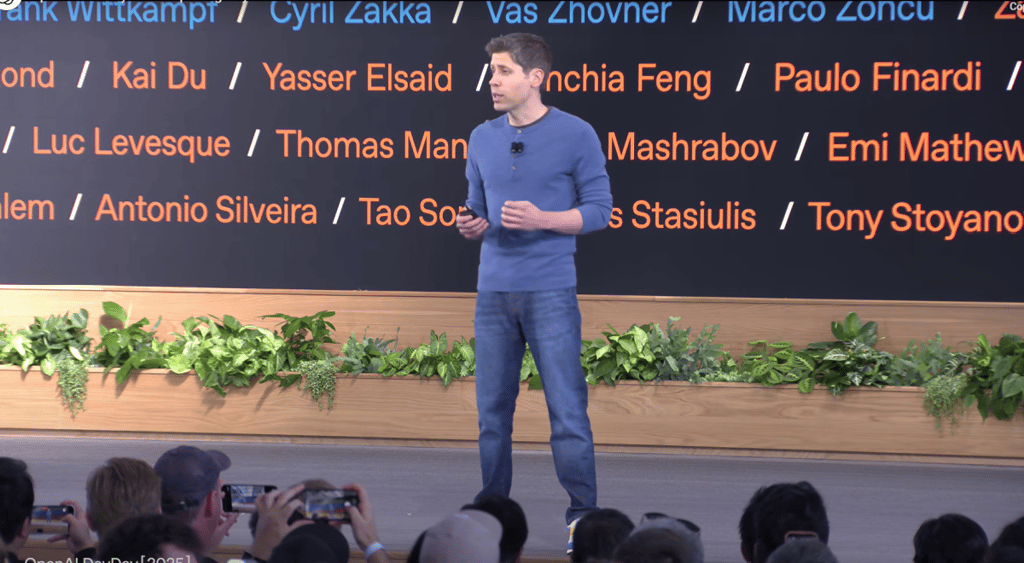
Sam Altman, founder and CEO of OpenAI, wrote last year that AI’s “astounding triumphs,” such as fixing climate change and establishing a space colony, will eventually become commonplace.
Elon Musk, another entrepreneur at the forefront of AI development, stirred a heated discussion by saying that robots will surpass the best human surgeons within five years.
Robots will surpass good human surgeons within a few years and the best human surgeons within ~5 years. @Neuralink had to use a robot for the brain-computer electrode insertion, as it was impossible for a human to achieve the required speed and precision. https://t.co/ipPhQK8z1j
undefined Elon Musk (@elonmusk) April 27, 2025
These and other promises contrast starkly with what big tech actually delivers. For many, AI’s impact is mostly felt through the use of chatbots, which haven’t solved their hallucinating problems yet, and the “slop” that fills social networks.






Others had much more bitter experiences. AI made it easier to fall for scams and led to the loss of loved ones, as happened to the parents of 16-year-old Adam Raine, who took his own life after confiding his darkest thoughts to a chatbot.
Experts say that even if big tech finally develops artificial general intelligence (AGI), the type of AI that would match or surpass human intelligence and be capable of solving issues like climate change, the consequences for humanity may be dire.






“Public benefit became an externality”
Johannes Himmelreich, a professor at Syracuse University, says tech companies, like any other companies, are in the business of making money, which doesn’t necessarily align with the general good of the public.
Companies need massive investments to find revenue because the AI market is highly experimental.
“Beyond chatbots and coding agents, it’s yet unclear what the revenue model of AI will look like. And if you run out of ideas, you fall back on advertising, and that’s the model of the AI shopping agent,” Himmelreich told Cybernews.
OpenAI, the leading AI company best known for ChatGPT, was founded as a non-profit organization in 2015, with the goal to “advance digital intelligence in the way that is most likely to benefit humanity.”
The company later shifted to a for-profit model and hit its first $1 billion revenue month in July this year. A total of $12.7 billion in revenue is expected this year.
In recent months, OpenAI has introduced an Instant Checkout function in ChatGPT that allows users to buy directly from merchants like Etsy and Walmart, promising a “personalized” experience.
Beyond chatbots and coding agents, it’s yet unclear what the revenue model of AI will look like. And if you run out of ideas, you fall back on advertising, and that’s the model of the AI shopping agent.Johannes Himmelreich
The company is reportedly planning to introduce sponsored content next year to monetize its free users.
Such updates may make shopping more convenient, while ChatGPT’s erotic version, which is yet to be released, could bring spiciness in users’ lives.
However, it is highly debatable whether these and other innovations, including a social network dedicated entirely to AI-generated videos, really benefit humanity.
Roman Yampolskiy, a professor of computer science at the University of Louisville, says targeted commerce and parasocial companions yield immediate, measurable profit via engagement, data extraction, subscriptions, and lock-in.
“Capital pressures, tractable KPIs, and weak regulation moved the industry down the steepest revenue gradient. Public benefit became an externality,” he says.
A theoretical solution for climate change
Fighting the climate crisis is another big tech promise that’s yet to be fulfilled. Altman has previously said that the best way to solve climate change is to build really strong AI first.
He said that spending 1% of the world’s electricity to train AI that figures out how to achieve carbon goals would be “a massive win.”
However, such a theoretical solution doesn’t soothe concerns about the technology’s broad environmental impact, including its contribution to climate change.
Data centers require vast amounts of electricity, which leads to increased carbon dioxide (CO2) emissions. A Guardian analysis from 2024 found that the real emissions from Google, Microsoft, Meta, and Apple data centers are likely 7.62 times higher than the companies report.
Morgan Stanley report predicts that the global data center industry will emit 2.5 billion metric tons of CO2-equivalent emissions by 2030.
Himmelreich says the fact that data centers run on dirty energy is “our own social and political failure” more than the failure of the tech companies.
“The US voted against a green energy transition, and that’s the world we live in. If anything, AGI and technology are unfortunately our best hope in fighting climate change,” he says.
AI data centers, which are often located in water-scarce areas like California and Arizona in the US, or the Middle East, need a lot of mostly potable water for cooling equipment.
According to a paper published on the preprint server arXiv, global AI demand is projected to account for 4.2 to 6.6 billion cubic meters of water withdrawal in 2027, more than half the United Kingdom’s total annual water withdrawal.
The US voted against a green energy transition, and that’s the world we live in. If anything, AGI and technology are unfortunately our best hope in fighting climate change.Johannes Himmelreich
However, some real-world examples show how AI could potentially serve the environment. Google Maps’ AI-based eco-friendly routing has helped to prevent over one million tonnes of CO2 annually, equivalent to taking 200,000 cars off the road.
And the United Nations Environment Programme uses AI to detect when oil and gas installations vent methane, a gas responsible for around 30% of the rise in global temperatures.
AGI may have “extremely bad” outcomes
Yampolskiy says environmental impact “pales in comparison” to existential risks from AGI. Altman himself has previously warned that AI will likely lead to the end of the world.
“But in the meantime, there will be great companies created with serious machine learning,” he said in 2015.
Musk even put a number on the likelihood of AI destroying humanity, saying there is a 20% chance of that happening.
According to a survey of over 2,700 AI researchers, if science continues undisrupted, there is a 10% chance of unaided machines outperforming humans in every possible task by 2027. The likelihood grows to 50% by 2047.
While the majority of researchers said good outcomes from superhuman AI are more likely than bad, about half gave at least a 5% chance of extremely bad outcomes, such as human extinction.
Unlock more exclusive Cybernews content on YouTube.