Can there be a cyber or AI-Zapad 2025?
It’s long been said that a hypothetical World War III would be vastly different from the two previous world wars, mainly due to technological advancement. In addition to fighting with guns, bombs, and artillery, a cyber and AI war will remain an always-open second front. Has Russia already opened it?
Image by Cybernews.

 Follow us
It’s long been said that a hypothetical World War III would be vastly different from the two previous world wars, mainly due to technological advancement. In addition to fighting with guns, bombs, and artillery, a cyber and AI war will remain an always-open second front. Has Russia already opened it?
- Russia’s Zapad 2025 military exercises appear to extend beyond traditional drills, with signs of growing emphasis on cyber warfare and AI-driven tools
- Zapad may serve as a testing ground for synchronizing physical maneuvers with covert cyberattacks and AI systems.
- Reports show a surge in GPS jamming and spoofing across Lithuania, Estonia, and Poland.
Russia has always been known for having one of the largest military presences in the world. It also strongly relies on manpower and large-scale training exercises such as Zapad, which is currently taking place in western Russia and Belarus.
It’s a joint military training operation conducted by the two nations, held roughly every four years. The last one was held in 2021, and five months later, in February of 2022, Russia began its full-scale invasion of Ukraine.
Ever since then, Europe has observed “an upsurge in GPS interference in areas such as the Baltic and Black Seas, particularly near airports and critical infrastructure,” reports Euronews.






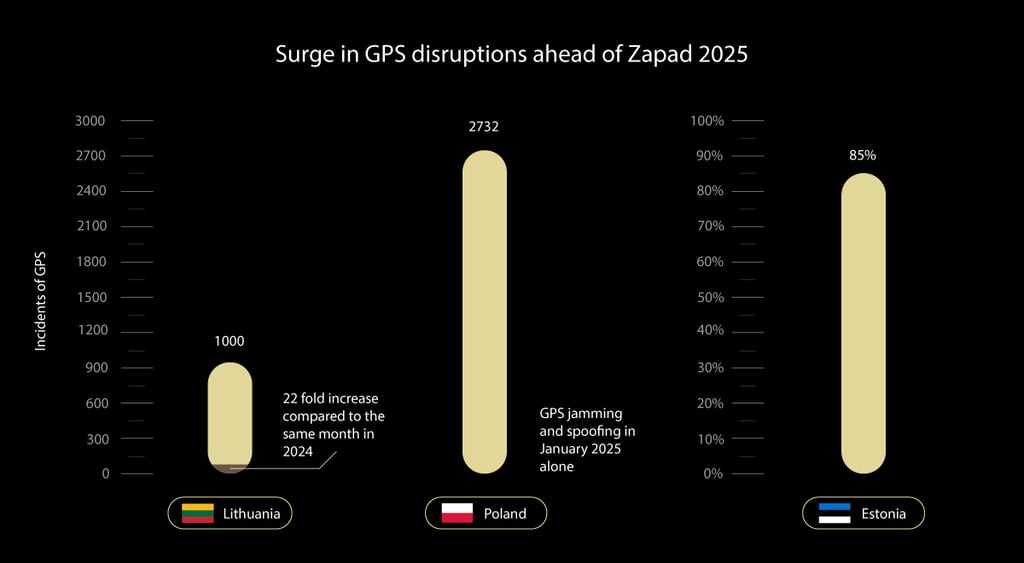
While GPS disruption isn’t new in the weeks leading up to Zapad, this year, it’s different. Lithuania reported over 1,000 incidents of GPS interference in June, a 22-fold increase compared to the same month in 2024, according to the national communications regulator.
In Estonia, authorities said that as many as 85% of flights experienced navigation disruptions. Poland documented 2732 cases of GPS jamming and spoofing in January 2025 alone.
One of the most significant instances of GPS jamming occurred when it affected European Commission President Ursula von der Leyen’s plane. She was traveling to Plovdiv, Bulgaria, to attend meetings focused on security and EU expansion along NATO’s eastern flank, meaning, near the border with Russia’s zone of influence.
“Since the Ukraine war began, we have seen notable advancements in electronic warfare, with Russia deploying more sophisticated jamming and spoofing techniques,” said Professor Sylvester Kaczmarek, Tech CEO at OrbiSky, a company primarily focused on space, AI, robotics, cybersecurity, and edge computing.
The Cybernews community is talking about this. Be a part of the conversation.
“These include integrated systems that combine GPS disruption with drone operations and cyber intrusions, honed through real-world application in Ukraine to evade detection and enhance operational denial,” he explained.
Just this week, Polish and NATO jets shot at least 19 Russian drones that had entered the Polish airspace from the direction of Belarus. Russia says they flew in from the direction of Ukraine.
“Regarding the ‘invisible' cyber component, Zapad likely includes covert cyber elements as a proving ground for synchronizing cyberattacks with physical maneuvers, such as infiltrating networks to gather intelligence or disrupt logistics while ground forces simulate advances,” said Kaczmarek.
Chances are, one of the cyber elements in this year’s Zapad involves AI.
AI-Zapad
Just a week ago, Defense Minister Andrei Belousov was briefed on a new database that collects results of drone strikes against Ukrainian targets.
“When using this program, data is accumulated for artificial intelligence. This will come in handy,” Belousov said, likely hinting at the long-term goal of feeding battlefield data into machine-learning systems that could possibly make drones more autonomous and effective in combat.
The defense minister was also introduced to a new training and development center for unmanned engineering systems, which, according to the state media, is responsible for advancing both aerial and ground-based robotics.
“I anticipate Russia will increasingly integrate AI-driven tools into its cyber and electronic warfare strategies. Drawing from lessons in Ukraine, Moscow has advanced AI for applications like autonomous drones with optical navigation resistant to jamming, enhanced command-and-control systems, and reconnaissance targeting,” says Kaczmarek.




This convergence allows for more agile hybrid operations, blending AI with electronic warfare to disrupt adversaries' sensors and communications. Given Zapad's focus on multi-domain scenarios, it's plausible these could be tested this year, perhaps through simulated AI-coordinated strikes or cyber intrusions during the exercise,” he added.
