Google lets Gemini analyze parts of your screen in Chrome – but one key territory remains excluded
Google is taking another step towards turning its operating system Chrome into an AI assistant with a new Gemini feature that can analyze exactly what users are looking at on screen.

Image by Cybernews

 Follow us
Google is taking another step towards turning its operating system Chrome into an AI assistant with a new Gemini feature that can analyze exactly what users are looking at on screen.
- Google's new "Select from screen" feature lets users highlight content in Chrome and send it directly to Gemini, giving the AI more context to answer questions.
- Chrome is becoming Google's AI-first browser, with Gemini deepening its access to on-screen content - a move that excites developers but concerns security experts.
- Despite broad international rollout, Gemini in Chrome is still unavailable in the UK, which stands out because the UK is a major Chrome market and is usually included in early launches.
Key Takeaways by nexos.ai, reviewed by Cybernews staff.
The new “Select from screen” tool appears inside Gemini in Chrome's "+" menu and works like a built-in screenshot tool, allowing users to highlight text, images, or sections of a webpage and send them directly to Gemini.
Rather than describing what’s on a page, users can simply point at the content they want help with, allowing the AI far more context to answer questions.
Users must grant permission before Gemini can access information, consents and data policies can change. In May, Cybernews reported that Google removed wording related to how Chrome’s on-device AI models handle data.






Chrome as an AI agent
The new feature signals Google’s broader ambition to make Chrome – not Android – the primary interface for AI.
Gemini is becoming deeply integrated into the browser itself, capable of understanding web content and automating tasks in real time.
It is part of a broader wave of so-called “AI browsers,” in which assistants like Copilot in Edge or Gemini in Chrome operate directly within the browsing environment.
Gemini in Chrome can already access the current webpage, browse multiple tabs with permissions, use location and microphone access, and understand browsing context to help complete tasks.
Through Gemini’s new model 3.5 Flash, introduced June 24th, developers can also build AI agents capable of interacting with browsers, desktop applications, and mobile apps using Gemini’s computer use capabilities, allowing AI to understand what’s on the screen and take actions on a user’s behalf.
While these capabilities are designed to power advanced features, if hijacked, security experts warn, they can become a surveillance toolkit.
Gemini in Chrome still not available in the UK
Curiously, Gemini in Chrome, which was first unveiled at Google I/O in May 2025, is still unavailable in the UK – despite being one of its largest European markets and one with the highest Chrome and Android usage in Europe.
The UK holds 50% of the browser market share (May 2025–May 2026) – ahead of Safari at 29% and Edge at 11%.
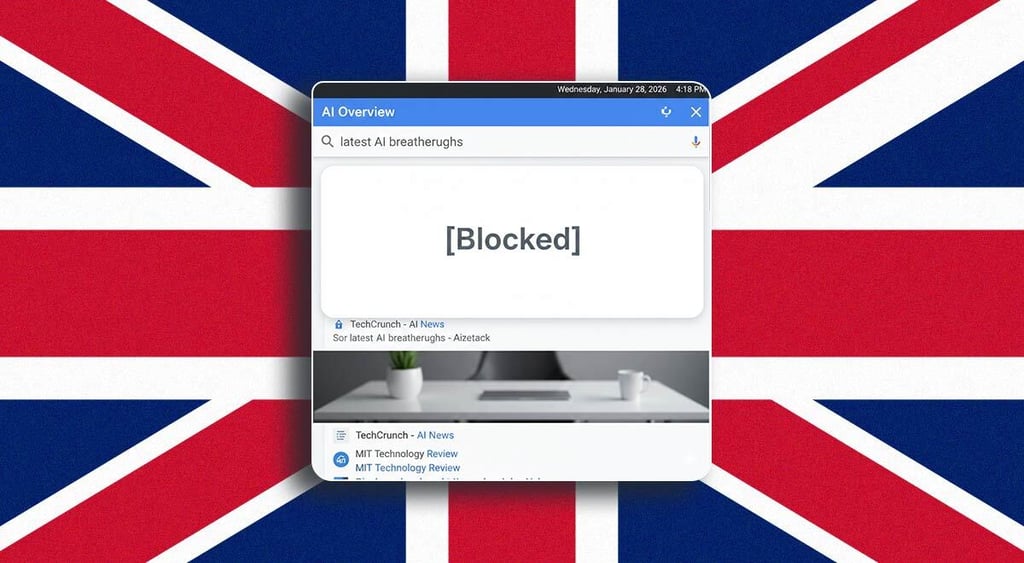
The UK’s omission is even more glaring given that the territory is usually a first-wave launch market, alongside the US, Canada, Australia, France, Germany, Italy, and Spain – all of which have Gemini in Chrome.
Other territories recently announced include India, Japan, and Hong Kong, as well as numerous countries across Latin America, Africa, and the Middle East.

Check if your data was exposed
Find out if your email and related personal information have appeared in known data breaches.
Cybernews has contacted Google to ask why Gemini in Chrome is still unavailable in the UK and will update this story if it responds.
Unlock more exclusive Cybernews content on YouTube.