Google unveils Gemini Omni, Antigravity 2.0 at AI-packed I/O 2026 developer conference
Google kicked off its annual Google I/O 2026 developer conference Tuesday with a major push toward agentic AI, unveiling Gemini Omni, a highly advanced AI video simulation model, the faster Gemini 3.5 Flash, and Antigravity 2.0, its agent-first coding platform built for autonomous AI tasks.
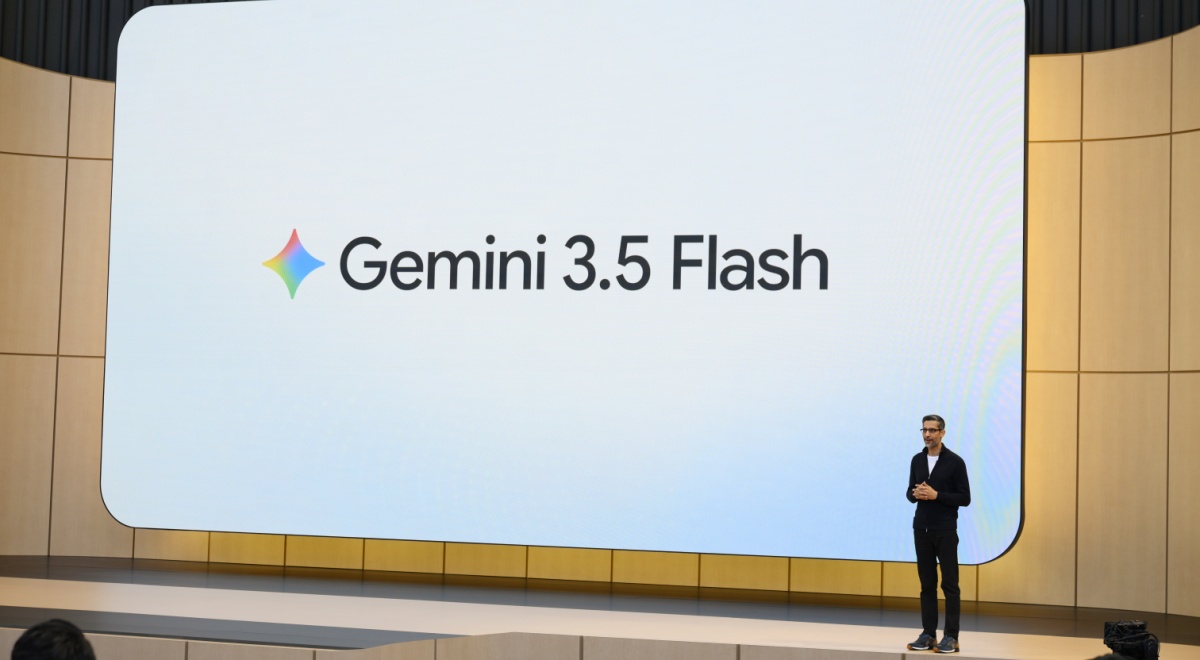
Sundar Pichai delivers the Google I/O 2026 keynote. David Paul Morris/Bloomberg via Getty Images

 Follow us
Google kicked off its annual Google I/O 2026 developer conference Tuesday with a major push toward agentic AI, unveiling Gemini Omni, a highly advanced AI video simulation model, the faster Gemini 3.5 Flash, and Antigravity 2.0, its agent-first coding platform built for autonomous AI tasks.
- Google CEO Sundar Pichai opened I/O 2026 with a keynote of Gemini launches, including Gemini Omni, Gemini 3.5 Flash, and Antigravity, Google’s new agent-focused coding platform.
- Google says its latest AI tools can generate video, power conversational search, and let autonomous AI agents handle complex coding and development tasks.
- The keynote shows Google pushing Gemini beyond chatbot-style responses and toward a broader AI ecosystem designed to reason, create media, and operate across Google products.
Held at its headquarters in Mountain View, California, the two-day event is being livestreamed to more than 500 extended developer events across 100 countries.
Another 7,000 attendees gathered in person to watch Alphabet and Google CEO Sundar Pichai deliver a two-hour keynote from Googleplex’s Shoreline Amphitheater.
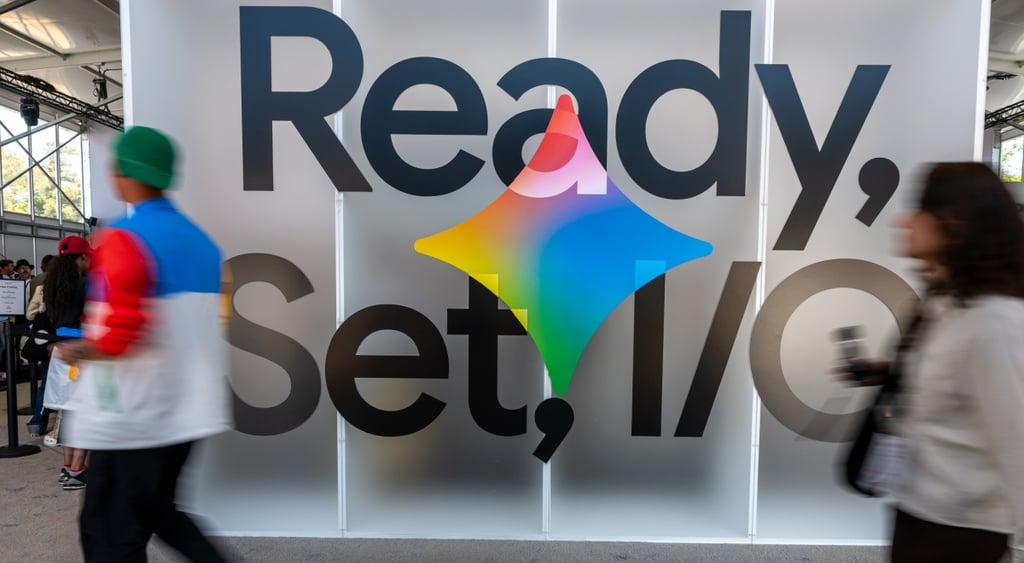





The conference is also offering live sessions, technical demos, and on-demand learning opportunities through its more than 2,000 developer communities and 1,000 experts, Google announced.
Google goes all-in on agentic AI
“It's been 10 years since we pivoted the company to be AI first,” Pichai began his keynote, emphasizing Google’s mission to improve people's lives at scale, using a differentiated, full-stack approach to AI innovation.
“This approach enables us to iterate and innovate faster, and it's lighting up every part of the company,“ the Alphabet CEO said.

Touting the almost frenzied growth of its AI division, the Google chief rattled off a list of milestones, including:
- 3.2 quadrillion tokens processed by Google per month (up sevenfold from last year)
- 19 billion tokens processed by Google APIs per minute
- 8.5 million+ developers building with Google AI models monthly
- Gemini app users jumped from 400 million to 900 million in one year
- 2.5 billion monthly AI Overviews users
- 50 billion+ images generated with Nano Banana
What’s more, Pichai said Google’s planned AI spending is expected to hit somewhere between $180 billion and $190 billion this year alone.
And when it comes to agentic AI, Google appears to be pushing AI across its entire ecosystem, evolving Gemini from a query-focused chatbot into an autonomous system capable of handling complex tasks for real-world users.
Gemini Omni pushes AI into video/world simulation
One of Google’s more exciting announcements is the launch of Gemini Omni, a new multimodal “world model” that can create literally “anything from any input.”
Starting with videos for now, users can input any combination of images, audio, video, and text to “generate high-quality videos grounded in Gemini's real-world knowledge,” Google describes a seemingly Nano Banana on steroids.
Besides allowing users to create their own digital avatar, the first-generation Omni Flash also lets users edit videos simply by talking to Omni.
Gemini Omni is our new model that can create anything from any input - starting with video. It combines Gemini’s intelligence with our generative media models, for a new level of world understanding, multimodality, and editing.
undefined Sundar Pichai (@sundarpichai) May 19, 2026
Gemini Omni Flash is rolling out today to Google AI… pic.twitter.com/Bmdt6yAkf4
Said to simulate physics, gravity, and kinetic motion better than prior models, Omni combines Gemini reasoning with DeepMind's Nano Banana, Veo, and Genie, anticipating what should happen next in a user’s video.
Omni is rolling out to Google AI Plus, Pro, and Ultra subscribers globally starting Tuesday through the Gemini app and Google Flow. YouTube Shorts will get Omni next week, while developers and enterprise APIs will have to wait a few more weeks, the company said.
Google says AI agents built an operating system from scratch
Google also introduced Gemini 3.5 Flash, a faster model built for agentic coding, long-horizon tasks, and real-world workflows.
Also available starting Tuesday for developers, Google claims Gemini 3.5 Flash is 4x faster than rival frontier models and has achieved major gains in coding benchmarks.
Google’s core next-gen production model also powers Antigravity 2.0, the company’s agent-first coding platform.
“The new model has been a game-changer for us internally at Google. We've been using 3.5 Flash with the reimagined version of our agent-first development platform, Antigravity. And it's dramatically accelerated how we build,” Pichai said.
The new “agent-first” coding and development platform uses multiple autonomous AI agents working in parallel, utilizing the desktop app, CLI tools, software development kits (SDK), voice support, and Android/Firebase integrations.






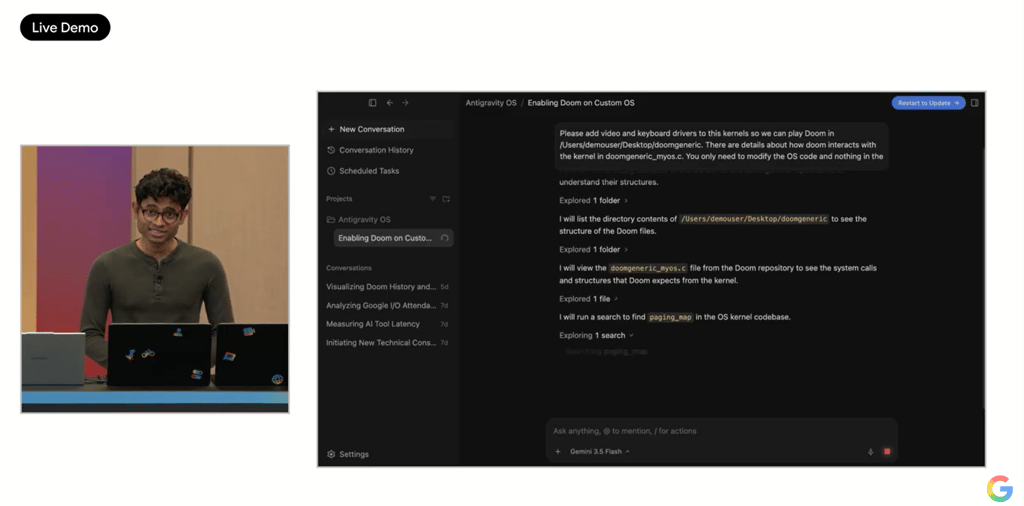
In a wild onstage demonstration during the keynote, Google DeepMind engineer Varun Mohan showed how Antigravity and Gemini 3.5 Flash together built a functioning operating system from scratch – and in only 12 hours.
Google says the build involved 93 subagents, 15,000 model requests, 2.6 billion processed tokens, and reportedly cost under $1,000 in API credits, with Mohan demonstrating the agent’s handiwork by playing the game Doom on the newly built operating system live onstage.
Google expands AI deepfake detection tools
As advancements in AI video and image creation take hold and leap into uncharted territory, Google said it is taking the initiative to grow its arsenal of AI transparency and deepfake detection tools.
“As generative AI gets better, so does the need for greater transparency,” Pichai told the audience, adding that studies show people only identify high-quality deepfake videos about a quarter of the time.
Pichai said since the launch of Google’s SynthID watermarking system three years ago, over 100 billion images and videos have been watermarked – along with 60,000 years of audio assets.
The SynthID pixel-embedded watermark, which is invisible to the naked eye, helps users verify whether content was created or altered using AI.
Users who previously had access to SynthID Detector only through the Gemini app will now be able to use the tool in Search starting Tuesday, and in Chrome desktop and mobile browsers in the coming weeks.
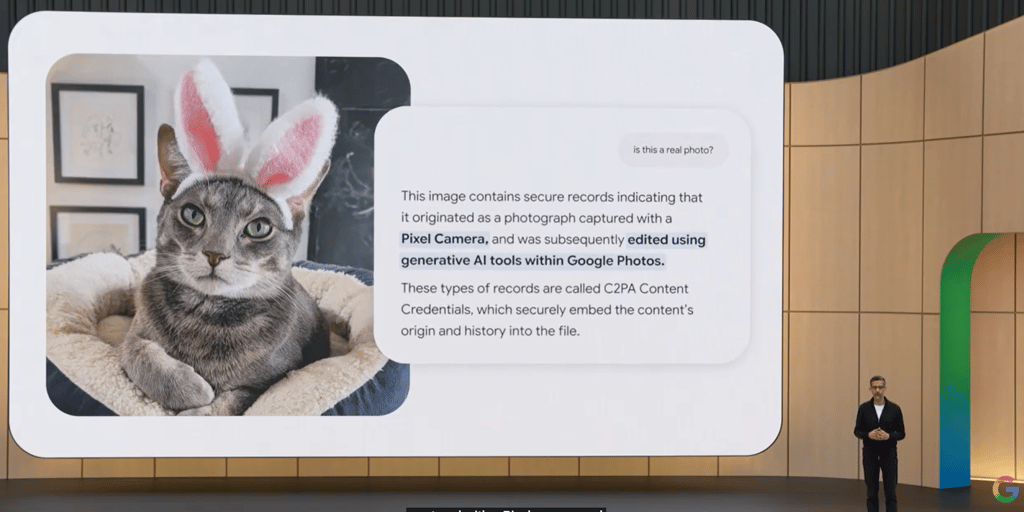
Google is also expanding the built-in C2PA Content Credentials, a separate tool that lets users check content metadata via Google Lens, including where an image originated and whether it was edited using generative AI tools.
“We want more people to have easy access to these tools,” Pichai said, describing the process while showing an AI-generated image that had circulated on social media the year before.
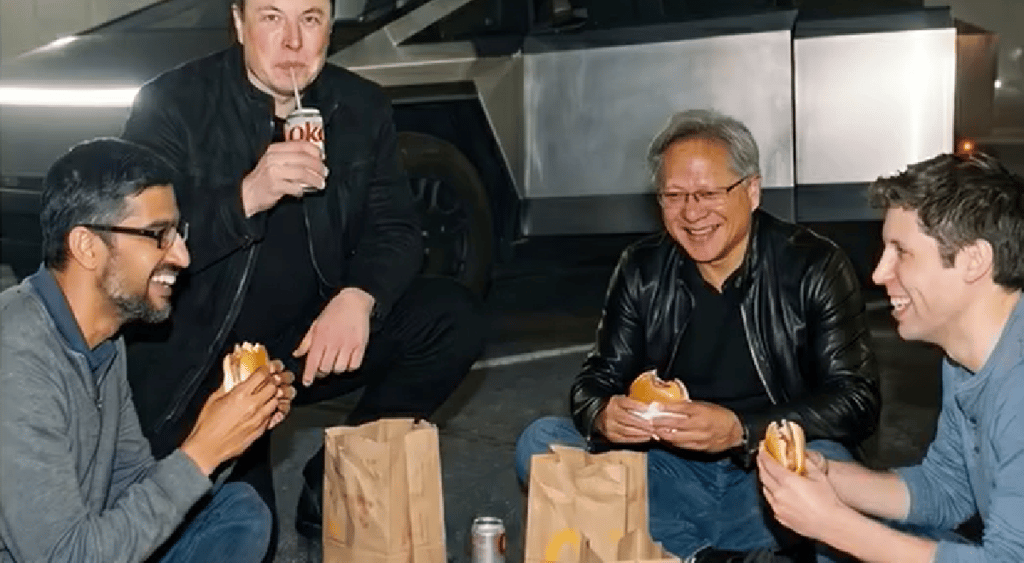
The picture showed Pichai eating a hamburger alongside Elon Musk, OpenAI CEO Sam Altman, and Nvidia CEO Jensen Huang. Pichai jokingly commented, “It's obviously fake. I don't eat hamburgers.”
“You can simply circle to search or right-click in Chrome and ask, ‘Was this generated with AI?’ And you'll get a clear response along with other helpful context,” he said.
Pichai said OpenAI, Kakao, and ElevenLabs have now signed on to adopt Google’s watermarking system, with Nvidia already committed as of last year.

Check if your data was exposed
Find out if your email and related personal information have appeared in known data breaches.
Unlock more exclusive Cybernews content on YouTube.