Famed “Big Short” investor Michael Burry is betting against AI giants: what does he see?
Michael Burry, the contrarian investor who correctly called the 2008 financial crisis, is now expressing his skepticism about the AI boom. Not only that: the hedge fund manager just backed up his words by placing two huge bets against Nvidia and Palantir.
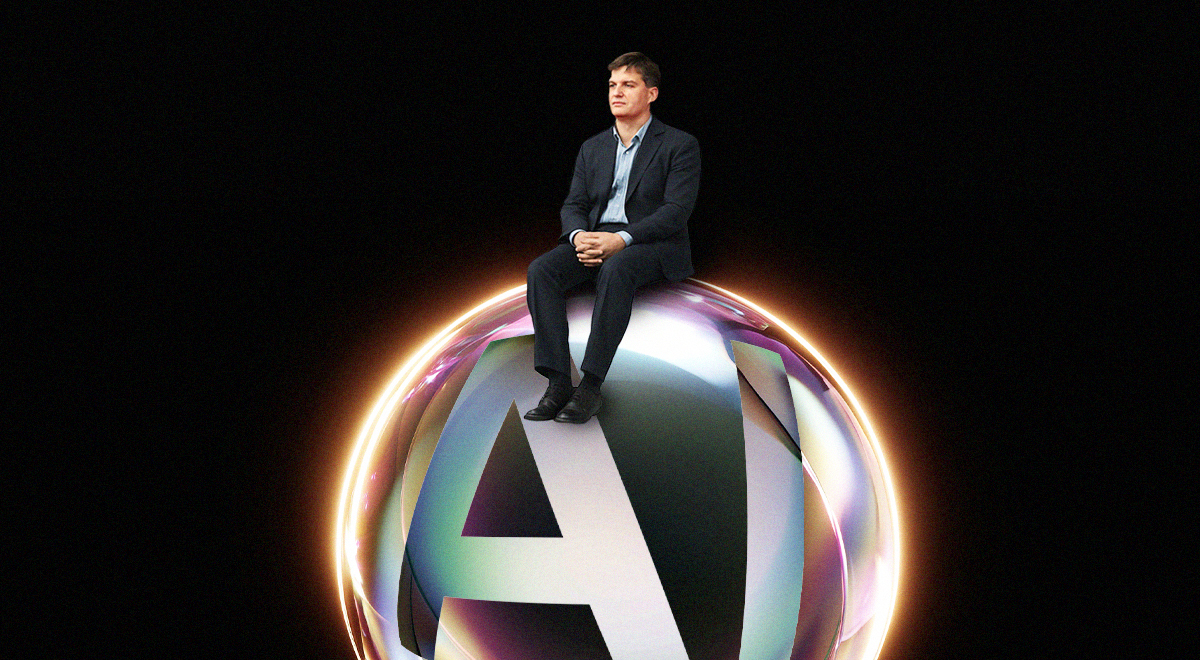
Image by Cybernews.

 Follow us
Michael Burry, the contrarian investor who correctly called the 2008 financial crisis, is now expressing his skepticism about the AI boom. Not only that: the hedge fund manager just backed up his words by placing two huge bets against Nvidia and Palantir.
When Burry speaks, people listen – especially the ones whose day job is investing. He’s mostly known for his prediction that the US housing market would collapse in 2008.
It did, and Burry was soon profiled in the 2010 Michael Lewis book “The Big Short: Inside the Doomsday Machine,” and portrayed by Christian Bale in the 2015 film adaptation.






Mostly, he’s silent. But now, since more analysts are beginning to see really bizarre movements in the markets, he’s speaking again. More specifically, Burry is betting that AI is more of a bubble than a revolution.





Memes and cryptic messages
First, he’s finally posted something on X after a two-year hiatus. His single, ominous post read: “Sometimes, we see bubbles. Sometimes, there is something to do about it. Sometimes, the only winning move is not to play.”
Sometimes, we see bubbles.
undefined Cassandra Unchained (@michaeljburry) October 31, 2025
Sometimes, there is something to do about it.
Sometimes, the only winning move is not to play. pic.twitter.com/xNBSvjGgvs
The third sentence is, of course, a nod to the movie WarGames, where an AI supercomputer runs thousands of simulations of nuclear war and discovers all of them end in mutual destruction. Burry must believe today’s market is headed in the same direction.
Indeed, big tech firms keep splurging on AI, pledging to invest hundreds of millions of dollars into AI infrastructure and data centers. Nvidia’s valuation has reached $5 trillion.
However, pressure is growing to demonstrate how all these investments will pay off. Promises of future returns aren’t enough, it seems, at least based on the way analysts grilled executives from Meta, Amazon, and Alphabet on earnings calls last week.
According to Burry, though, those future profits aren’t even coming. To him, the US markets today are just as vulnerable as they were in 2008.
On X, Burry swapped his banner image to a still from Star Wars: A New Hope, where Obi-Wan Kenobi uses a mind trick to deceive Imperial stormtroopers, and made it clear he now positions himself as a rebel, speaking out against the AI mainstream.
Then, he posted three images offering insight into why he’s extremely doubtful about the AI frenzy, adding: “These aren’t the charts you are looking for. You can go about your business.”
These aren’t the charts you are looking for.
undefined Cassandra Unchained (@michaeljburry) November 3, 2025
You can go about your business. pic.twitter.com/ICldNUp2OI
The first chart shows that growth has slowed pretty sharply in Amazon and Alphabet’s cloud-computing divisions. It also cooled down in Microsoft.
The second highlights how the US tech industry’s capital expenditures have surged during the AI boom, and how similar this spike is to those preceding the dot-com crash and the 2008 financial crisis.
The third shows the complex financial deals experts are now quick to call “circular financing,” which actually clouds perceptions of AI demand and raises the possibility that AI is simply a very expensive narrative rather than a mature industry.
Palantir CEO Karp infuriated
Burry also shared a highlighted excerpt from Capital Account, a book that covers the dot-com bubble. And details how the crash resulted in vast tracts of unused infrastructure and plunging prices. Back then, many huge companies fell like dominoes as well.
Scion bought roughly $187.6 million in puts on Nvidia and $912 million in puts on Palantir, according to Securities and Exchange Commission filings.
That’s not all. Burry’s fund, Scion Asset Management, disclosed on Monday that it bought puts (bets that share prices will fall) on the two whales riding the AI wave: Nvidia and Palantir.
Scion bought roughly $187.6 million in puts on Nvidia and $912 million in puts on Palantir, according to Securities and Exchange Commission filings.
The next day, Nvidia and Palantir fell 4% and 8% respectively. Unsurprisingly, since Burry’s words and actions clearly matter on Wall Street, Scion’s manoeuvres have annoyed Palantir CEO Alex Karp.
“When I hear short sellers attacking what I believe is clearly the most important software company in America, therefore in the world, in terms of our impact, it just is super triggering,” said Karp, whose company was the top-performing stock in the S&P 500 in 2024 and is in the top five performing stocks this year.
We’ll have to wait to see who's right. Karp, though, may find solace in the fact that Burry hasn’t always been correct in his predictions: around three years ago, he sent out a “Sell” tweet, but the market rallied rather than crashed.
Unlock more exclusive Cybernews content on YouTube.