AI agents will ruin Windows 11 and endanger our data, furious users say
Apparently, Microsoft is planning to turn Windows 11 into a full-fledged AI operating system, even though the last few days have suggested that its hardcore user base doesn’t really want an agentic future. This time, the backlash might be even noisier.

Image by Cybernews.

Apparently, Microsoft is planning to turn Windows 11 into a full-fledged AI operating system, even though the last few days have suggested that its hardcore user base doesn’t really want an agentic future. This time, the backlash might be even noisier.
Mayank Parmar, editor-in-chief of Windows Latest, has noticed that Microsoft created an experimental feature called “Agent Workspace,” which gives AI agents access to the most-used folders in the user’s directory, such as Desktop, Pictures, Music, and Videos.
The feature, located on the “AI Components” page, will also enable AI agents to have their own runtime, desktop, user account, and the ability to run in the background – if the feature is enabled.
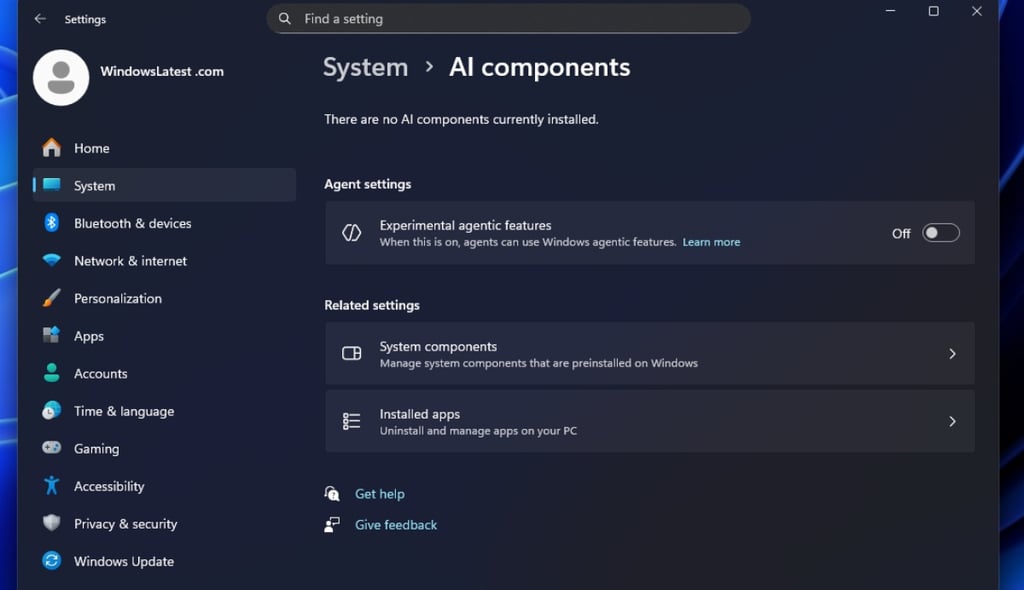
If it is, the “Agent Workspace” will go live. Not now, though: the feature doesn’t work right now and is only available to a select group of developers. Still, the plan is clearly to unleash AI agents on all Windows in the future.






“Potential security disaster”
Essentially, the “Agent Workspace” is a separate, contained Windows session made just for AI agents where they get their own account, desktop, and permissions so they can click, type, open apps, and work on files in the background while you keep using your normal desktop.
Parmar has tried the new workspace out himself – and is a little worried, saying it could be a “potential security disaster.”
Officially, Windows gives the AI agent limited access to specific folders and keeps its actions isolated and auditable. The human user also controls what the agent is allowed to fiddle with.






“The creation of the agent workspace where agents can work in parallel with a human user, enabling runtime isolation and scoped authorization,” Microsoft notes in a support document.
“This provides the agent with capabilities like its own desktop while limiting the visibility and access the agent has to the user’s desktop activity.”
Have thoughts about this topic? Others do, too. Join them in the discussion.
However, whereas Microsoft is seemingly keen to stress how efficient and better than, say, Windows Sandbox, the “Agent Workspace” is going to be, Parmar’s not convinced because Sandbox doesn’t actually have access to user’s personal files and folders.
“In Windows Sandbox, Microsoft creates an isolated and hardware-based virtualization, and even a separate kernel to keep the sandbox completely separate,” writes Parmar, explaining that Windows 11 opens up apps and even local folders to AI agents.
The future is agentic
In a way, that’s not really surprising because the point of AI agents is to do your tasks for you. That means access to apps and private folders for the sake of efficiency and productivity.
At the same time, this sort of trade’s not for everyone. Plus, even though Microsoft says that the AI agents will use a limited amount of RAM and CPU, it doesn’t disclose what the specific limit is – this might mean that the feature could be resource-intensive.
Up until now, AI agents have been largely limited to browsers or web-based containers, but Microsoft – competing with other tech giants building AI products – wants Windows 11 to be a native platform for them.
Even though Microsoft says that the AI agents will use a limited amount of RAM and CPU, it doesn’t disclose what the specific limit is – this might mean that the feature could be resource-intensive.
But some heavy users are really unhappy, saying that these tools are still slow and not yet useful at all. Parmat even goes so far as to say that we’re witnessing the enshittification of Microsoft’s desktop platform.
“We have ads, pop-ups, reliability issues, frequent Blue Screen errors, and PCs getting stuck at BitLocker, among other critical issues. At the same time, Microsoft is adding AI features to Windows 11 and is lately pitching Windows as an agentic OS,” he said.
When Windows boss, Pavan Davuluri, said on X a week ago that Windows is evolving into an agentic OS, the responses were mostly furious. Run Dunn, for instance, has been using Windows since 1982 but said he just closed his accounts and repatriated his data, adding: “AI has made you insane.”
For the first time since 1982, I no longer have a Microsoft operating system on any of my computers.
undefined Ron Dunn (@ronInBendigo) November 11, 2025
I just closed my Microsoft365 account, and repatriated my data. I've replaced Office.
I no longer use Azure, nor any Microsoft languages, databases, or development environments.…
Davuluri has been attempting to calm the fuss down. When one expert said developers should now choose Mac or Linux, the head of Windows replied: “We care deeply about developers.”
Hey Gergely, I am responding here, and I think this applies to a bunch of the comments that people have made. I mean, a lot of comments 🙂.
undefined Pavan Davuluri (@pavandavuluri) November 15, 2025
The team (and I) take in a ton of feedback. We balance what we see in our product feedback systems with what we hear directly. They don’t…
The techies are, unsurprisingly, still at it. One commented, “Microsoft has gone full-blown evil corporation again. No customer validation on any of the AI cruft. No full opt out. Office products are bastardized with Copilot buttons everywhere.”
“They put Copilot in Notepad. NOTEPAD,” another raged.
Unlock more exclusive Cybernews content on YouTube