North Korea pursues AI to modernize its army, navy, and air force
How can one of the most sanctioned nations in the world prevent itself from falling behind in the AI arms race? That is the question facing the international community as North Korea begins to talk openly about embedding AI into the heart of its military.

Image by Cybernews.

 Follow us
How can one of the most sanctioned nations in the world prevent itself from falling behind in the AI arms race? That is the question facing the international community as North Korea begins to talk openly about embedding AI into the heart of its military.
In August 2025, the General Staff Department of the Korean People's Army ordered every branch to produce detailed plans for AI-based combat systems. According to Daily NK, these plans must be completed by September and tested during winter training, which starts on December 1st.
Kim Jong Un's embrace of unmanned systems
Kim Jong Un has made clear that modern warfare cannot be fought with outdated methods, and his words have been echoed in his military directives. Missiles and nuclear capabilities are no longer enough when flexing in front of the international community, and AI autonomous systems are seen as the perfect partner alongside its traditional strengths.
Pyongyang is thinking bigger than matching its adversaries plane for plane or ship for ship, as AI algorithms are as crucial as artillery. Kim Jong Un recently declared that the development of AI-powered military drones was a top priority and was pictured alongside a range of new drones, including one that resembles the American Global Hawk.






Sadly, these ambitions reflect the growing use of drone technology in recent conflicts in Ukraine and across the Middle East. Warfare has officially gone far beyond nuclear deterrents. But the age-old strategic game of defense versus offense has become much more expensive with the introduction of AI.
CSIS reported that defending against attacks costs nearly twice as much as it takes to strike, warning that while interceptor prices may briefly dip, they inevitably surge again as faster, longer-range, and smarter systems are needed to keep up with advancing offensive weapons. For North Korea, this is as much about perception as performance, but perception itself has strategic value.
AI upgrade for the North Korean Army, Navy, and Air Force
The modernization program has been divided across every branch of the military. The Army has been instructed to develop AI command systems that unify operations between infantry, mechanized forces, artillery, and unmanned platforms.
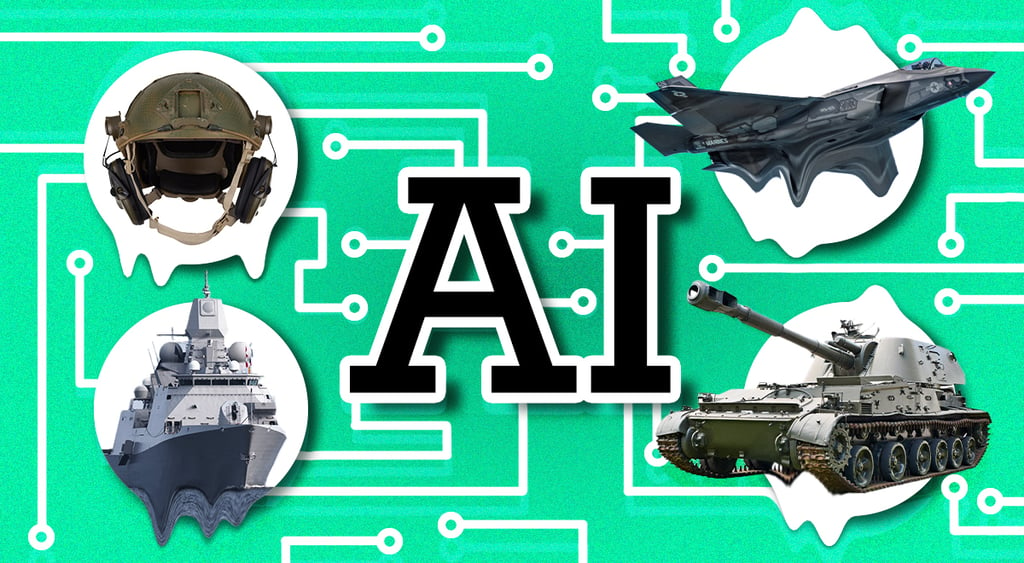
The Navy is attempting to combine uncrewed and human-crewed vessels in missions ranging from harbor defense to submersible activities, and even nuclear counterstrike scenarios. This strategy suggests that Pyongyang could be considering underwater drones or remotely operated craft that could expand its maritime reach.
In the air, North Korea's fleet is old and technologically outdated. So the Air Force is exploring mixed formations where piloted jets fly alongside drones. This mirrors experiments already underway in countries such as the United States and Australia, where "loyal wingman" drones act as force multipliers; therefore, the appeal of adding uncrewed aircraft is obvious.
Even if the drones are not at the cutting edge, they could provide reconnaissance or decoy functions that would make the air force harder to counter. Kim's inspection of large reconnaissance UAVs shows his ambition to transform what has long been considered a weak link in North Korea's arsenal.
Special operations and the nuclear force
North Korea's Special Operations Forces have been given instructions to think creatively about warfare. Advances in technology mean that unmanned systems can assist in everything from assassinations and demolitions to infiltration and harassment raids.
One of the biggest concerns is that the four-stage plan to integrate AI into nuclear command and control would cover everything from managing storage sites to coordinating launches and planning counterstrikes.
There is no evidence that North Korea is close to fully automating nuclear decision-making. But the very idea of using AI in warfare is profoundly worrying.
Sanctions have severely limited its access to advanced computing hardware, sensors, and navigation systems. But Russia's war in Ukraine has also created opportunities.
North Korean personnel assisting Moscow may have gained direct exposure to modern drone warfare. Such knowledge can be repurposed back in Pyongyang, accelerating the learning curve for its own forces. Russia also gains a workforce and political support in a mutually beneficial, if informal, partnership.
It would be wrong, however, to assume that these partnerships can instantly erase North Korea's technological deficits. Building drones and AI systems at scale will require access to supply chains and software development skills. Both of which are in short supply in the country.
Timelines, pressures, and realities
The deadlines set for the military's AI integration by September, reviews in October, and trial units by December create a sense of urgency that permeates every level of command. But the gap between political ambition and operational reality is a familiar story.






Leadership in North Korea often involves setting goals that are more about signaling intent than reflecting current capabilities. But even if the December deadline yields only small-scale demonstrations, the move toward AI integration will send a clear warning message to its adversaries.
Despite the showboating, access to hardware and software expertise is one of the biggest challenges for North Korea. Even when this obstacle is overcome, training soldiers to trust and use AI systems effectively will take time.
However, a handful of working drones or AI-assisted command tools could be enough to send a message to world leaders, even if the broader modernization program remains aspirational.
Regional implications and global concerns
For South Korea and Japan, the possibility of swarms of drones or AI-assisted infiltrations presents new risks and defense challenges. Many nations are facing the reality that their traditional missile defense systems are not designed to counter small drones. This leaves their defense systems with a massive vulnerability.
Curious what others think about this story? Contribute your thoughts to the debate below.
AI in warfare is already a controversial subject with debates raging over the ethics of autonomous weapons and the dangers of delegating lethal decisions to machines. But the bigger question is what happens when nations refuse to play by the rules?
North Korea's push to modernize its military with AI and unmanned systems is ambitious, but there is no hiding from the fact that it's also shrouded in uncertainty. The months ahead will reveal how much of this plan is rhetoric and how much translates into operational reality.
Pyongyang is sending a message to the world that, despite the sanctions imposed on the nation, its technology is thriving. Every country will be watching closely. But the integration of AI into sensitive areas such as nuclear command raises profound questions about stability, risk, and the future of warfare.
North Korea's year strategy is expected to be officially unveiled at the Ninth Party Congress in 2026. The announcements will formalize its AI ambitions. Whether these tech goals are achievable remains uncertain. But the intent itself is a reality that could shape the security environment of Northeast Asia and beyond for years to come.