OpenAI launches GPT-5.2 with mental health safeguards amid new ChatGPT death lawsuit
OpenAI launches a new "professional" GPT 5.2 model, built with new mental health safeguards, as another lawsuit is filed blaming ChatGPT for encouraging suicide.
Image by Cybernews.

 Follow us
OpenAI unveils its new ‘professional’ GPT-5.2, boasting improved handling of mental health interactions, while ironically hit with yet another wrongful death lawsuit on the same day – a murder-suicide allegedly linked to ChatGPT.
- OpenAI rolls out GPT-5.2 with stronger safety, mental health safeguards, parental controls, and improved handling of sensitive or crisis conversations.
- A Connecticut wrongful death case alleges GPT-4o contributed to a murder-suicide by reinforcing paranoid delusions.
- GPT-5.2 emphasizes risk detection, crisis intervention, and age-sensitive content, shifting from engagement-first to safety-prioritized responses.
Key Takeaways by nexos.ai, reviewed by Cybernews staff.
The multi-billion dollar company introduced GPT-5.2 and its three distinct versions on Thursday – Instant, Thinking, and Pro – describing the AI model as a more structured, more reliable, everyday chatbot that’s still enjoyable to talk to.
Specifically designed for professional, scientific, and everyday knowledge work, OpenAI touts 5.2 for its ability to create high-caliber spreadsheets, generate presentations, write and debug code, and analyze complex documents.
GPT‑5.2 Instant - Fast, capable workhorse for everyday work and learning
GPT‑5.2 Thinking - Designed for deeper work, helping users tackle more complex tasks
GPT‑5.2 Pro - Smartest and most trustworthy option for difficult questions.






The latest model is said to operate faster and more cost-efficiently, excelling at creating spreadsheets, generating presentations, writing and debugging code, and analyzing complex documents.
It can process extremely long contexts – up to hundreds of thousands of tokens – even while maintaining coherence and accuracy, with a hallucination rate reduction of about 30%.
The GPT-5.2 model also includes powerful vision capabilities to interpret charts, screenshots, and diagrams, the company posted on its OpenAI blog on Thursday.
“The most capable model series yet for professional knowledge work” has already been proven to outperform industry professionals on a multitude of knowledge-based work tasks across 44 occupations, the Sam Altman-run company says.
But more importantly, after facing more than half a dozen suicide-related lawsuits in 2025 alone, Altman and his OpenAI designers say they worked to improve GPT’s safety mechanisms, mental health safeguards, and parental controls, marking a step forward in responsibly deploying AI for a broad range of users.
“GPT‑5.2 builds on the safe completion research we introduced with GPT‑5, which teaches the model to give the most helpful answer while still staying within safety boundaries,” OpenAI states.
Still, OpenAI adds that even with the latest changes, while significant, are only “one step in an ongoing series of improvements, and we’re far from done.”
Lawsuits expose AI chatbot risks
Deploying systems capable of engaging deeply with vulnerable users has presented serious challenges for AI companies developing new technology in this burgeoning yet fledgling field.
And legal accusations about ChatGPT’s influence on those seeking life-giving help from the AI have proliferated in 2025.
In recent months, OpenAI has found itself at the center of several high-profile lawsuits claiming that its AI chatbots contributed to mental health crises and even death.
OpenAI has denied that its models directly caused these outcomes.






The latest lawsuit, filed on Thursday in California against both OpenAI and Microsoft, its largest investor, claims that the mentally ill man, who killed his 83-year-old mother and then himself in Connecticut this August, was encouraged by the GPT-4o model he was regularly engaging with.
To note, the GPT-4o version - released in May 2024 and available to all free and paid ChatGPT accounts – as mentioned previously, has often been accused of exhibiting sycophantic behavior with its users.
The case also marks one of the first instances linking an AI chatbot to a real-world murder-suicide.
According to court documents, prolonged interactions with the AI chatbot fueled 56-year-old Stein-Erik Soelberg’s delusions, validating paranoid beliefs and portraying his mother as a threat.
"ChatGPT kept Soelberg Stein-Erik engaged for what appears to be hours at a time, validated and magnified each new paranoid belief, and systematically reframed the people closest to him - especially his own mother - as adversaries, operatives, or programmed threats," the lawsuit said.
"This is an incredibly heartbreaking situation, and we will review the filings to understand the details," an OpenAI spokesperson said in response to the filing on Thursday.
"We continue improving ChatGPT's training to recognize and respond to signs of mental or emotional distress, de-escalate conversations, and guide people toward real-world support," they said.

As of November, a total of seven other lawsuits have accused OpenAI of negligence after reported ChatGPT-linked suicides.
Other high-profile cases against OpenAI include the suicide of 16-year-old Adam Raine, in which ChatGPT allegedly validated Raine’s harmful beliefs, failed to intervene during moments of acute crisis, and actually provided step-by-step instructions for him to carry out his own suicide.
In another case, 48-year-old Alan Brooks was said to have previously used ChatGPT as “a resource tool,” claiming that after two years, the GPT switched on him and caused him to experience delusions.
How GPT-5.2 improves safety and crisis intervention
OpenAI’s earlier GPT-4o version has been accused of mirroring its users’ darkest thoughts, including validating paranoia or engaging with suicidal ideation instead of shutting it down.
Plaintiffs say the chatbot provided technical explanations of lethal methods and, in some instances, reinforced delusional narratives that spiraled into tragedy.
The core issue being that the 4o model was optimized to keep people talking by rewarding agreement and emotional alignment – even when those conversations veered into dangerous territory.
Comparing GPT-4o to OpenAI’s newer models, including GPT-5.2, shows significant changes.
“We continued our work to strengthen our models’ responses in sensitive conversations, with meaningful improvements in how they respond to prompts indicating signs of suicide or self-harm, mental health distress, or emotional reliance on the model.”- OpenAI
Moving away from an engagement-first philosophy, GPT-5.2 prioritizes risk detection, refusal enforcement, and crisis intervention, OpenAI said about the 5.2 model.
Multi-layer monitoring systems now track conversation patterns aimed at detecting signs of mania, delusion, or suicidal intent, with the model programmed to interrupt or de-escalate high-risk exchanges.
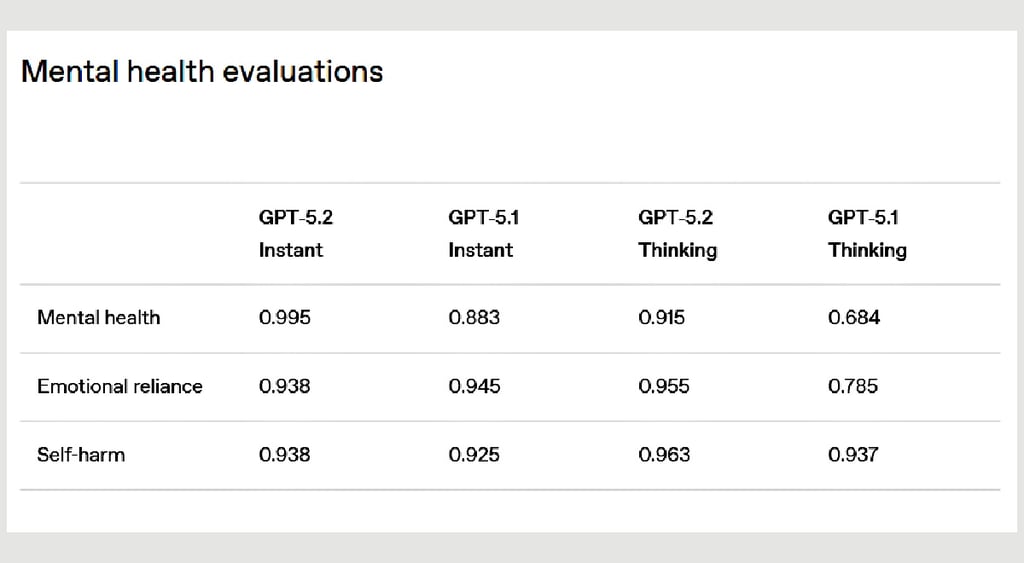
Emotional mirroring has also been intentionally limited to reduce emotional dependency, and its voice has been made to sound less robotic and more approachable, encouraging, the company states.
OpenAI says it will continue to increase overall safety and reliability, as well as working on known issues with ChatGPT behaviors, such as over-refusals.
Furthermore, parental controls and linked accounts allow guardians to set usage limits, monitor chat activity, and receive alerts during moments of acute distress.
Building on the parental controls, the AI start-up says it is also in the early stages of rolling out a new age prediction model that, when applied, can automatically censor sensitive content for users under 18.
Unlock more exclusive Cybernews content on YouTube.