OpenAI launches ChatGPT Health, a new space for medical data
OpenAI launches ChatGPT Health, allowing users to upload medical records, connect wellness apps, and ask personalized health questions using their own data.

Image by OpenAI.

 Follow us
OpenAI has introduced ChatGPT Health, a dedicated space within ChatGPT designed to help users navigate health and wellness questions using their own medical context.
- OpenAI launched ChatGPT Health, a dedicated space for health and wellness questions.
- Users can upload medical records and connect wellness apps for more personalized responses.
- With layered, end-to-end encryption, health conversations are isolated and not used to train models, the company says.
Key Takeaways by nexos.ai, reviewed by Cybernews staff.
The new ChatGPT Health feature will enable users to upload medical records, integrate with wellness apps such as Apple Health and MyFitnessPal, and ask health-related questions within a dedicated environment designed specifically for sensitive data.
The move comes as the advancements in medical technology and artificial intelligence are expected to overhaul the entire healthcare industry as we know it, for both patients and regulators.
Health-related queries have been tagged by OpenAI as one of the most common use cases for the AI chatbot.






“Based on our de-identified analysis of conversations, over 230 million people globally ask health and wellness-related questions on ChatGPT every week,” OpenAI stated in a blog post announcing the new feature.
"Designed to support, not replace, medical care"
The Sam Altman-run company said its goal was to create a more structured, more transparent, and more privacy-conscious product than a general-purpose chatbot conversation, enabling users to “feel more informed, prepared, and confident navigating your health.”
OpenAI says it has repeatedly heard from users who already rely on ChatGPT to interpret lab values, prepare for appointments, or understand treatment instructions, often outside any formal healthcare setting.
AI teams were said to have worked with more than 260 physicians across 60 countries over the past two years, incorporating feedback on hundreds of thousands of model responses to train the chatbot.
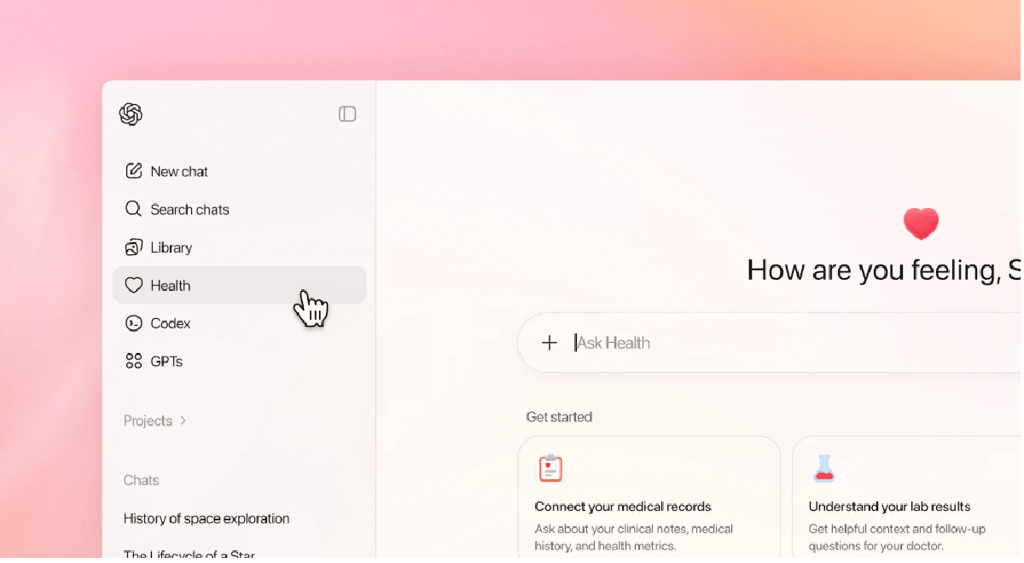
Health aims to give users a central place to bring their medical data, from medical records and test results to wearable data from connected apps to insurance information.
This will allow users to securely connect their own data and get responses from the chatbot with personal context, rather than generic advice, the company says.
Users can upload files directly or connect tools (+) or ‘Apps’ in ChatGPT “Settings” from the following sources:
- New: Medical Records for lab results, visit summaries, and clinical history
- New: Apple Health for health and fitness data, including movement, sleep, and activity patterns (must be on iOS to sync)
- New: Function for lab test insights, nutrition ideas, and taking action on your health
- New: MyFitnessPal for nutrition advice, macros, and recipes
- New: Weight Watchers for GLP-1 personalized meal ideas, recipes, and food guidance
- AllTrails to help you find your next hike
- Instacart to turn meal plans into shoppable lists
- Peloton for suggested workout classes or guided meditations
OpenAI explains that with permissions in place, ChatGPT can help explain recent test results, suggest questions to ask a doctor, identify patterns over time in wellness data, or weigh tradeoffs between insurance options based on individual healthcare usage.
However, the company stresses that the tool is “designed to support, not replace, medical care” and is not intended for diagnosis or treatment.
Protecting sensitive health data
The launch reflects growing demand for AI tools that can handle personal health information more securely as regulators and healthcare providers scrutinize how such data is used.
"Health operates as a separate space with enhanced privacy to protect sensitive data,” OpenAI said, noting the health AI will have its own memories, files, and conversations that are isolated from other chats.
“Conversations in Health are not used to train our foundation models,” it said.

However, while non-health contexts, such as a recent move or lifestyle change, may occasionally be used to inform a health conversation, information created inside Health does not flow back into general ChatGPT interactions, OpenAI reiterates.
On the technical side, OpenAI says ChatGPT Health builds on its existing security architecture, with additional, layered protections, including purpose-built encryption and isolation to keep health conversations protected and compartmentalized.
Users can enable multi-factor authentication, review or delete Health memories, and revoke access to connected apps at any time, the company says.






For medical records in the US, OpenAI is partnering with a consumer health data network, b.well. Apple Health and other wellness apps can also be connected, though integrations vary by region and platform.
OpenAI said users can sign up for access through a ChatGPT Health waitlist here as the company begins rolling out the feature.
Unlock more exclusive Cybernews content on YouTube.