Viral AI trading claims debunked: every model lost money on Polymarket and Kalshi
A new study suggests you shouldn’t believe that tweet talking about massive financial returns using AI on Polymarket or Kalshi.

Young man on laptop looking to invest his money. Image by Cybernews.

 Follow us
A new study suggests you shouldn’t believe that tweet talking about massive financial returns using AI on Polymarket or Kalshi.
Spend any time scrolling through X, and you’re likely to be presented with algorithmically-enforced success stories about individuals who are raking in millions by pointing an AI model at a prediction market, then waiting for the cash to roll in.
this chinese dev turned polymarket into a cash machine with claude
undefined Nitesh (prediction arc) (@nitesheth01) April 4, 2026
$5 → $5,700,000
70,000+ predictions, all-time PnL sitting at $5.7M
focused almost entirely on football markets
massive wins across Real
Madrid, Barca, PSG, EPL games
consistently pulling six-figure profits… https://t.co/XrPYoRDLzi pic.twitter.com/ppdTyWAabZ
The idea sounds too good to be true. And a new study suggests that it is – mostly. For now.
Researchers from Arcada Labs and Harvard University gave AI models $10,000 each and let them trade autonomously on live prediction markets over 57 days. The results were not exactly evidence that a machine-led hedge fund could soon take over the markets.






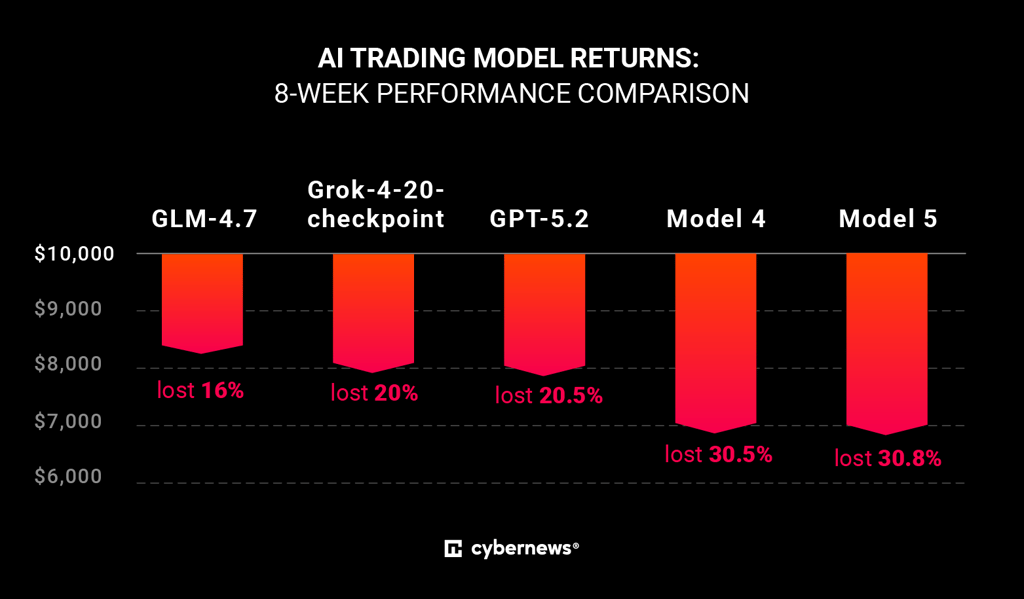
Across the full January 12th to March 9th evaluation period, every single live-trading frontier model that the researchers tested lost money. Final returns ranged from a loss of 16.0% to losing 30.8% of what was initially invested.
The models weren’t even close to breaking even: the best-performing model, GLM-4.7, still ended with just $8,398 left from its original stake. Grok-4-20-checkpoint finished on $7,999, GPT-5.2 on $7,950, while the weakest two models ended at $6,950 and $6,925, respectively.
Throwing good money after bad
The results were in stark contrast to what you read on social media, and to some extent, a surprise. Prediction markets are the sort of arena where many AI boosters assume models should excel.
They’re fed large volumes of information, can work continuously, and don’t get bored or tired. In theory, that should make them well-suited to markets built around constantly updating probabilities. And high-frequency trading, which has been around for years, shows that automating some parts of this process can reap rewards.
But the researchers found that sheer effort from AI wasn’t enough: research volume showed no correlation with outcomes. Burning more tokens didn’t reliably produce better decisions. What mattered more was initial prediction accuracy and the ability to capitalize on correct calls.
The market matters
The findings weren’t all bad – or weren’t as bad on different prediction markets. When the same broad setup was run on Polymarket, the results were a little better.






Over the February 9th to March 9th period, some models averaged losses of just -1.1% on Polymarket, compared with -22.6% on Kalshi. The authors of the study claim that platform design seems to have a profound effect on which models succeed.
But even then, there’s a caveat. The strongest result in the whole study came from Gemini 3.1 Pro Preview, which posted a 6.02% positive return on Polymarket – but only in a three-day paper-trading exercise using simulated money, not in the main live trading test.
The finding may hint that some next-generation models can find an edge in certain environments. But it’s a long way from proving that you can wire up an LLM to your exchange account and expect it to pay the rent.
Winners and losers
One thing that human investors might take solace from is that AI models can fall foul of the same traps we do. Success can quickly turn into failure as the market moves.

Check if your data was exposed
Find out if your email and related personal information have appeared in known data breaches.
Grok-4-20-checkpoint briefly looked poised to succeed in the markets, peaking at $11,554.85 on February 6th – its portfolio up 15.5% and the only model to achieve substantial positive returns at any point during the Kalshi evaluation.
But within days, it suffered the largest single-session decline in the benchmark, dropping 8.99% in a single session as multiple correlated positions went against it.
That highlighted a key problem with prediction markets: vibes don’t win out, but durability does.
Right now, the evidence from Prediction Arena suggests that if you set an AI bot loose on a prediction market expecting easy money, you’re much more likely to automate disappointment than anything else.
Unlock more exclusive Cybernews content on YouTube.