Workers who retrain for AI-era jobs still face a "penalty"
It's often difficult to gauge the true impact of AI on the labor market, given the tremendous hype surrounding the technology. If we assume that it will, at least, have some impact, however, then helping people adapt to new roles will be key (assuming that there will be sufficient new roles existing, of course).

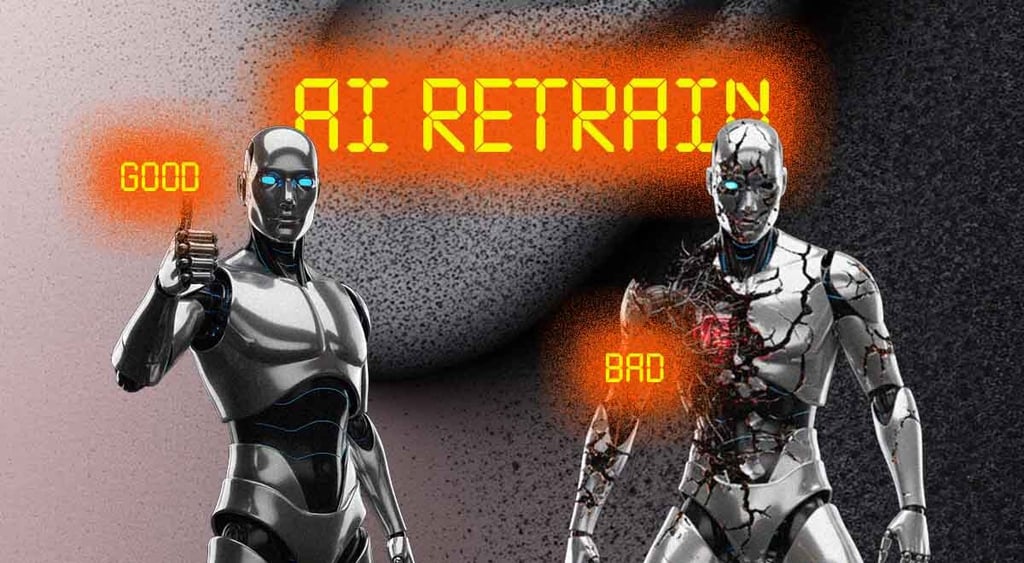
Image by Cybernews.

 Follow us
It's often difficult to gauge the true impact of AI on the labor market, given the tremendous hype surrounding the technology. If we assume that it will, at least, have some impact, however, then helping people adapt to new roles will be key (assuming that there will be sufficient new roles existing, of course).
For instance, in a recent article, we explored the challenges that come when the skills we have become fundamentally mismatched to the new needs of the labor market. Harvard research finds a consistent loss of earnings of up to 16.5% a decade after people lose their jobs to automation. This was compared to their earnings trajectory had they managed to keep their job in the first place.
Making the move
Another Harvard study looks at whether retraining can help people to offset these losses. The researchers looked at 1.6 million job training spells from the Workforce Innovation and Opportunity Act (WIOA) between 2012–2023, before connecting those with both the earnings of participants throughout that period and the level of AI-related exposure their jobs faced. This allowed them to compare the income of those who retrained with those who only received job search assistance.





The results provide good and bad news. On the positive side, those who retrained generally did better than those who simply tried to find a different role. The flip side is that even those who retrained lost out compared to those whose jobs weren't as affected by AI.
The researchers found that there could be particular benefits from transitioning to roles that made heavy use of AI, which they believe up to 40% of affected occupations may qualify for.
Struggling to transition
Research from the Kellogg School of Management sheds some light on why there's a salary drop even if people manage to successfully transition.
The research explores what happens when scientists switch fields or technical domains. The results show that those who successfully pivoted saw a significant reduction in their citations and patents, especially when they moved into a relatively unfamiliar domain.
"The core finding is a substantial ‘pivot penalty,’ where the impact of new research steeply declines the further a researcher moves from their prior work," the researchers explain.
This so-called "pivot penalty" was especially pronounced among scientists who didn't have access to things like elite networks and institutional support. It was also hard for those without a strong reputation to tap into.
When this penalty exists in a field defined by novelty and innovativeness, especially when it's well documented that innovation success often comes from recombining ideas from multiple domains, what hope does it offer the rest of society?
A broken career ladder
Perhaps part of the problem is that career transitions are seldom parallel in nature. After all, we've gained our current status with a level of experience that we won't have in a new career. That means we're more likely to start lower down.

That's problematic in itself, but research from Stanford shows that the kind of AI-intensive professions advocated by the Harvard researchers are also changing in ways that undermine our ability to transition into them.
The researchers analysed ADP payroll data and found that in AI-intensive professions, hiring among younger workers has declined by around 16% over the last few years. This impact was largely confined to entry-level roles, with the researchers arguing that these roles are especially vulnerable to AI because workers in them typically have more theoretical than practical knowledge. This may ring true for those making career transitions as well, regardless of their age.
"We're going to have to think about how the labor market adjusts so that everyone gets a chance to be working their way up the career ladder," the researchers explain.
Softening, not eradicating the blow
What emerges across these studies is that while retraining can soften the blow of technological disruption, it rarely eliminates it. Workers who pivot into new domains often face a “penalty,” whether in earnings, prestige, or lost seniority, and the very rungs of the career ladder they hope to climb may themselves be eroding as AI reshapes entry-level work.






Much of the hype surrounding AI has presented the technology as largely beneficial to society, but if it's to deliver on this promise rather than exacerbate existing inequalities, we can't rely on individual resilience alone.
This will require intentional support, whether from employers as they rethink the career pathways available to people, or from policymakers who invest in the training infrastructure required to support people. Even the education industry itself will need to adjust to support people in a process of continuous reinvention.
Only then will the promise of pivoting become less of a gamble and more of a genuine opportunity.
Unlock more exclusive Cybernews content on YouTube.