Tesla’s climate work quickly undone by noisy, dirty xAI methane gas turbines
Elon Musk’s eyes are now firmly focused on AI slop – and to hell with the climate crisis. His AI company, xAI, is now operating dozens of unpermitted methane gas turbines in two US states, undoing all the noble work Tesla has done on climate.
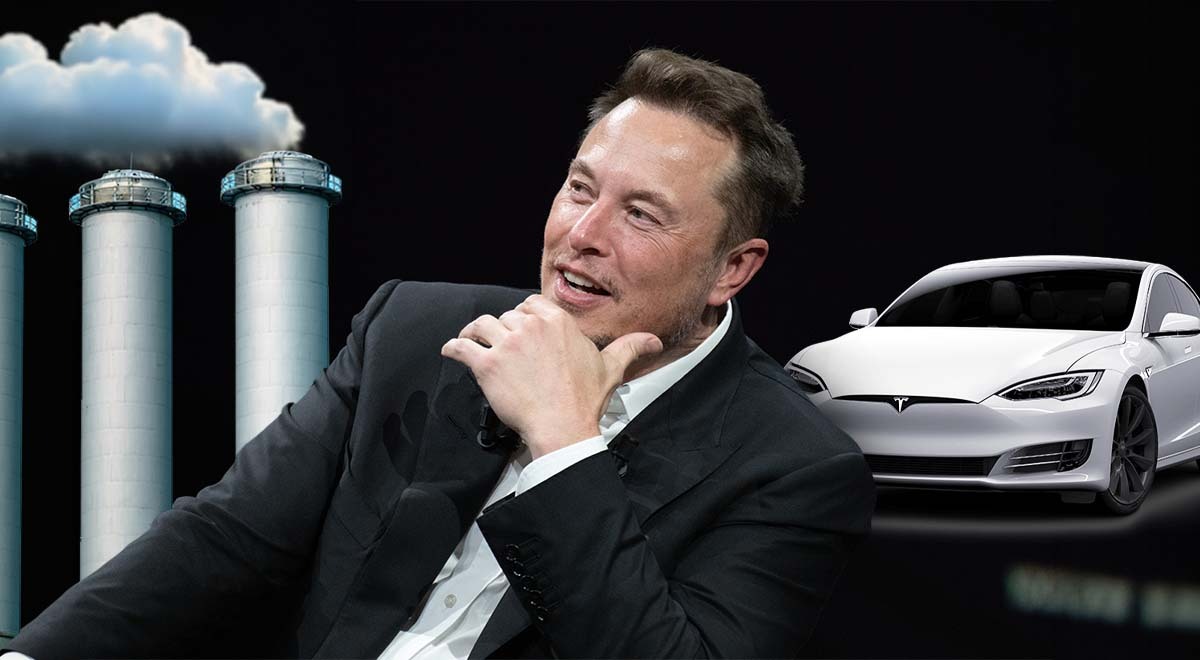
Image by Cybernews.

 Follow us
Elon Musk’s eyes are now firmly focused on AI slop – and to hell with the climate crisis. His AI company, xAI, is now operating dozens of unpermitted methane gas turbines in two US states, undoing all the noble work Tesla has done on climate.
The math is quite simple. According to xAI’s own permit application, the facilities in Tennessee and Mississippi could emit more than 6 million tons of greenhouse gases and over 1,300 tons of health-harming air pollutants every year.
For comparison, Tesla’s latest impact report boasts of avoiding 32 million metric tons of CO2. Clearly, Musk is now erasing a large chunk of his own company’s climate legacy to power an AI model – and not even one of the best ones.
Long gone are the days when Musk was calling the mass release of CO2 in the Earth’s atmosphere the “dumbest experiment in history.”







By now, it’s obvious that Musk says a lot of things, smart, silly, and absurd. But we should actually be paying more attention to what his companies – especially his AI vanity project – do, because it’s totally contrary to what the billionaire used to preach.
Ignoring all rules
Already in 2024, when xAI built its Colossus supercomputer in South Memphis, the company, unable to secure enough grid power, installed 35 portable methane gas turbines – without permits or pollution controls.
According to the Southern Environmental Law Center (SELC), xAI has exploited a loophole by classifying the turbines as “non-road engines” to dodge the Clean Air Act.
And xAI doesn’t seem to care about the legality of its actions. The company soon parked 27 more unpermitted gas turbines just across the state line in Southaven, Mississippi, to power its second data center, MACROHARDRR. Those 27 turbines generate up to 495 megawatts, the equivalent of a conventional power plant.






Combined with the Memphis facility’s 422 MW, xAI is now operating nearly a gigawatt of unpermitted fossil fuel generation across the two sites.
Even when the Environmental Protection Agency closed the “non-road engine” loophole in January 2026, xAI is still burning gas at the Mississippi facility.
It’s all very loud, too. Residents living in neighborhoods close to the Mississippi data center complain of Mordor-like noise and told NBC News recently that the power plant “sounds scary.”
Even using Tesla’s own optimistic figure, xAI’s 6 million tons of annual greenhouse gas emissions would erase around 19% of all the climate benefits Tesla claims to deliver globally.
They also told state regulators that xAI’s plans and current operations would increase pollution in a county already struggling with air quality. Indeed, the SELC has said that gas turbines produce pollution and release hazardous chemicals, including formaldehyde.
xAI at least removed roughly half of the unpermitted turbines in Memphis after the National Association for the Advancement of Colored People (NAACP) threatened to sue the company over violations of US environmental regulations and polluting nearby Black communities with toxic chemicals.
Not a genuine commitment
At the Memphis site alone, the turbines emit between 1,200 and 2,000 tons of nitrogen oxides per year, likely making xAI the largest industrial source of smog-forming pollution in the entire 11-county Memphis metropolitan area.
The Memphis facility also consumes up to 1.5 million gallons of water per day for cooling, with plans to scale to 13 million gallons per day, tapping into Memphis’s vulnerable aquifer system.

Check if your data was exposed
Find out if your email and related personal information have appeared in known data breaches.
Tesla’s 2024 Impact Report claims that its global fleet of electric vehicles, solar panels, and energy storage products helped avoid 32 million metric tons of CO2-equivalent emissions.
That number is probably overstated as an independent study by Greenly estimated Tesla’s real avoided emissions at closer to 10.2 to 14.4 million metric tons.
The Cybernews community is talking about this. Be a part of the conversation.
Still, even using Tesla’s own optimistic figure, xAI’s 6 million tons of annual greenhouse gas emissions would erase around 19% of all the climate benefits Tesla claims to deliver globally.
All this makes Musk and Tesla’s mission to accelerate sustainable energy look more like a marketing slogan than a sincere commitment.
Unlock more exclusive Cybernews content on YouTube.