Base44 vs Bolt: which is better at building apps?
Being behind major reports like The Mother of All Breaches and RockYou2024, our in-house cybersecurity experts and journalists provide unbiased, real-world testing and in-depth analysis.
We maintain complete transparency by openly sharing our testing methodologies with our audience.
Learn more

When AI first hit the mainstream, we never thought that within just two to three years, we’d be seeing tools that could build an app from a single prompt. Now, apps like these are popping up left and right, and the space is becoming crowded. But two names are standing out and generating more buzz than the rest.
Introducing Base44 and Bolt AI. Both promise to speed up your workflows, simplify your builds, and take away bottlenecks that typically happen when building and managing apps.
While both tools have a few similarities, they take very different approaches. Base44 leans into automation and streamlined site generation, while Bolt AI focuses on customization and advanced AI-driven design tweaks.
To separate fact from marketing promises, I’ve teamed up with the Cybernews research team to investigate both platforms. Our goal? To give you a clear, understandable, and digestible article you can use to decide which one is best for your team.
Overview of Base44 vs Bolt
As a Cybernews expert who's spent countless hours researching AI app builders with my team, I can tell you that choosing between Base44 and Bolt isn’t straightforward. Both platforms promise to turn your ideas into functional apps using AI, but they approach this goal differently and are best suited for different kinds of users.
After diving deep into user feedback, platform documentation, and online discussions, we found that these tools serve overlapping but distinct needs. Base44 positions itself as a solution for entrepreneurs, small teams, and non-developers who want to create business apps, productivity tools, or MVPs without writing code. Bolt, meanwhile, is designed with developers, agencies, and more technical users in mind, providing a full-stack environment for prototypes, complex applications, and scalable web projects.
When it comes to customer experience, Base44 offers a simplified, guided, and template-driven workflow that removes many of the technical barriers. Bolt, by contrast, demands a bit more technical know-how but rewards users with far greater flexibility and customization options.
| Factor | Base44 | Bolt |
| Target audience | Entrepreneurs, small teams, non-developers | Developers, agencies, tech-savvy users |
| Use cases | Business apps, productivity tools, MVPs | Prototypes, web apps, complex applications |
| Customer experience | Simplified, template-driven approach | More technical but flexible |
| Cost | Fixed monthly subscription + usage-based credits (messages & integrations) | Token-based usage, scales with demand |
| Main features | Full-stack environment (UI, backend, DB), AI app generation, hosting included | Full-stack development, modern frameworks, deployment |

What is Base44?
Base44 positions itself as a tool that takes you “from idea to live app in minutes” with no coding required. The company emerged from the growing demand for accessible app development platforms that don’t require years of programming knowledge or a technical team to get started.
Based on our research, Base44 primarily targets entrepreneurs, small business owners, and anyone who needs functional apps without the technical overhead. It uses a prompt-first workflow where you describe your idea in plain English and let AI handle the heavy lifting, generating both the front end and back end with database, auth, storage, and hosting. The platform can auto-select between multiple models (e.g., Claude Sonnet 4 and Gemini 2.5 Pro) and lets advanced users override that choice. It also bundles in hosting, analytics, and user management, making it more than just a front-end builder.

Non-technical founders, small business owners, marketing teams needing quick internal tools, and anyone prioritizing speed and accessibility over deep customization.
What is Bolt?
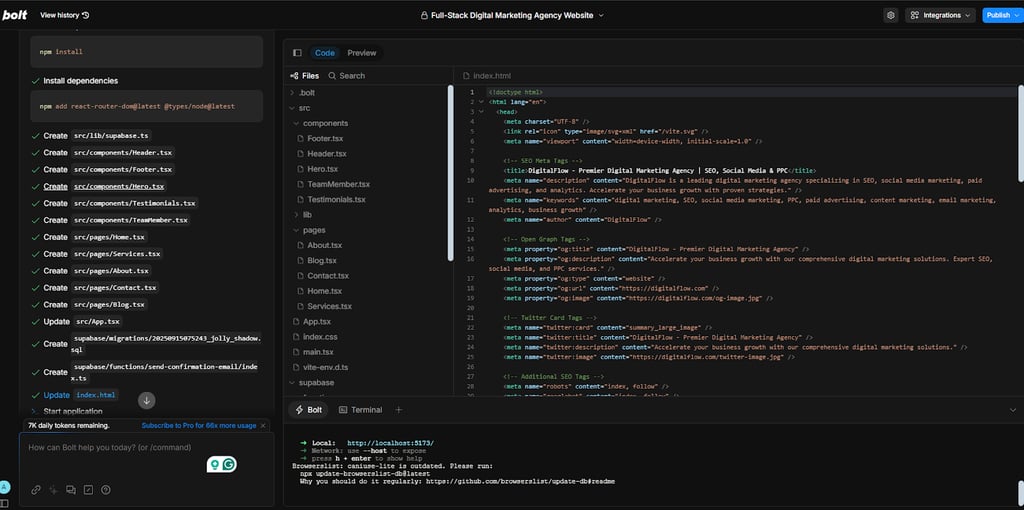
Bolt (formerly Bolt.new) allows users to "build and scale high-performing websites & apps using your words" and has gained significant traction in the developer community. The platform reached $40M ARR in just 6 months, showing serious market adoption.
From what we've observed in developer forums and reviews, Bolt appeals to a more technical audience while still maintaining AI-powered simplicity. The platform uses AI to generate and deploy full-stack web apps using modern frameworks.
Developers, development agencies, startups with technical teams, and users who need advanced customization and modern web technologies.
Quick comparison: Base44 vs Bolt
Here's the high-level breakdown that most of our readers want to see first:
| Feature | Base44 | Bolt |
| Ease of use | Very beginner-friendly with guided prompts | Moderate learning curve |
| Integrations | Solid but less extensive than developer-level stacks | Extensive, modern, and developer-oriented |
| Pricing | Fixed monthly subscription + usage-based credits (predictable base) | Token-based, scalable with usage |
| Scalability | Standard protections with enterprise SSO/RBAC options; past issues patched | Excellent for prototypes and enterprise growth |
| Support | Standard channels, documentation, GitHub integration | Active developer community, peer support |
| Security | Standard protections, with past issues patched | Enterprise-grade compliance and options |
Based on our analysis of user feedback and platform capabilities, Base44 wins on simplicity. Their pricing models reflect different philosophies: Base44’s fixed monthly plans appeal to budget-conscious teams. However, Bolt’s token-based system offers scalability and flexibility for developers building complex projects.
In-depth comparison of the features
Let me break down the core features that matter most when choosing between these platforms.
| Feature Category | Base44 | Bolt |
| AI models | Runs on Claude Sonnet 4 and Gemini 2.5 Pro, auto-selects best model with manual override | Offers GPT-4 along with other advanced models such as Claude, giving users more choice |
| Development approach | Prompt-first workflow with templates and guided AI enhancements. Best for those with no coding background | Developer-first with AI-generated code scaffolding, local data handling, and framework support |
| Deployment | Automatic hosting, backend management, and analytics bundled in every plan. Minimal setup needed | Built-in deployment with advanced workflows, scaling options, and support for custom domains |
| Customization | Flexible inside its system: edit templates, connect APIs, manage workflows, but less direct code access | Full code visibility and modification, plus support for modern frameworks and integrations |
| Learning resources | Starter templates, design tokens, guided prompts, and beginner-friendly onboarding | Community-driven documentation, GitHub examples, and peer support forums |
The differences become even clearer when you compare how they’re used day to day. Base44 focuses on speed and accessibility, aiming to get a working app live in minutes. Hosting, analytics, and authentication are automatically included, which means small teams don’t need to stitch together third-party tools.
It only makes perfect sense for MVPs, back-office solutions, or marketing teams that need quick internal apps without relying on developers.
Bolt, however, is designed for depth and flexibility. It gives developers the freedom to choose frameworks like Next.js, Astro, or Vue while also handling AI-driven scaffolding for repetitive tasks. Its token-based model adapts to different usage levels, from light prototyping to enterprise-grade scaling.
Bolt also provides stronger customization options, letting technical teams modify workflows, integrate complex APIs, and fine-tune security and compliance at a granular level.
In short, Base44 reduces friction for non-technical users, while Bolt empowers technical teams to build scalable, production-ready solutions with modern standards. Both tools are strong, but their philosophies diverge sharply: simplicity versus flexibility.
AI Model integration
Both platforms leverage AI differently, and understanding these differences is important for making the right choice.
Workflow logic builder
The workflow builder defines how each platform handles automation, triggers, and app logic.
- Base44 takes a prompt-first approach. Users can describe workflows in plain English. For example, “when a form is submitted, send an email and update the database.” The system converts that into working logic. Combined with pre-built templates, this creates a smooth experience for those who have never touched a workflow tool before.
- Bolt goes deeper. It generates actual code scaffolding and allows developers to extend workflows with modern frameworks. That means you can start with AI scaffolding but then customize the details, adding advanced triggers, conditions, or integrations. It’s less beginner-friendly but much more powerful.
Version control
Version control is critical for teams building apps. It keeps projects consistent and allows collaboration without overwriting code.
- Base44 integrates with GitHub on higher-tier plans. Non-technical users won’t have to deal with branches, but developers can still plug into GitHub if they need a more formal setup. The approach is hybrid: simple for solo founders, structured for small teams.
- Bolt leans harder into developer workflows. Since the system generates full code, it integrates cleanly with GitHub from the start. Developers can work with branches, pull requests, and commits without friction, which is the expected standard for technical teams.

Storage
Every app needs a place to store data, files, and logs.
- Base44 includes built-in storage and database functionality. Hosting and backend come with every plan, so you don’t need to set up cloud services separately. For small to medium projects, this all-in-one package is a huge time saver. It also removes the need to manage billing across multiple platforms.
- Bolt provides local store databases and supports connections to external services. This gives developers flexibility, as you can prototype with the built-in store, then connect to Postgres or other databases as your app scales.
Deployment
Once the app is ready, deployment is the final step.
- Base44 keeps deployment as simple as possible. Every plan includes hosting, backend management, and analytics. Apps go live without configuring servers, domains, or SSL certificates. This is a strong advantage for small teams that don’t want to spend time on DevOps.
- Bolt provides built-in deployment pipelines with advanced scaling. Developers can set up custom domains, handle more web requests, and even integrate enterprise workflows. While the setup is more technical, it ensures apps can grow without hitting artificial limits.
Customization
Customization is where these platforms really diverge.
- Base44 gives users flexibility inside its no-code system. You can edit templates, connect APIs, and manage workflows, but you don’t get deep access to the underlying code. For non-technical users, this is perfect as it reduces complexity. But developers may find it restrictive if they want total control.
- Bolt opens everything. Developers can view, edit, and extend generated code. Support for modern frameworks like Next.js, Astro, and Vue means projects are not locked in. You can start with AI scaffolding and then shape the app however you want.
Learning resources
A tool is only as strong as the help available to its users.
- Base44 has a library of starter templates, guided prompts, and built-in onboarding flows. New users can get from zero to a working app in minutes, even without reading documentation. It’s designed for speed and confidence.
- Bolt depends more on its community-driven documentation and GitHub examples. Experienced developers benefit from peer discussions and code snippets, but beginners may find the learning curve higher.
What you can build with an AI app builder
After reviewing hundreds of user examples and case studies, I can tell you that AI app builders have democratized software development in ways we couldn't imagine five years ago.
Common applications:
- Customer relationship management systems
- Internal productivity tools and dashboards
- E-commerce platforms and marketplaces
- Content management systems
- Project management applications
- Data collection and analysis tools
Key features to look for:
- Responsive design that works on all devices
- Database integration and management
- User authentication and role-based access
- API connectivity for third-party services
- Deployment and hosting solutions
- Scalability options as your user base grows
The reality is that you can build surprisingly sophisticated applications with modern AI builders. Base44 supports personal productivity tools and back-office solutions to customer portals and complete enterprise products. Similarly, Bolt enables everything from simple websites to complex web applications.
Expected results: Most users report going from idea to working prototype in hours rather than weeks. The quality depends heavily on how well you can communicate your requirements to the AI. Think of these tools as having a very fast developer who needs extremely clear instructions.
The learning curve isn't about coding anymore. It's about understanding how to break down your business requirements into clear, actionable prompts that AI can interpret accurately.
Final word on the Base44 vs Bolt comparison
After extensive research and analysis of user feedback, both platforms serve their intended audiences well, but they solve different problems. Both are AI app builders, and the right pick depends on who’s building and how you plan to grow.
Base44 excels in situations where predictable pricing and simple workflows are a priority. It’s the natural choice for teams that lack deep technical expertise and care more about speed to market than fine-grained customization. For straightforward business applications and internal tools, Base44 delivers exactly what’s needed without overcomplicating the process.
Bolt, on the other hand, dominates when modern development practices and flexibility matter most. It’s better suited for teams with developers or technical users who can take advantage of its scalability, advanced integrations, and code ownership features. If your project requires complex workflows, future growth, or the ability to export and extend code, Bolt is the stronger option.
What do I recommend? Choose Base44 if you're a non-technical entrepreneur or small business owner who needs functional apps quickly without the development complexity. The fixed pricing and simplified approach make it ideal for straightforward business needs.
Choose Bolt if you have technical expertise on your team or need sophisticated, scalable applications. The token-based pricing offers flexibility, and the platform's capabilities better align with professional development practices.
FAQ
Is Base44 better than Bolt?
Neither platform is universally better. Base44 wins for non-technical users who prioritize simplicity and predictable costs. Base44's "set price each month" approach is good for startups and growing teams who want budget predictability. Bolt excels for technical teams needing flexibility and modern development capabilities.
What are the advantages of Bolt?
Bolt uses AI to generate and deploy full-stack web apps using modern frameworks, offering more sophisticated development capabilities. The platform provides better version control, more integration options, and code export functionality. Bolt's deployment pipelines and custom integrations make it suitable for complex, scalable applications.
Is Base44 a good app builder?
Yes, Base44 serves its target market well. The platform offers a gentle learning curve with built-in idea templates and design tokens that guide non-developers effectively. It handles backend, database, hosting, and integrations automatically, making it excellent for users who want functional apps without technical complexity. However, it may not satisfy users needing extensive customization or complex enterprise features.