Best AI tools for outreach in 2026
Being behind major reports like The Mother of All Breaches and RockYou2024, our in-house cybersecurity experts and journalists provide unbiased, real-world testing and in-depth analysis.
We maintain complete transparency by openly sharing our testing methodologies with our audience.
Learn more

AI outreach tools improve your outreach efforts by helping research leads, personalize messages, automate sequences, and improve reply rates. Outreach is an important part of sales, but succeeding at scale is difficult. Drafting messages, personalizing them, and finding the right time to reach out and follow up takes time and effort. AI can automate all of the busywork that comes with outreach and more.
But AI outreach tools go beyond simple automation. They can also help boost relevance, speed, and consistency – but only if used correctly.
For this guide, I tested and reviewed leading AI outreach tools together with the Cybernews research team to find the best tool for every type of outreach need. Below, you’ll find our list of the top AI tools for outreach, a side-by-side comparison table, best-use workflows, and practical tips for using AI outreach tools.

Best AI tools for outreach – shortlist
- Apollo.io – best AI tool for outreach overall
- Instantly.ai – high-volume AI cold email outreach
- Outreach.io – sales engagement for large businesses
- Lindy AI – no-code AI agents for outreach
- ZoomInfo – deep data AI outreach
- Lemlist – personalized AI outreach with visualization tools
The best AI tools for outreach compared
Before jumping into individual reviews, it can be helpful to compare these AI outreach tools side by side. Below, I summed up my findings into a quick side-by-side look, comparing price, features, deliverability support, and who each tool is best suited for.
| Rating | Starting price | AI features | Deliverability support | Best for | |
| Apollo.io | 4.9 | $49.00/month | Research, writing, automation | Low | Mid-to-large businesses that want an all-in-one sales platform |
| Instantly.ai | 4.7 | $37.60/month | Email warmup, email writing | High | Any size business or organization looking to send cold emails at a high volume |
| Outreach.io | 4.5 | Custom | Sequencing, advanced analytics, forecasting, coaching | Low | Automation, scalability, and unique insights for large businesses |
| Lindy AI | 4.3 | $49.99/month | Custom AI agents, research, writing, automation | Low | Smaller teams that want a custom AI agent that can do more than outreach |
| ZoomInfo | 4.0 | Custom | Deep contact and company data, buying intent signals | Medium | Large businesses and enterprises that want deep insights into prospects |
| Lemlist | 3.8 | $55.00/month | Visuals, writing, email warmup | Medium | Creative marketing and teams that want more personalization |
6 best AI tools for outreach – our detailed list
Finding the best AI outreach tool for your business can be overwhelming. There are hundreds of platforms on the market, all of them promising better sales. Below, you can find our list of the best AI tools for outreach, each with its strengths and weaknesses, to help you find the right fit for your team.
1. Apollo.io – best AI outreach tool overall in 2026

| Rating: | 4.9 |
| Standout features: | All-in-one platform, massive database, AI Writing Assistant, Buying Intent Data |
| Starting price: | $49.00/month |
| Best for: | Mid-to-large businesses that want an all-in-one outreach platform |
Apollo.io is the best AI outreach tool we’ve tested. It’s an all-in-one outreach platform that helps teams find leads, enrich data, and send automated and personalized messages. It’s ideal for mid-to-large businesses and enterprises, but I wouldn’t recommend it for teams that are just starting out – there are better options for small teams available, which I cover below.
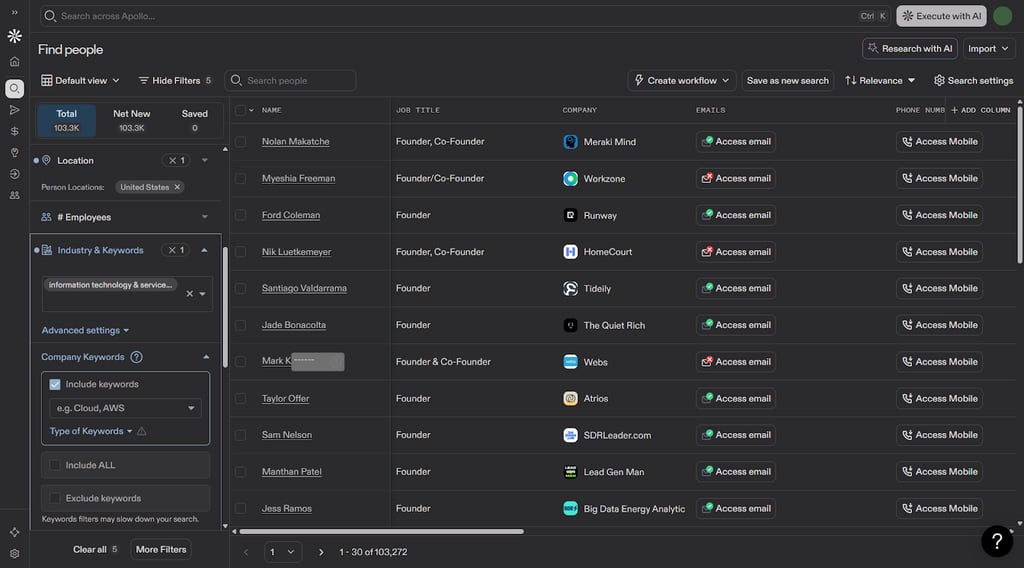
The main benefit of Apollo.io is that it’s an all-in-one solution. Most outreach tools require you to buy leads elsewhere and import them, whereas Apollo keeps the entire process, from targeting to booking the meeting, in a single platform.
On top of that, Apollo.io has a massive database, which is great for finding prospects. You can filter leads using specific criteria, like job role, company size, recent job changes, or department budgets. Since everything can be done from the same platform, you can drop contacts straight into automated email sequences or call them using Apollo’s built-in dialer.
Some of its standout features include the AI writing assistant, which helps you draft personalized email openers by analyzing your website and a prospect’s LinkedIn profile, making it a solid LinkedIn outreach AI tool. There’s also a buying intent data feature, which flags companies that are actively researching solutions like yours. I also appreciated that there’s a browser extension, which pulls contact details and company insights directly from LinkedIn, Gmail, and CRM tools, saving me time by removing the need to switch tabs.
Unfortunately, it’s not beginner-friendly, mainly because of the interface. I found it cluttered and overwhelming, especially for those who may be using this type of tool for the first time. Teams also need to keep an eye on credit usage, especially when working with large datasets.
You can start using Apollo.io for free. The free tier gives you 75 credits/month, which is enough to try out the service before upgrading. Paid plans start at $49.00/month, which provides you with around 2500 credits/month as well as access to core features. Upgrading to higher tiers gives you more credits and access to advanced features like automated workflows and analytics.
2. Instantly.ai – easy cold email outreach at high volumes
| Rating: | 4.7 |
| Standout features: | Unlimited email accounts, Email Warmup, campaign email rotation |
| Starting price: | $37.60/month |
| Best for: | Any size company or organization looking for high-volume AI cold email outreach |
Instantly.ai is another solid AI outreach tool specializing in high-volume outreach. Unlike Apollo.io, Instantly.ai is more suited for beginners because of its intuitive interface and low learning curve. During testing, I found that its limited features actually work in its favor in terms of usability, providing you with the exact tools you need for high-volume outreach but not much more.
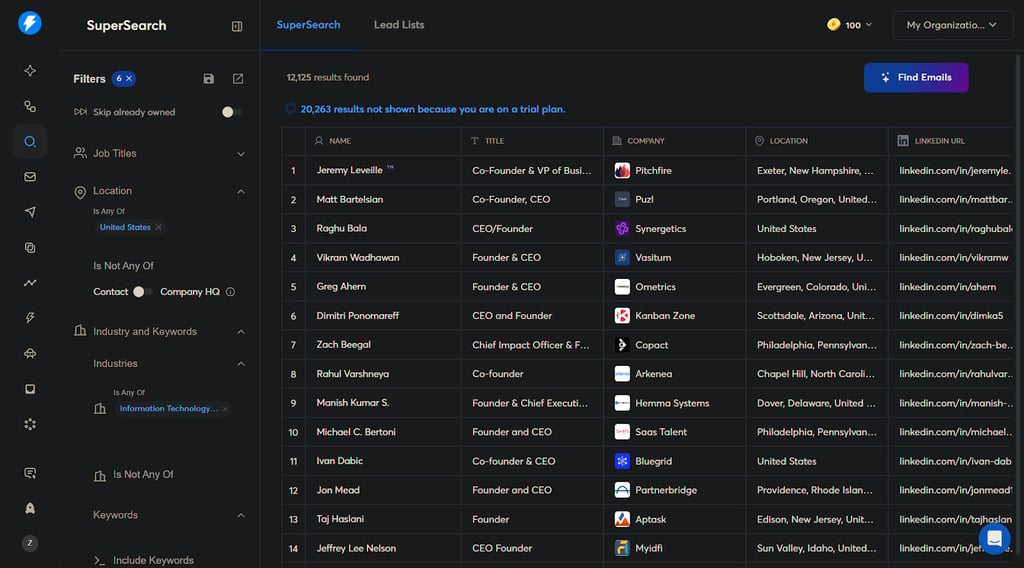
Deliverability and scale are where Instantly.ai shines the most, ensuring that your emails reach the recipient’s primary inbox, even when sending at a high volume. Email Warmup is its standout feature, which uses AI to open, reply to, and engage with your sent emails, building a positive sender reputation. This decreases the risk of your emails ending up in spam.
Another feature I liked was email rotation, which improves deliverability even further by automatically distributing your emails across different email accounts, ensuring no single email address sends too many messages and gets flagged.
There’s also Unibox, which is essentially a master inbox where you can find all of your sent emails and replies. I appreciate this feature because it removes a lot of the busywork of moving emails between different accounts.
While it has generative AI tools to create personalized emails, I found them robotic and in dire need of human review. Plus, its customer support isn’t the best, and a lot of users have reported negative experiences because of it.
As for pricing, you can get Instantly.ai for $37.60/month if you opt for a 1-year plan, which I find somewhat pricey for a platform with limited features. It doesn’t have a free tier, but you can test out the service with a 14-day free trial.
3. Outreach.io – enterprise-level sales engagement and analytics
| Rating: | 4.5 |
| Standout features: | Automation, advanced analytics, forecasting, coaching |
| Starting price: | Custom |
| Best for: | Large businesses and enterprises that need automation, scalability, and analytics all in one place |
Built for large businesses and enterprises, Outreach.io is a comprehensive sales engagement platform with a workflow-first approach. During my extensive review, I found that Outreach.io works best for teams that need highly coordinated sales sequences and deep insights into what works and what doesn’t.
Outreach.io has an extensive list of features to improve your company’s workflows. Features like advanced sequence automation, CRM sync, AI assistance, conversation intelligence, and forecasting can give you powerful insights that are hard to get from lighter tools. That depth also means a steeper learning curve and higher cost. Smaller teams or those focused on simple cold email outreach may find the platform overly complex and expensive compared with other tools.
That being said, if you do go for it, you’ll get access to Kaia, which is Outreach.io’s conversational AI. Kaia also powers the conversation intelligence feature, which automatically captures and analyzes call and meeting data, providing unique insights. It can also identify weak spots for rep coaching.
Outreach.io doesn’t have set pricing like other AI outreach tools on this list. To get a quote, you need to contact the sales team. There’s no free plan or even a free trial, but you can get a demo after talking to sales.
4. Lindy AI – custom AI agents for outreach

| Rating: | 4.3 |
| Standout features: | Build your own AI agent, research, writing, automation |
| Starting price: | $49.99/month |
| Best for: | Small to mid-size companies that want an all-round AI tool (not just outreach) |
Lindy AI is a great alternative to AI outreach tools because it’s not exactly one. It lets you build custom AI agents to help you automate your outreach campaigns. From finding leads to generating emails to setting up and running sequences, Lindy AI can do anything you want it to – and you don’t even need to have technical skills to build it.
You tell the agent what to do, when to do it, and how to react – and it handles the rest. It can be a simple automation tool or a sort of AI employee that handles tasks like research, personalized message generation, follow-ups, and mundane tasks like updating datasets.
Overall, I’d say that one of the main strengths of Lindy AI is flexibility. Since it’s not an outreach tool, you’re not locked into someone else’s idea of how outreach should work. If your process is unique, Lindy can match it. That being said, the setup and the whole process of getting it to work as you envision it can take a lot of trial and error, so it’s something to keep in mind.
You can try Lindy AI for free with the free plan, which gives you 400 credits/month. Upgrading to a paid plan will cost you $49.99/month and give you 5000 credits/month. If you don’t want to commit without trying out the premium version, you can test Lindy AI with a 7-day free trial as well.
5. ZoomInfo – deep B2B data and buying intent signals
| Rating: | 4.0 |
| Standout features: | Deep contact and company data, buying intent signals |
| Starting price: | Custom |
| Best for: | Large businesses and enterprises looking for prospects and unique insights |
While outreach is part of its operations, ZoomInfo isn’t an outreach tool like most of the platforms on this list. Still, it made the list because it has a massive database with over 209M+ professional and 13M+ business profiles. You can filter leads based on job title, industry, company size, and many more. Teams can also see buying intent signals, which show when a company is actively researching products or services similar to what you’re offering. Best of all, the platform seamlessly connects with major CRMs and outreach tools, so once you identify the right leads, you can push them into your existing sales workflow.
Overall, the biggest advantage of ZoomInfo is the size and depth of its data. While it can handle outreach tasks like running sequences and even generating email campaigns, ZoomInfo shines as a data-first platform that helps teams decide who to contact, when to reach out, and why, using deep company insights, intent signals, and automation to guide smarter outreach decisions. It works best when used in conjunction with other outreach tools.
Like Outreach.io, ZoomInfo doesn’t have fixed pricing for any of its plans, so you’ll need to contact its sales team to get things going. Luckily, unlike with Outreach.io, there’s a free trial you can use to test out the platform before committing long-term.
6. Lemlist – highly personalized, creative, multi-channel campaigns
| Rating: | 3.8 |
| Standout features: | Visual personalization, LinkedIn integration, automated workflows |
| Starting price: | $55.00/month/user |
| Best for: | Marketing agencies and teams looking for more creative solutions across multiple channels |
Lemlist may be last on our list, but it’s still a solid AI outreach tool, particularly for businesses that are looking to be more creative in their outreach efforts. With advanced personalization features, Lemlist is a great tool to make your emails stand out.
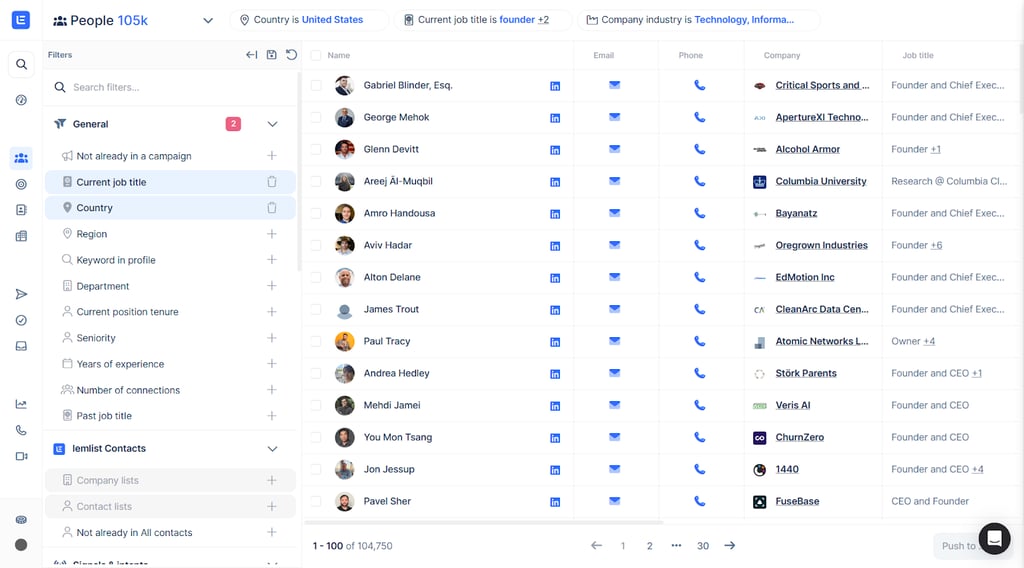
During our tests, we found Lemlist’s personalization quite advanced. You can add visuals like images, videos, and even graphs that include the prospect’s website or name, making every message feel like it was made just for them. You can even create personalized landing pages that mirror the content of your emails, which provides a smooth and personalized experience from click to conversion.
Lemlist also stands out with a deep LinkedIn integration, particularly for personalized outreach automation. It can view LinkedIn profiles on your behalf, send connection requests, and send personalized messages (both text and voice). You can also set up effective sequences across multiple channels, but I found it works best if LinkedIn is a key part of your campaigns.
That being said, Lemlist isn’t ideal for spammy, high-volume campaigns. It’s more suited for businesses building a premium brand.
Lemlist is quite pricey, starting at $55.00/month/user, especially considering its limitations on the starter plan. To get the most value, you’d have to sign up for the MultiChannel Expert or Enterprise plans, which are even more expensive, but if you have the budget, it can be invaluable. It doesn’t have a free plan, but you can test it out with a 14-day free trial.
What is the AI outreach method?
AI outreach tools are software programs powered by AI that help businesses reach the right people more quickly and efficiently. They rely on a combination of machine learning and data analytics to speed up tasks like finding leads, writing emails, and tracking replies.
At its core, AI outreach covers three key areas:
- Targeting. Analyzing data, identifying high-priority leads, segmenting leads into lists, and sourcing contact information.
- Personalization. Generating personalized messages (openers and follow-ups) for different leads and segments.
- Optimization. Automating repetitive tasks and providing unique insights from analytics.
Together, they help teams send relevant messages to the right audience at a much faster rate. That being said, the AI research method works best when it’s combined with human judgment, especially in cases where context and nuance matter most.
How AI outreach works
AI outreach tools combine data aggregation, message generation, and automation to run personalized outreach campaigns across multiple channels. But what does this mean exactly? Here’s a quick breakdown of its core functions:
- Data and verification. Collects contact details and checks their accuracy through enrichment and validation.
- Context mining. Analyzes role-based and company-level signals, such as job titles, industries, and recent activity.
- Message generation. Creates emails, direct messages, and call scripts based on prospect data and goals.
- Multichannel formatting. Adapts messages for different channels, like email, LinkedIn, and video or voice scripts.
- Automation and learning. Runs sequences, tests variations, and reports on performance to improve future outreach.
The whole process is pretty straightforward. Teams segment prospects, then enrich them with contact information and company data. Next, messages are personalized and added to automated sequences. After replies are tracked, teams review results and iterate to improve future outreach. Teams can rely on the AI outreach tools every step of the way or just use them to optimize specific steps.
Why AI outreach tools matter for modern sales teams
- Faster prospect research and targeting. Scans large data sets to find prospects that match the ideal customer profile. This helps sales teams spend less time searching for leads and more time talking to the right people.
- Better personalization at scale. Tailors messages for each prospect based on company information, behavioral data, and more. This enables teams to reach more people while still writing unique messages for each client.
- More consistent follow-ups. Automate follow-up messages so no prospect is forgotten.
- Improved messaging experimentation. Built-in testing tools, like A/B testing, allow teams to compare different subject lines, messages, and call scripts. This makes it easier to see what works best and improve outreach based on real results.
- Cleaner reporting and pipeline visibility. Having all outreach campaigns in one place makes it easier to track prospects, messages sent, messages opened, replies, and more.
- Reduced manual busywork for reps. AI outreach tools can handle repetitive tasks like data entry, list updates, and sequence management. This allows sales teams to focus on conversations, demos, and closing deals.
AI outreach tools help sales teams to operate more efficiently by removing friction. They can automate tedious parts of research, generate personalized messages, set up follow-ups, enable A/B testing, provide clear insights, and reduce overall busywork.
What to look for in an AI outreach tool
Choosing the right AI outreach tool can make or break your campaign, so it’s important to take a step back and set your expectations first. Once you know what you want your AI outreach tool to do, you’re ready to look for the perfect fit:
- Personalization quality. First and foremost, a good AI outreach tool generates personalized messages based on real data instead of generic fluff you can find anywhere. Make sure to do some testing on this core functionality before committing long-term.
- Sequence builder and multichannel support. Set up outreach sequences across email, LinkedIn, calls, and even video or voice. This ensures prospects are reached in the most effective channels.
- Contact enrichment and data quality. Data is key in outreach. Your selected AI outreach tool should be able to enrich your data by verifying emails, filling in missing details, and providing accurate company and role data. Clean data improves response rates and reduces bounce issues.
- Deliverability tools. Features like domain warm-up, spam checks, and health monitoring will keep your emails out of spam folders. This ensures your outreach actually reaches prospects’ primary inboxes.
- Integrations. Seamless connections with CRMs, email clients, calendars, and LinkedIn save time and ensure that all of the information is in one place, improving workflow.
- Analytics that tie to pipeline outcomes. Look for reporting that shows not just opens or clicks but how outreach contributes to meetings and revenue. This helps teams focus on what drives results.
- Compliance and admin controls. Compliance is key. Ensure your selected tools help you stay compliant with GDPR, CAN-SPAM, and other regulations. While the compliance rests in the company’s hands, your team should have easy access to admin controls to enforce policy and prevent mistakes.
- Usability. These tools should make work easier, not harder. Test out the apps and ensure they’re easy to navigate for day-to-day tasks. They should also have governance tools to give managers visibility and control.
- Price-to-value ratio for your team size. Evaluate the plans and pricing and consider whether the tool matches your team’s needs and budget. Sometimes, going for the more expensive option is more cost-effective in the long run if the cheaper one doesn’t check all the boxes and slows down productivity.
A good AI outreach tool will be able to handle targeting, personalization, and optimization tasks while balancing your team size, goals, and workflow. However, it’s important to keep in mind that there are always tradeoffs. For instance, deeper AI personalization may need more data and oversight, advanced deliverability or integrations can add complexity, and top-tier features might cost more. It’s up to you to decide what’s worth it and what’s not.
How to use AI for outreach across channels
AI outreach tools work best when used across multiple channels. Each channel has its own strengths and weaknesses and can help you connect with different audiences. Here’s what you could do with:
- Email. Use AI to draft personalized subject lines and body text. Schedule follow-ups automatically and test different variations to see what gets the best responses.
- LinkedIn. AI can suggest connection requests, messages, and post comments based on the prospect’s profile and activity. Keep messages short, professional, and relevant to their role or company.
- Video. Use AI to create short, personalized videos for introductions or follow-ups. Scripts should highlight the prospect’s needs and your solution.
- Voice. AI can generate call scripts or talking points based on prospect data. Reps should use these scripts as guidance but adapt naturally during the conversation.
For each channel, it’s important to know what AI can handle, what the sales rep should verify, and what to avoid. Here’s a quick checklist to reference.
Email:
- What AI should do: draft personalized subject lines and body text, suggest follow-up timing, and test variations.
- What the rep must verify: accuracy of prospect details, tone, and any references to company or role.
- What to avoid: spammy templates, overly casual familiarity, and AI-generated claims that aren’t verified.
LinkedIn:
- What AI should do: suggest connection requests, message drafts, and relevant comments based on profile activity.
- What the rep must verify: correct job title, company name, and context of messages.
- What to avoid: overly generic messages, pretending to know the prospect personally, or referencing events or details the AI hallucinated.
Video:
- What AI should do: create short scripts highlighting the prospect’s role or needs, suggest visuals or talking points.
- What the rep must verify: script accuracy, personalization, and professional tone before recording.
- What to avoid: using AI-generated facts that aren’t true, overly long videos, or gimmicky personalization.
Voice:
- What AI should do: generate talking points, call scripts, or question prompts tailored to the prospect.
- What the rep must verify: that the script matches the prospect’s situation and contains no factual errors.
- What to avoid: reading scripts verbatim without adapting, using false familiarity, or relying on AI-generated assumptions.
By combining AI’s speed with a rep’s judgment, outreach stays personalized, professional, and accurate across all channels.
Tips for successful email outreach
With prospects’ inboxes full of spam, for email outreach to work, you need to use all of the tools at your disposal. Here’s how you can improve email outreach with AI:
- Lead with relevance in the first sentence. AI outreach tools can help by pulling information, such as job title changes, company growth, or buying intent signals to explain why you’re reaching out.
- Keep it short (aim for skim-friendly structure). Short emails perform better. Outreach tools with AI writing can help with structure, wording, and keeping messages focused.
- Ask one clear question or CTA. CTA is a supporting element of your cold emails. There usually should be just one to keep the message focused. AI tools can suggest a simple CTA based on the prospect’s role or company, such as asking for a quick reply or a short call.
- Use a soft follow-up sequence. Most replies come from follow-ups, but it can be taxing to set up follow-ups for all of your leads. AI can automate the whole process by setting up and running sequences that are sent at the right time.
- Personalize with real signals, not generic compliments. Saying “I liked your website” does not count as personalization. Strong outreach tools use real data, like recent activity or role-specific challenges, to make messages feel thoughtful and relevant.
- Protect deliverability. This is where AI outreach tools really shine. Many of them have advanced features to improve deliverability like email warmups, email rotation, reputation monitoring, and more, all to ensure your emails end up in the primary inbox instead of spam.
You can also use conversational AI, like ChatGPT, to generate personalized messages for your leads. For example, you can ask it for role-based openers based on job title, industry, or seniority level. It can help frame your messages around a specific pain point naturally. AI also works well with generating short call-to-action text that is not too salesy or pushy. Lastly, you can use it to generate a number of follow-up variations.
Final verdict: which AI outreach tool should you choose?
After comparing these platforms side by side, I can confidently say that it really depends on your needs. All of them have their own strengths and weaknesses that make them good options for one task and bad options for another. Here’s a quick breakdown of our top picks:
- Apollo.io – best all-round AI outreach tool for most teams
- Instantly.ai – high-volume AI cold email outreach
- Outreach.io – AI sales outreach with deep analytics, forecasting, and even coaching
- Lindy AI – custom AI agents for teams that want flexibility
- ZoomInfo – massive contact database for large and enterprise teams
- Lemlist – AI personalization, branding, and LinkedIn automation
How to decide which one is best for your team? Check your:
- Team size. Think about the number of people that will use the tool daily. Smaller teams can get away with less, while larger teams usually need stronger permissions, reporting, and monitoring features.
- Primary channel. Consider where you look for prospects. Some teams rely entirely on email, others exclusively contact leads on LinkedIn, and the rest use a combination of channels, requiring multi-channel support.
- CRM stack. Your selected tool must support the tools you already use like Salesforce, HubSpot, and more.
- Compliance needs. Review the tool’s compliance with global standards, especially if you operate in highly regulated regions.
FAQ
Are AI outreach tools compliant with email and privacy regulations?
Yes, many AI outreach tools are compliant with email and privacy regulations, but you must make sure they’re configured correctly.
Will AI outreach hurt deliverability?
No, AI outreach tools usually don’t hurt deliverability as long as you don’t misuse these tools by sending high volumes of emails too quickly or skipping warm-up and domain safeguards.
Can AI tools send LinkedIn messages automatically?
Yes, many AI outreach tools support LinkedIn and allow you to automatically send messages to prospective clients.
What’s the best AI outreach tool for small teams?
Based on our testing, the best AI outreach tool for small teams is Instantly.ai, but it really depends on priorities. If cold emails at high volume are your priority, then Instantly.ai is perfect. If you want a more all-round tool, Apollo.io could be an option, but it has a steeper learning curve. Overall, tools with simpler setup, clear pricing, and built-in safeguards perform best for small teams that need quick value without heavy configuration.
How do I avoid sounding robotic using AI?
To avoid sounding robotic using AI, don’t be overly dependent on it. The best results come from incorporating human review to adjust tone, limit over-personalization, and reviewing sequences before launching them at scale.