Trendos vs Ahrefs: which AI visibility tool is better in 2026?
Being behind major reports like The Mother of All Breaches and RockYou2024, our in-house cybersecurity experts and journalists provide unbiased, real-world testing and in-depth analysis.
We maintain complete transparency by openly sharing our testing methodologies with our audience.
Learn more
Search engines are no longer the only way people find brands online. More users are turning to AI assistants for recommendations instead of searching on Google, and that shift is driving businesses to rethink how they show up online. Tools that track how a brand appears in AI-generated responses are becoming part of that conversation. Trendos and Ahrefs both tackle this, but their approaches differ.
To determine which platform delivers more value, the Cybernews research team and I compared both tools across the features that matter most. In this Trendos vs Ahrefs review, I examine their AI visibility tracking, reporting, workflows, integrations, pricing, and overall usability to help you decide which tool is the better fit.
Trendos vs Ahrefs: overview
| Trendos | Ahrefs | |
| Rating | ||
| Key features | Live prompt tracking across real AI models, competitor benchmarking, sentiment analysis, multi - model monitoring, Ad Radar | AI brand tracking, competitor comparisons, share of voice insights, integration with Ahrefs SEO tools |
| Pros | Dedicated AI visibility monitoring, tracks multiple AI platforms, clear competitor comparisons | Part of a complete SEO platform, strong for teams already using Ahrefs, connects AI insights with traditional SEO data |
| Cons | Focused mainly on AI visibility rather than traditional SEO, requires another platform for broader SEO workflows | AI visibility is not its main focus, best value requires an existing Ahrefs workflow |
| Who’s it for | Teams that want to monitor and improve their AI search presence | SEO teams that want AI visibility insights alongside their existing SEO strategy |
| Free version/trial | ✅ Yes | ❌ No |
| Price | From $30.00/month | From $129.00/month |

Quick verdict: Trendos vs Ahrefs
Trendos is the better choice for teams that want a platform built specifically around AI visibility. It focuses on tracking how brands appear in AI-generated answers, helping users monitor mentions, compare competitors, and understand how their visibility changes across different AI platforms.
Ahrefs takes a broader approach. Instead of replacing traditional SEO workflows, it adds AI visibility insights to the wider Ahrefs ecosystem. This makes it a better fit for SEO teams already using Ahrefs.
The key difference is where AI visibility fits into the bigger picture. Trendos treats it as the main focus, while Ahrefs treats it as an additional layer within a wider SEO toolkit.
Trendos vs Ahrefs: real experience
To understand how these platforms compare in practice, I tested both tools across AI visibility tracking, competitor analysis, reporting, workflows, and integrations. While both track brand presence in AI-generated responses, they approach the process differently. Trendos focuses on dedicated AI visibility monitoring, while Ahrefs brings AI insights into a broader SEO workflow.
AI visibility tracking
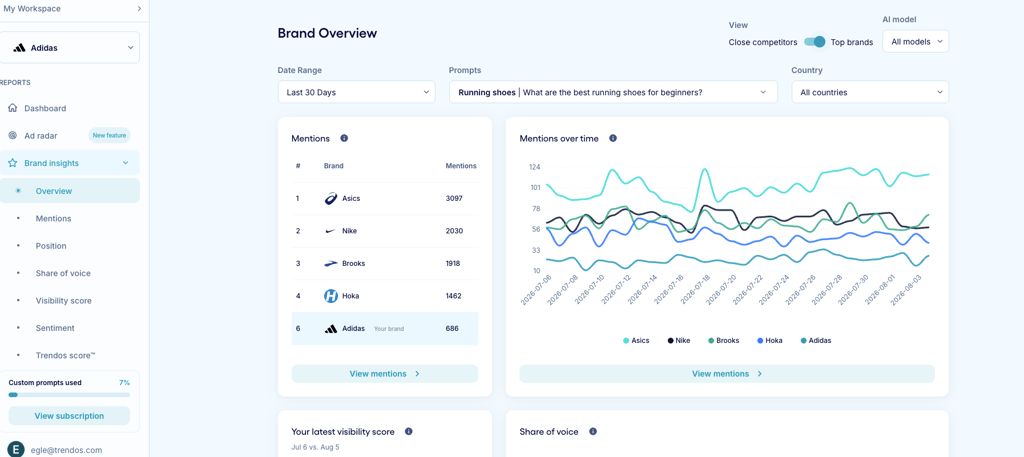
Both platforms track AI visibility, but Trendos stands out in how it collects the data. It sends live prompts to real AI models and analyzes the responses, rather than relying on keyword-based estimates or API proxies. This means the mentions and rankings reflect what users actually see in AI-generated answers.
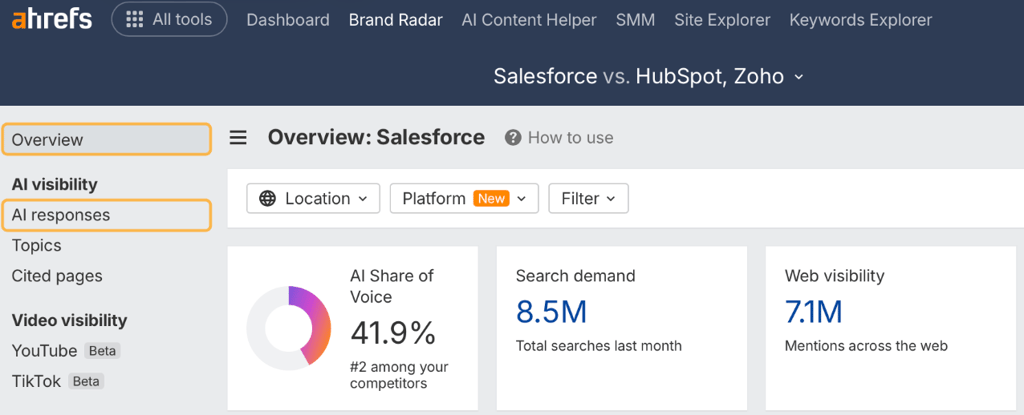
Ahrefs takes a different angle. It layers AI visibility tracking onto an SEO platform most teams are already familiar with, making it easy to connect what's happening in AI search with your broader SEO data without switching between tools.
Dashboards and reporting
Collecting AI visibility data is only useful if teams can quickly understand what it means. Both Trendos and Ahrefs provide reporting features, but they are designed with different priorities in mind.
Trendos goes beyond showing how often your brand appears in AI answers. Its Citations Insights feature shows which sources AI engines use when answering questions in your category, then provides recommendations based on those findings. Instead of leaving you with a visibility score, it gives you a clearer idea of what to improve next.
Ahrefs benefits from its place within the Ahrefs ecosystem. Users can connect AI visibility insights to the SEO data and workflows they already rely on, which is especially useful for teams managing search performance from a single platform.
Workflow and usability
Beyond features and reporting, the way a platform fits into your daily workflow can make a big difference. Trendos and Ahrefs take different approaches: one focuses on dedicated AI visibility management, while the other fits into a broader SEO process.
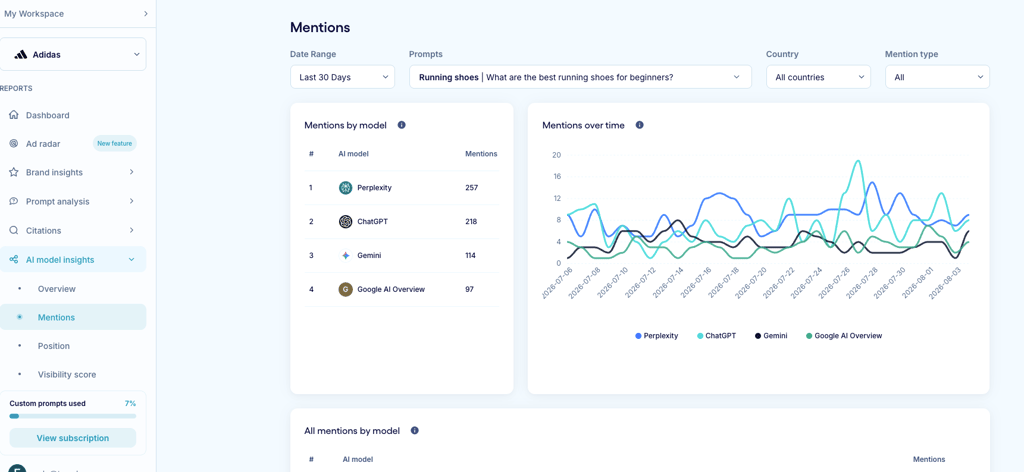
Working with Trendos doesn't take long to figure out. Since the platform is built around AI visibility, users can get straight to the data they need without navigating unrelated features.
Ahrefs works best as part of the larger Ahrefs ecosystem. For teams already using Ahrefs, this creates a smoother workflow by keeping AI visibility insights alongside existing SEO research, competitor analysis, and reporting tools.
SEO integrations and ecosystem
For teams already working with SEO tools, AI visibility is often just one part of a much larger workflow. The ability to connect AI insights with existing search data, research, and reporting can make a big difference.
Trendos works well as a standalone AI visibility platform, but it is not designed to replace a full SEO suite. Its strength lies in helping teams understand their AI search performance, rather than in combining that data with broader SEO research.
Ahrefs has the clear edge here. It sits inside a platform that already handles keyword research, competitor analysis, and backlink tracking, so if your team is already using Ahrefs, adding AI visibility to the mix doesn't mean learning a new tool.

Pricing
The biggest pricing difference comes down to what each platform is actually built for. Trendos focuses purely on AI visibility, while Ahrefs bundles AI tracking into a broader SEO platform.
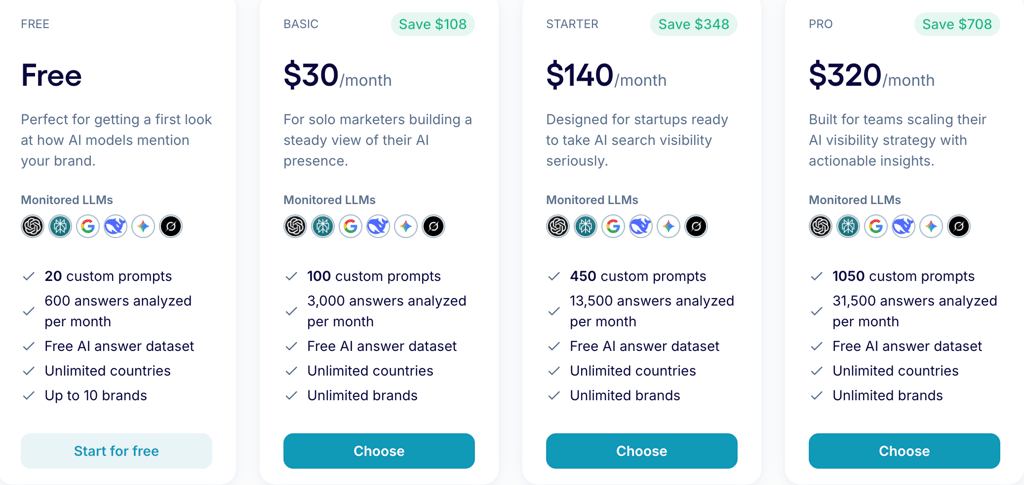
Trendos offers a free plan that includes 20 custom prompts, 10 brands, and access to 6 LLMs, allowing you to test it before committing. The paid plan starts at $30.00/month for teams that need higher limits and additional capabilities.
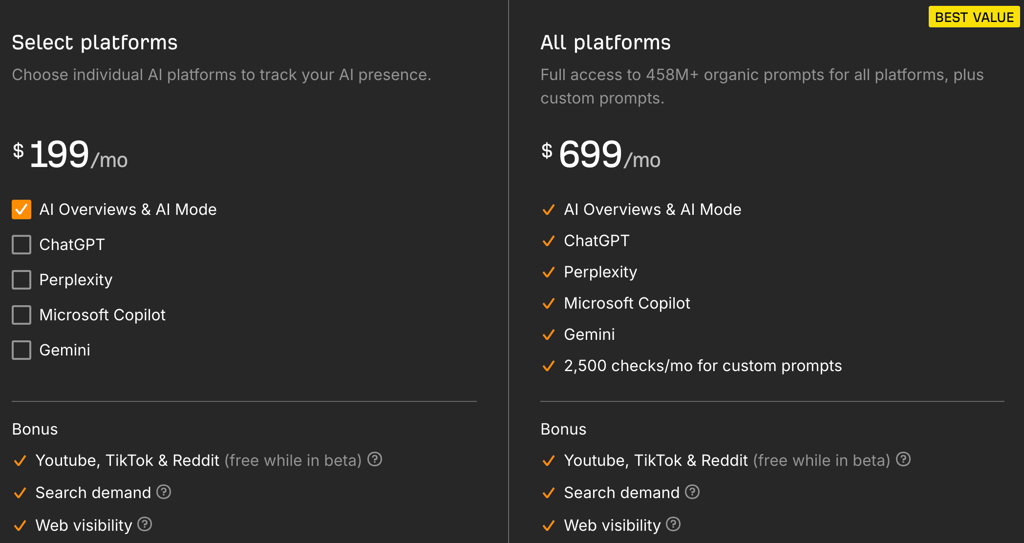
Ahrefs is available on Ahrefs plans starting at $129.00/month, though tracking additional AI answer engines can increase the cost. Monitoring 6 AI engines reaches $699.00/month, which makes sense if you're already using Ahrefs, but is harder to justify if AI visibility is the only thing you need.
Trendos vs Ahrefs: which one should you choose?
Picking between these two comes down to what you actually need them for. Both are solid tools, but they're built with different users in mind.
Go with Trendos if tracking AI visibility is your main goal. It's a good fit for marketers and brand teams who want to know how they show up in AI-generated responses, keep an eye on competitors, and find ways to improve. The whole platform is built around that one problem, which makes it easier to focus on what actually matters.
Go with Ahrefs if you're already using Ahrefs for SEO. It works best for teams that want AI visibility data sitting alongside their keyword research, backlink analysis, and other SEO metrics. It doesn't replace what you're already doing, as it just adds AI insights on top of it.
What’s missing from each tool
Both platforms handle AI visibility well, but their limitations become clearer when you look beyond AI search.
Trendos is built specifically for AI visibility, but it isn't designed to replace a full SEO platform. If your team also relies on keyword research, backlink analysis, site audits, or other traditional SEO capabilities, you'll need to use it alongside another solution.
Ahrefs approaches the problem from the opposite direction. It fits naturally into an established SEO workflow, but its AI visibility capabilities aren't as extensive as those of a dedicated platform. Teams that want deeper AI visibility insights, competitor benchmarking, and a platform centered on AI search may find less comprehensive than Trendos.
Final verdict
After testing both, Trendos is the better fit for teams that are specifically focused on AI visibility. Its focused approach makes it easier to use day-to-day without navigating features outside AI visibility monitoring. Ahrefs makes sense if you're already paying for Ahrefs and want AI insights in the same place, but AI visibility is just one part of a much bigger platform, and that's both its strength and its limitation.
| Feature | Trendos | Ahrefs | Verdict |
| AI visibility monitoring | Trendos is built specifically for AI visibility, while Ahrefs adds AI insights to a broader SEO platform | ||
| Reporting and insights | Trendos provides more focused AI visibility reporting, while Ahrefs connects insights with wider SEO data | ||
| Workflow and usability | Trendos offers a focused workflow, while Ahrefs fits naturally into established SEO processes | ||
| SEO ecosystem | Ahrefs has the advantage thanks to its broader SEO toolkit and integrations | ||
| Pricing | Trendos offers easier entry with a free plan, while Ahrefs can become expensive for AI visibility alone | ||
| Best for | Teams focused on AI visibility | SEO teams already using Ahrefs | Depends on whether AI search or broader SEO capabilities are the priority |
FAQ
Is Trendos better than Ahrefs?
It depends on your goals. Trendos is better suited for teams focused on tracking brand visibility in AI-generated answers. Ahrefs is a better fit for existing Ahrefs users who want to add AI insights to their SEO workflow.
Which is easier to use?
Trendos is easier to get started with because the platform is focused entirely on AI visibility. You can quickly see the data that matters without working through a wider set of SEO features. Ahrefs will feel more familiar to existing Ahrefs users, but new users may need more time to understand where it fits into their workflow.
Which is better for beginners?
Beginners may find Trendos easier to navigate, as it focuses specifically on AI visibility tracking. Ahrefs is aimed more at users who already have an SEO workflow and want to include AI-related data.
Which tool is more affordable?
Trendos is generally the cheaper option, offering a free plan with limited access to its features. Its paid plan starts at $30.00/month, while Ahrefs can cost more for teams tracking multiple AI engines.
How do Trendos and Ahrefs differ?
The main difference is their focus. Trendos concentrates specifically on tracking brand visibility in AI-generated responses. Ahrefs combines AI visibility insights with the wider Ahrefs SEO platform, which may appeal more to teams already using Ahrefs.
Is Ahrefs worth it if I already use Ahrefs?
Yes, Ahrefs can be worth it for teams already using Ahrefs who want AI visibility data without adding another platform. However, businesses focused mainly on AI search monitoring may get more value from a dedicated tool like Trendos.