Gauth AI review
Being behind major reports like The Mother of All Breaches and RockYou2024, our in-house cybersecurity experts and journalists provide unbiased, real-world testing and in-depth analysis.
We maintain complete transparency by openly sharing our testing methodologies with our audience.
Learn more

Gauth AI is an LLM-powered homework assistant that claims to help students actually learn their subjects, rather than simply giving them answers. It offers desktop and mobile apps that let students type their assignments or take a photo of them. Gauth can then either explain the issue or solve the assignment altogether. In case you’re still struggling, Gauth’s Plus plan includes free 24/7 access to human tutors.
But is it as good as its marketing claims? In this Gauth AI study companion review, with the help of the Cybernews research team, I examine how Gauth AI performs in real-world scenarios. I’ll be grading it based on its usability, answer accuracy, and effectiveness in practical use cases. Keep reading to learn more about this learning tool.
Quick overview: who Gauth AI is for
| Rating: | |
| Best for: | Students struggling with traditional learning methods |
| Great for: | Students looking for a supporting learning tool |
| Not great for: | Students above basic college level, students in schools with strict anti-AI policies |
Pros
What is Gauth AI, and how do students actually use it?
Gauth AI is a homework helper app for students. It answers questions that can be either typed in or scanned from a photo you send it. You can then prompt it to give you an answer, guide you step-by-step, or quiz you on the topic.
Gauth AI uses a custom chatbot model that leverages both Gemini and ChatGPT in its workflow to deliver the most accurate answers possible. It offers a browser-based chatbot for desktop devices, as well as apps for iOS and Android.
Students use Gauth in a variety of ways. Some use it to find answers to homework questions, which can be ethically questionable. Others use it for guided learning, where Gauth shows its full potential by not just answering a question, but explaining the answer so that the student can understand and apply the knowledge in the future.
First impressions: setup, interface, and usability
Both the desktop and mobile apps are very easy to use. Since they’re primarily chat-based, I would say that there’s no real learning curve to using Gauth. I didn’t need to customize any settings or turn on any special modes to get what I needed – Gauth gave me the answers based on my prompts.
Gauth AI takes both photo-based and text-based input. So, if you receive a homework assignment via email, you can copy-paste it immediately, but if you have it on paper, you can take a photo and won’t need to bother with typing it up – Gauth will scan it and answer it automatically.
Gauth’s response speed impressed me. The output was near-instantaneous, even for quite complex tasks. If you’re looking for a quick solution, Gauth is definitely handy.
Unfortunately, the Gauth AI free plan is pretty limited. It allows only 11 prompts a day, and also forces some pretty annoying ads. If you’re planning to use Gauth for regular learning, I’d suggest buying its premium version instead.
What Gauth AI does well (core capabilities)
Gauth AI’s core features are well-designed and executed. Here’s a breakdown of what Gauth does well.
Step-by-step math problem solving
I challenged Gauth with difficult SAT-level math questions sourced from PrepScholar. Gauth did an excellent job, answering all three questions correctly and providing thorough explanations for its process. While other users often pointed to advanced calculus, sometimes stumping Gauth, I haven’t noticed such an issue when testing.
Multi-subject homework support
To test out Gauth’s multi-subject homework capabilities, I decided to ask it something I had some knowledge of from my school days – namely, Shakespeare. I asked it to break down Claudius’ soliloquy from the first act of Hamlet, and I must say, I was quite impressed. The breakdown featured correct information and covered the subject in detail.
I also tested its niche social-science capabilities by asking it for the details of Poland’s parliamentary system. It answered the question correctly, though it needed some additional prompting to provide a detailed answer.
AI explanations vs final answers
Gauth doesn’t just answer questions. It can also give you detailed explanations of various concepts. When I asked it to prepare an essay for me in its basic chat mode, it didn’t write an essay. Instead, it gave me an outline with a detailed explanation of what each paragraph should contain.
Gauth also offers an instant solver mode that simply provides the best submission-ready answer it can generate. While very effective, this will likely lead to your homework being flagged and potentially get you penalized in school. I would really suggest avoiding this approach whenever possible.
Image recognition and OCR accuracy
When testing Gauth, I gave it several handwritten notes and tasks. It never had any major trouble translating my writing into digital text. This included simple sentences and mathematical equations, and was pretty impressive and helpful.
Accuracy and reliability: what happens with harder questions?
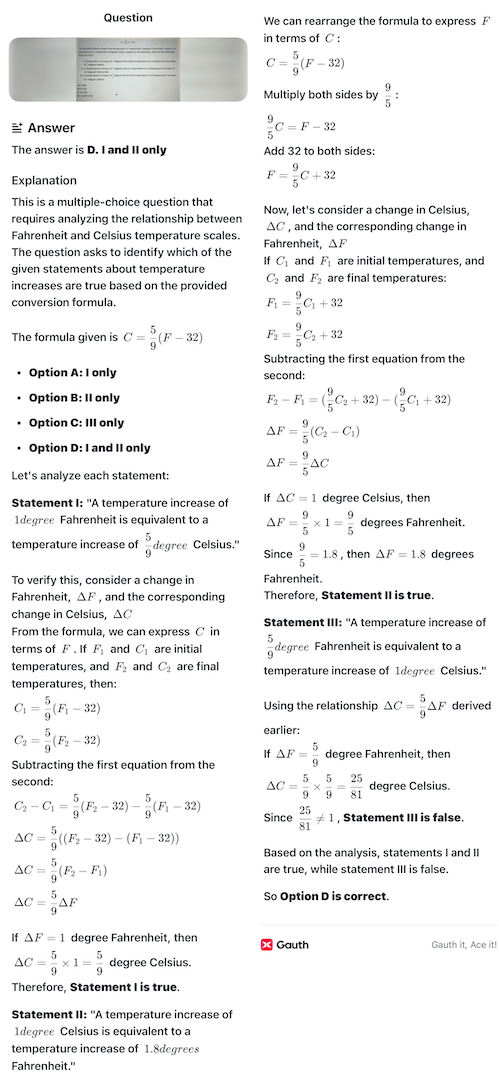
To test Gauth’s accuracy, I asked it a difficult SAT-level question:
C=(5/9)(F−32)
The equation above shows how temperature F, measured in degrees Fahrenheit, relates to a temperature C, measured in degrees Celsius. Based on the equation, which of the following must be true?
I. A temperature increase of 1 degree Fahrenheit is equivalent to a temperature increase of 59 degree Celsius.
II. A temperature increase of 1 degree Celsius is equivalent to a temperature increase of 1.8 degrees Fahrenheit.
III. A temperature increase of 59 degree Fahrenheit is equivalent to a temperature increase of 1 degree Celsius.
A) I only B) II only C) III only D) I and II only
Gauth answered correctly and gave a step-by-step breakdown of why it answered the way it did. If I were asked by a teacher why I made the choice I made, I could easily use the knowledge Gauth provided to show actual understanding of the issue. The example also made it easy to see what’s going on.
To further see Gauth’s answering performance, I looked at how it answers vague questions. I started by asking two questions lacking some key information:
- "A car is driving to another city. How long will it take to arrive?”
- "An object falls from a building. What is its velocity?"
In the past, many LLMs would start hallucinating answers. In this case, Gauth asked for clarification, rather than just guessing. This is a very good indicator, as a hallucinated answer could impact a student’s knowledge.
While some users on Reddit did point to Gauth struggling with advanced math in the past, I’m honestly just not knowledgeable enough in the field to find a question that would stump Gauth. When testing the product, I hadn’t experienced any hallucinations or wrong answers.
Pros, drawbacks, and academic concerns
Like any piece of software, Gauth AI has its pros and cons. In this section of my Gauth AI app review, I’ll break down what Gauth excels at and where it doesn’t.
Gauth’s strengths include:
- Fast homework help. Gauth provides near-instant homework answers, helping students complete their assignments while getting information that will help them understand more about the assigned subject.
- Clear step-by-step explanations. Gauth doesn’t just give answers. It explains its thinking step-by-step, allowing students to gain an understanding of not just what the answer is, but also why it is what it is.
- Accessibility. Gauth is easy to use, working as a conversational chat. It doesn’t require advanced prompting knowledge, and it easily scans even handwritten assignments.
Gauth also has its drawbacks:
- Risk of overreliance. While Gauth provides step-by-step explanations, it’s possible that students will become overreliant on its solutions, failing to learn and just copy-pasting them.
- Accuracy issues with complex problems. The more advanced the task in question, the more likely it is that Gauth will hallucinate part of the answer.
- Academic concerns. Most academic institutions have strict regulations regarding the use of AI in tasks. Should Gauth be detected, students can get in trouble and face severe penalties, especially when using the assignment-solving mode.
Pricing model and value for students
Gauth offers a single Plus plan, which gives students access to unlimited answers and 1500 credits for the assignment solver, which should be enough for around 30 tasks. Here’s a comparison of the free and paid plans:
| Feature | Gauth Free | Gauth Plus |
| Cost | Free | From $8.33/month |
| Answer limit | Limited – 11 questions a day | Unlimited |
| Assignment solver credits | None | 1500/month (around 30 tasks) |
| Solution detail | Basic answers | Detailed step-by-step guides |
| Tutor access | Must be purchased | 24/7 human tutors |
| AI model | Standard AI | Super Gauth AI – better for complex tasks |
| Speed | May slow down in peak times | Priority in peak times |
| Ads | ✅ Yes | ❌ No |
| Video explanations | Limited | Access to 20M+ videos |
In case you want to try out the Paid plan, Gauth offers a 3-day free trial. If you want to purchase the Plus plan, it is offered in three different term lengths. Here’s a price breakdown:
| Term length | 1 month | 3 months | 1 year |
| Total price | $11.99 | $31.99 | $99.99 |
| Price per month | $11.99 | $10.66 | $8.33 |
Gauth’s price point is definitely fair, given that in the US, a tutor usually charges upward of $40.00/hour for an in-person session. That’s over four times the price of Gauth with a yearly subscription.
Gauth AI vs other AI homework tools
Gauth isn’t the only tool of its kind on the market. For math assistants, tools like Photomath and Wolfram Alpha are excellent for solving equations, but not great teaching tools. In general, Photomath is simpler compared to Gauth, while Wolfram Alpha is far more powerful.
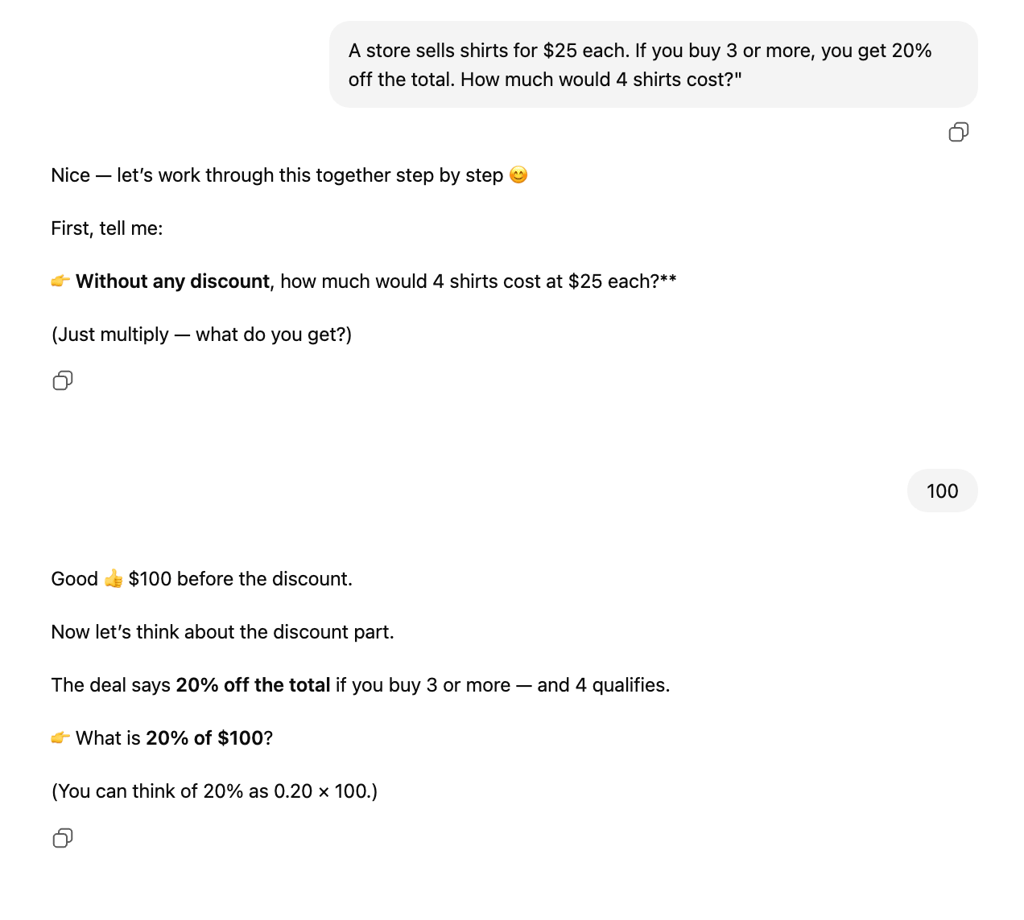
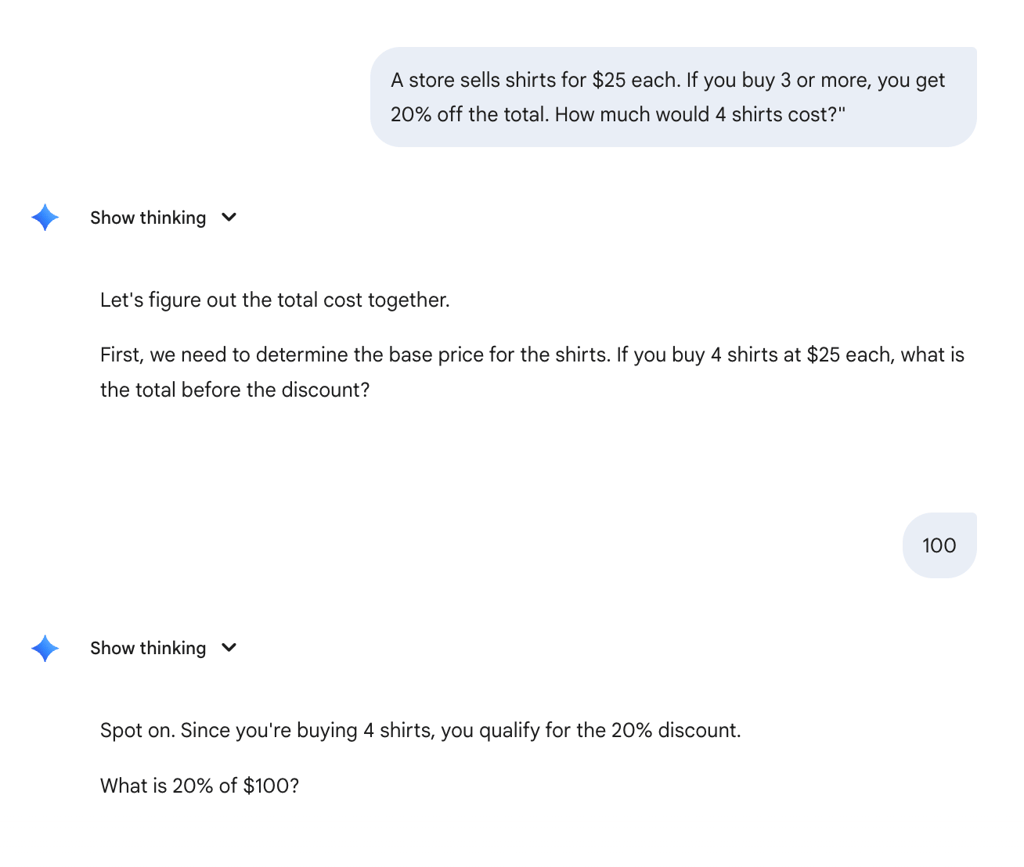
But to give you a comparison of the most similar AI tools, I took a look at ChatGPT and Gemini, as both offer study modes of their own. I asked Gauth and the two top LLMs the same question, setting ChatGPT to Study mode and Gemini to Guided Learning mode.
The question was pretty simple:
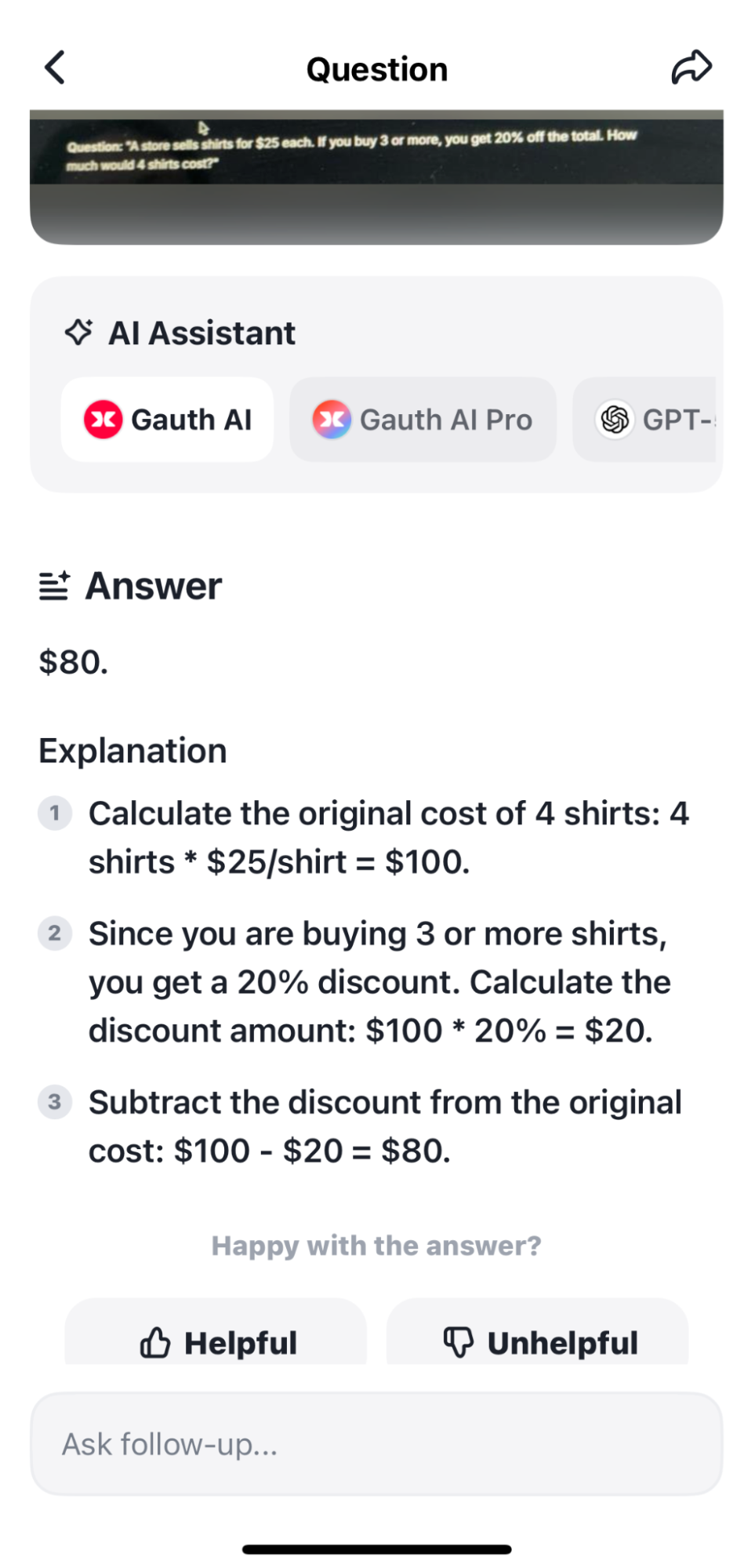
A store sells shirts for $25 each. If you buy 3 or more, you get 20% off the total. How much would 4 shirts cost?
All three apps answered my question correctly, of course. However, ChatGPT and Gemini asked me to solve it myself, asking me guiding questions, while Gauth simply broke down its calculations.
In general, asking students questions is better for reinforcing learning than just spitting out answers. Of course, you can ask Gauth to do the same for you, but that requires a specific prompt, rather than clicking a simple mode switch.
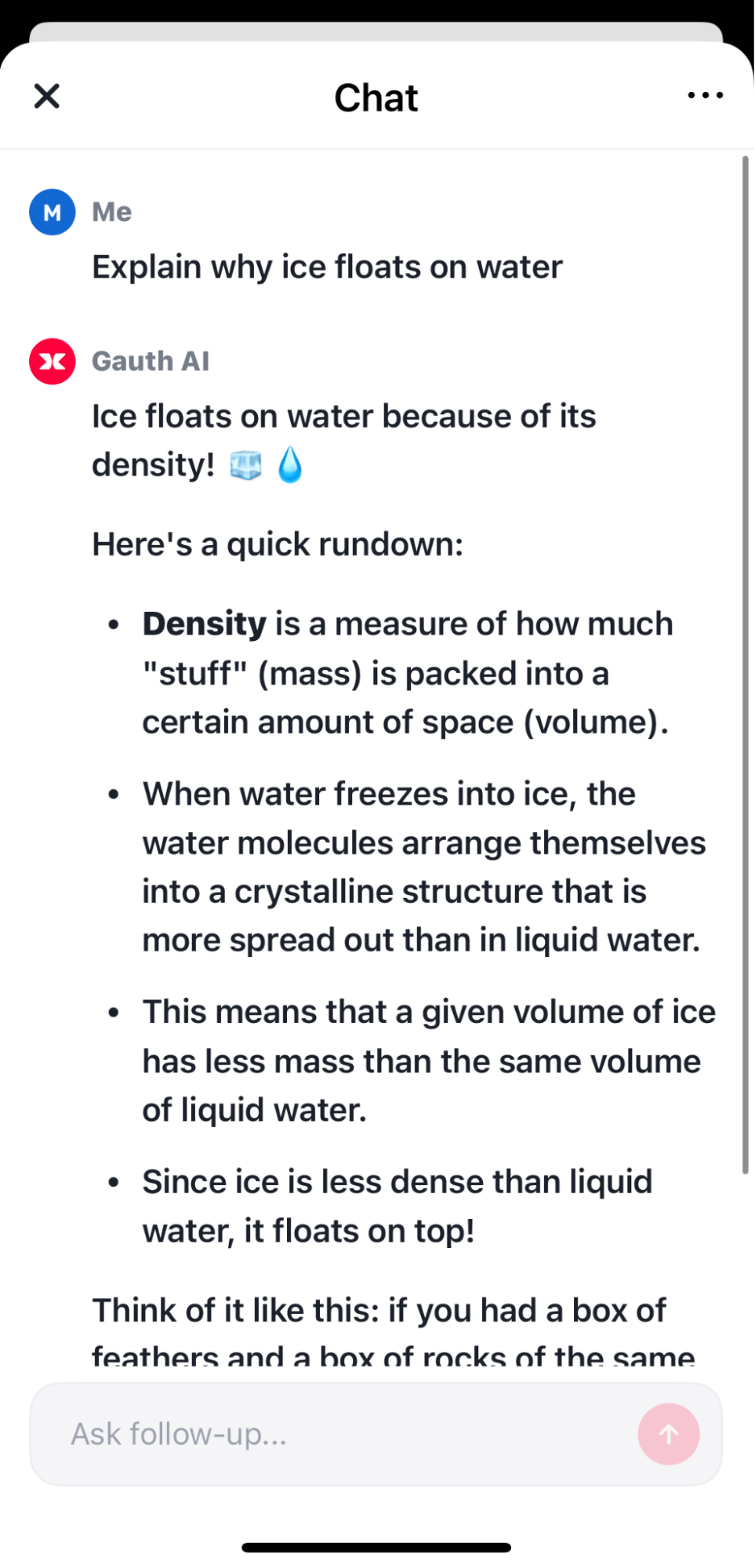
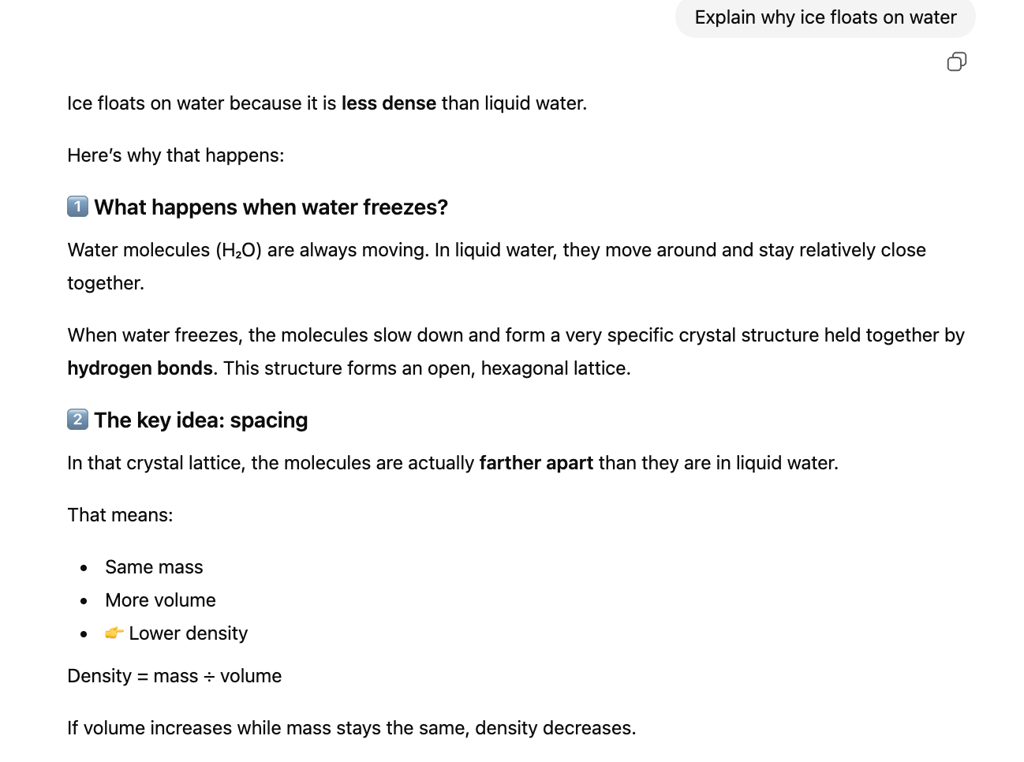
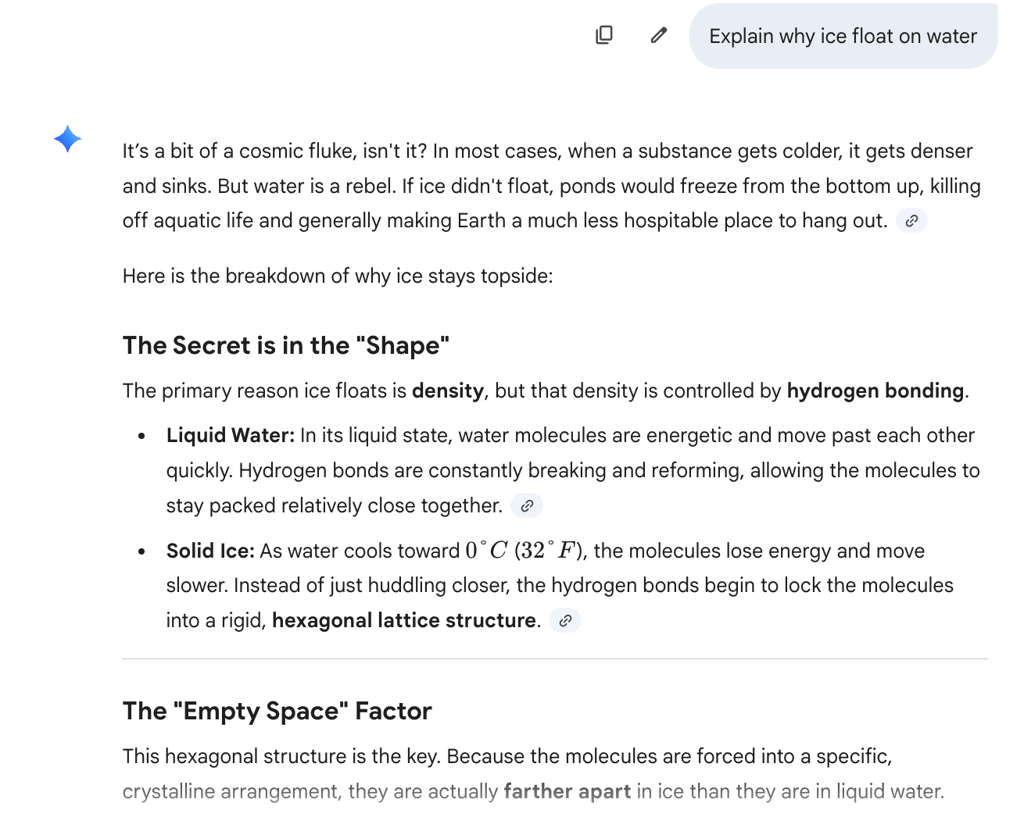
To test how these models teach about more complex topics, I asked a deceptively simple question: “Explain why ice floats on water.”
When it came to explaining the intricacies of ice, Gauth’s explanation was by far the simplest to understand. It avoided complex wording, while still going in-depth and using emojis to reinforce its contents. For the two chatbots, I set their regular fast modes, rather than learning-specific options.
Gemini’s was similar but a bit too wordy for my liking, while ChatGPT gave a pretty straightforward answer. What I liked about Gauth in particular was that it also explained simple concepts, like density, to ensure that the student understands the exact basic physics that have to do with ice floating.
Who should use Gauth AI
Gauth AI is an excellent choice for students who struggle to learn from traditional resources like books and lectures. It will explain concepts while also solving monotonous homework tasks. In case you need a more personal touch, Gauth also gives you access to a human tutor.
However, I wouldn’t use Gauth if you struggle with procrastination. While it will solve your homework, it’s likely you won’t read its explanation, which teachers can then easily detect by quizzing you live. I also would avoid using it to complete larger assignments, as teachers have ways of detecting AI use and may fail you on the spot – oftentimes also getting you into further trouble, depending on your school’s approach to AI.
Finally, users online report that Gauth can struggle with advanced concepts. While I wasn’t able to find a particular example, I’d avoid using it above the undergraduate level, where the answers can start being too basic and inaccurate for Gauth to be a reliable option.
Is Gauth AI worth it in 2026?
I would say that Gauth AI is worth it as a pure learning tool. It’s cheaper than ChatGPT and Gemini, while offering similar-quality teaching resources, and giving access to human tutors with its Plus plan. However, if you don’t need tutor access or use a chatbot anyway, ChatGPT and Gemini’s learning modes can provide very similar quality to Gauth, especially with a few prompt adjustments.
Note that I wouldn’t recommend using Gauth AI to solve assignments. This will eventually be detected and will likely lead to serious consequences, depending on your school’s AI policy. So, if you’re looking for a tool that will just write your homework for you, Gauth AI definitely isn’t worth the risk.
FAQ
Is Gauth AI free?
Yes, Gauth AI offers a limited free plan, which gives you 11 prompts a day.
Can teachers detect Gauth AI usage?
Yes, teachers can detect Gauth AI usage. By using a combination of AI detectors and intuition, it’s unlikely they’ll miss you using AI. In that context, Gauth should be used as an assisting tool, rather than a homework solver.
Is Gauth AI accurate?
Yes, Gauth AI is generally accurate. However, it can struggle with more advanced concepts, leading to hallucinations.
Is Gauth AI safe for students?
Yes, Gauth AI is safe for students, as long as it’s used appropriately. Using it to simply generate assignments and homework answers is likely to result in trouble at school.