The US job market is ignoring AI: lawyers, engineers, and other pros are in high demand
Brutal tech layoffs were announced in January, spearheaded by Amazon’s 16,000-job cut. The headlines write themselves: AI is displacing white-collar workers. Yet, many industries in the US that are supposed to shrink under AI pressure just keep adding jobs, despite other economic and geopolitical uncertainties.

Image by Cybernews

 Follow us
Brutal tech layoffs were announced in January, spearheaded by Amazon’s 16,000-job cut. The headlines write themselves: AI is displacing white-collar workers. Yet, many industries in the US that are supposed to shrink under AI pressure just keep adding jobs, despite other economic and geopolitical uncertainties.
- Since the release of ChatGPT, the overall US job market has increased by 1.1% over three years, showing no major upheaval, and many firms are hiring more professionals than ever before.
- Newspaper and periodical publishers shed 16-22% of their workforces and even sharper declines were seen in highly automatable roles like telemarketing, contact centers, and temporary jobs, which might suggest a more recent impact.
- Young people are at a higher risk of being outcompeted by AI.
Plenty of data points that fit the popular narrative of AI replacing jobs.
Amazon, ASML, Meta, Ericsson, Autodesk, and other major tech companies laid off around 25,000 employees in January, according to the layoffs.fyi tracker. Artificial intelligence (AI) is often cited as the major driver.
“Employment in information continued to trend down in February (-11,000). The industry had lost an average of 5,000 jobs per month over the prior 12 months,” the latest report by the US Bureau of Labor Statistics (BLS) confirmed.






However, even more data suggests completely the opposite.
Over three years into the ChatGPT era, companies are still hiring more professionals that the technology is supposed to displace and firing factory workers, whose jobs were considered safe from AI.






Is AI starting to hurt?
ChatGPT launched in November 2022, when the US had 155.5 million people employed.
By February 2026, the US had 157.3 million non-farm employees – a 1.1% increase. Clearly, AI hasn’t caused a major upheaval in the overall job market yet.
Major sectors paint a similar, counterintuitive picture, defying expectations about AI's impact on desk jobs.
The number of goods-producing workers decreased by 324,000, while the service-providing workforce grew by 2.1 million. Both moved roughly 1.5% in opposite directions.

The first early signals of potential AI disruption appear in the industry-level data.
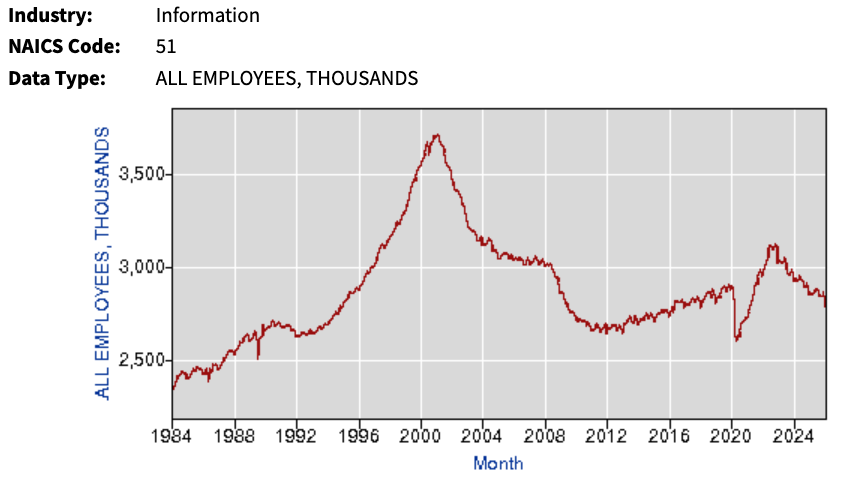
The information sector suffered the sharpest contraction of 332,000 jobs, or 10.6% of the total workforce, outpacing mining and logging, which lost 5.3% or 33,000 jobs.
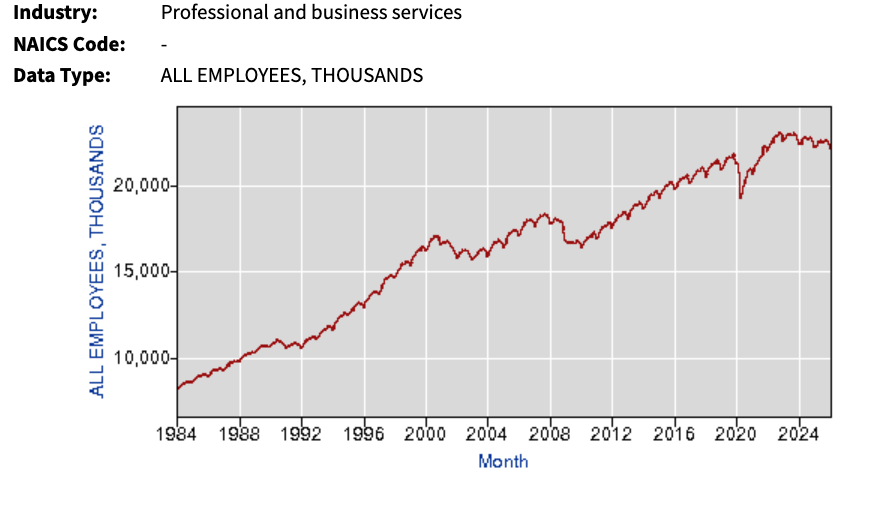
The professional and business services industry, which hires lawyers, accountants, marketers, etc., shed the most employees – 866,000. The government added the most – 763,000. The shifts remain modest compared to disruptions caused by the coronavirus pandemic or by previous disruptions such as the dot.com bubble.
And they don’t confirm direct AI impact yet – the picture becomes fuzzy again when looking deeper into specialization.
Law, tax, and software firms are hiring more people
Over 2.8 million people continue to work in the shrinking information industry. Who gets hired or fired?
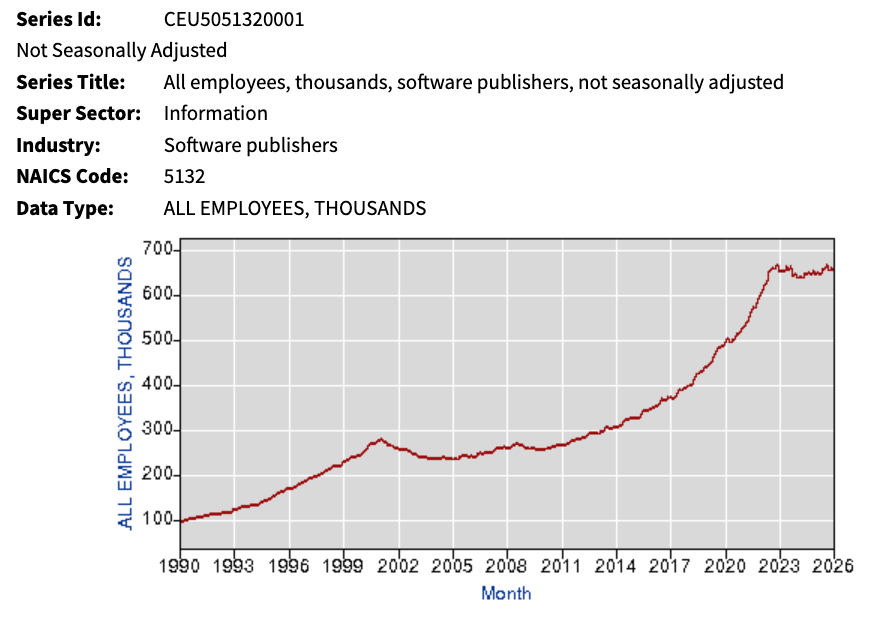
AI is supposed to decimate programmer jobs, but in January, software publishers employed 1.35% more people than a year ago. Before ChatGPT’s arrival, especially during the COVID pandemic, software companies had been growing rapidly, but later the number of employees remained stable near an all-time high.
Media streaming distribution services, social networks, and other content providers have slimmed by 3.4% since November 2022.
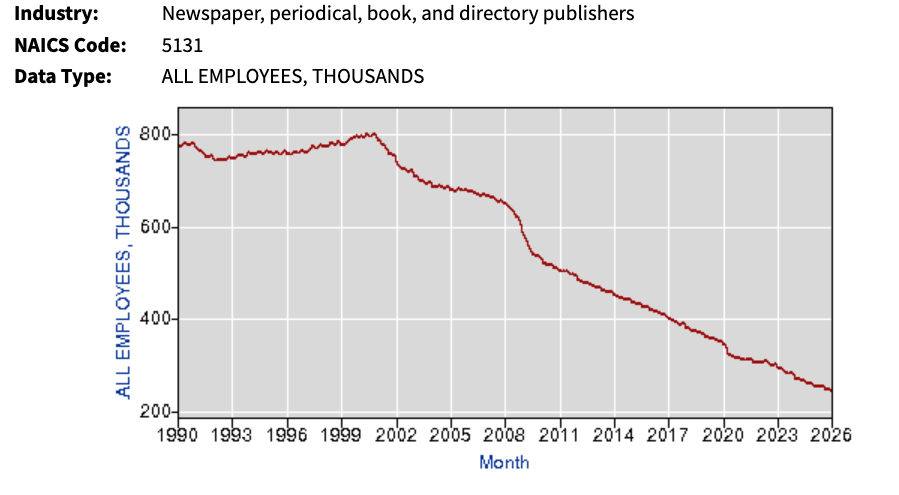
Traditional broadcasters and periodical publishers contributed most to the decline – this trend began long before the large language models (LLMs).
Motion picture and video production companies were hit the hardest – they had 40% fewer employees than the month ChatGPT was released.
Newspaper and periodical publishers shed 22% and 16% of their workforces respectively, a stable trend since the start of the millennium.
Telecoms decreased their headcounts by 12.6% and their partners (resellers) by 16%.
Web search portals and all other information services have 8% fewer employees.
Lawyers, accountants, engineers, designers, software developers, PR, marketing, and other “white-collar” professionals are mostly employed in another shrinking industry – professional and business services. These jobs are widely considered to be highly exposed to AI displacement.
In February, the whole industry employed 22.133 million people, 0.2% less than a year ago.
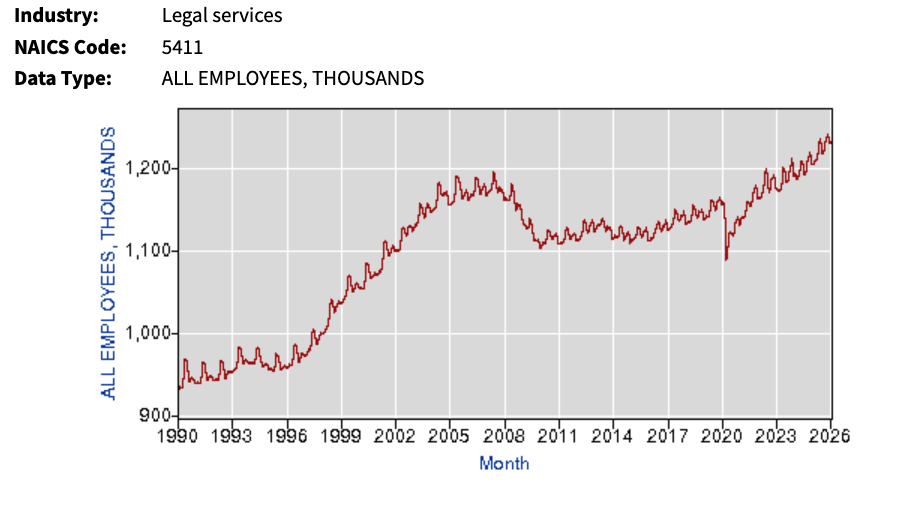
However, the legal services industry has 3.6% more jobs since ChatGPT was introduced. By headcount, the industry is larger than it has ever been.
Accountants are currently up 4% due to seasonal fluctuations – the seasonally adjusted data shows that their ranks remained relatively stable.
Translation, interpretation, and all other professional, scientific, and technical services report a counterintuitive 12% jump since the launch of ChatGPT.
Engineering and drafting services reported the largest increase of 110,000 workers, or 9.9%.
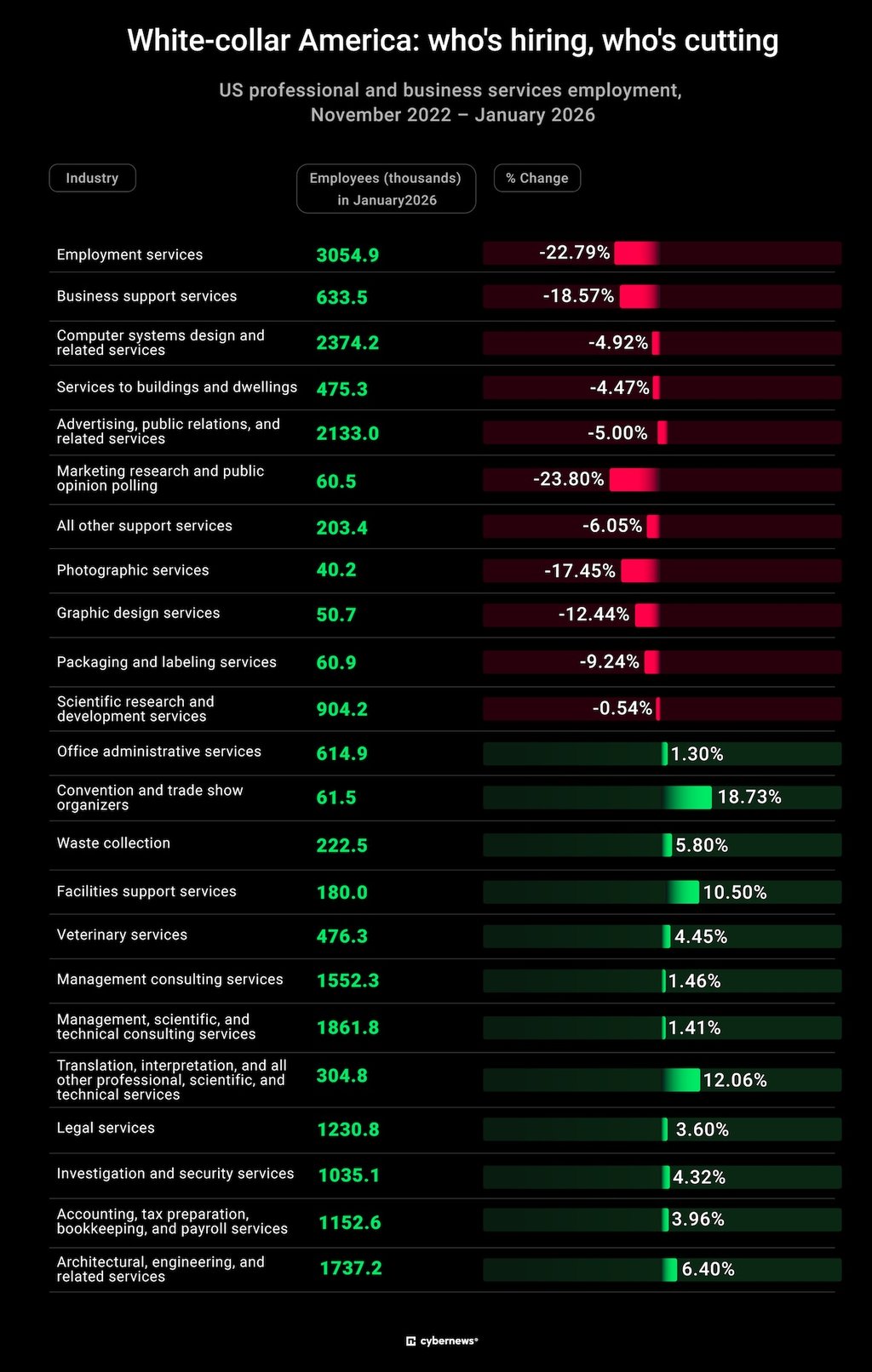
Management consulting services, covering administrative management, human resources, marketing, and other consulting services, also remained stable with 1.46% more employees compared to November 2022.
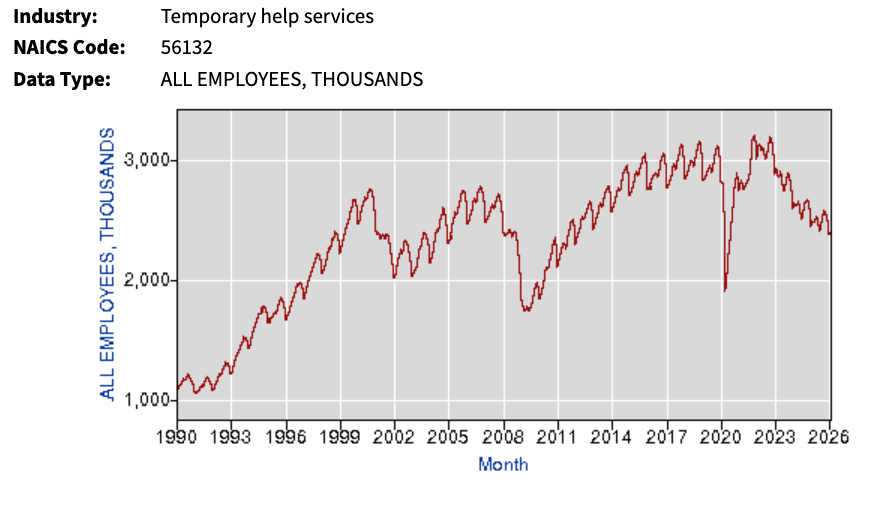
Most people – 793,000, or 25% – left Temporary help services, which supply workers to other companies on a short-term basis. This says more about the economy than about AI. Temporary workers are a closely watched leading indicator – it signals whether the companies are uncertain about the future, because they cut temporary workers first.
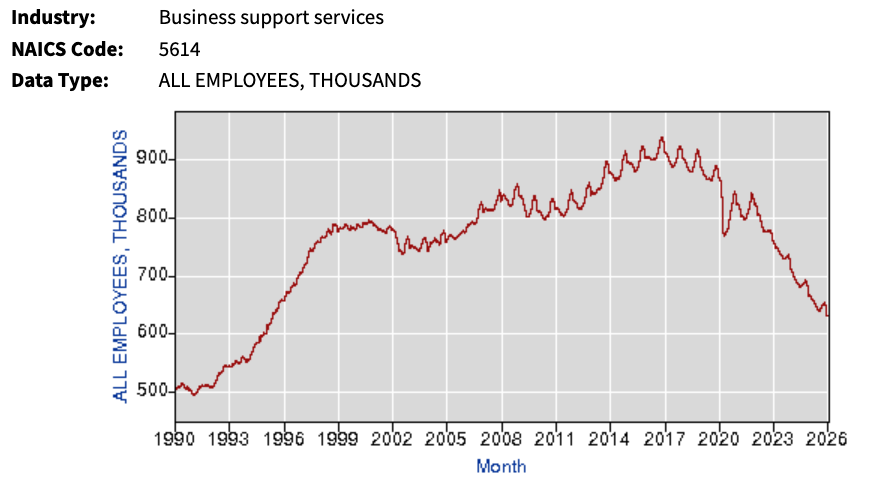
The steepest job declines have been concentrated in the business support services, such as telephone call centers (minus 27%, or 316,500 employees), telemarketing bureaus and other contact centers (minus 30%, or 120,000 employees). The trend of automation and offshoring also began before ChatGPT.
BLS data shows that the fastest-declining occupations in 2024 included typists, telephone operators, switchboard operators, telemarketers, and other professions that are easy to automate.
More people quit jobs than are fired
In the shrinking information industry, 89,000 people said farewell this January alone, when major tech firms announced layoffs. However, 90,000 people were hired in the same month, in the same industry, according to the latest data by the BLS.
Layoffs and other discharges only affected 42,000, less than half of the total separations. Over 42,000 people quit themselves.
The unemployment rate in the information industry is 4.4%, which is 1 percentage point lower than 5.4% a year ago and below the national average of 4.7% (16 years and over).
Contrary to the overall economy, job openings in the information sector rose year-over-year, and available positions outnumbered unemployed professionals.
The professional and business services industry has an unemployment rate of 5%, which decreased by 0.3 percentage points year-over-year, but remains slightly above the national average.
In January, 968,000 people in the industry said goodbye to their jobs: the proportion of layoffs and quits was 397,000 and 478,000, respectively. More people, 982,000, were hired.
The past data doesn’t predict the future – it only shows that AI hasn’t caused a major impact on the job market yet.
A warning sign for young workers
Anthropic, a major AI development company, recently confirmed that there was no clear impact on unemployment rates for workers in the most exposed occupations.
Humans, rather than AI, still do most of the work.
“We find no systematic increase in unemployment for highly exposed workers since late 2022, though we find suggestive evidence that hiring of younger workers has slowed in exposed occupations,” the company said in a report.
Anthropic considers a job as “exposed” when AI can theoretically speed it up or automate. Computer programmers, customer service representatives, and data entry keyers top the list.
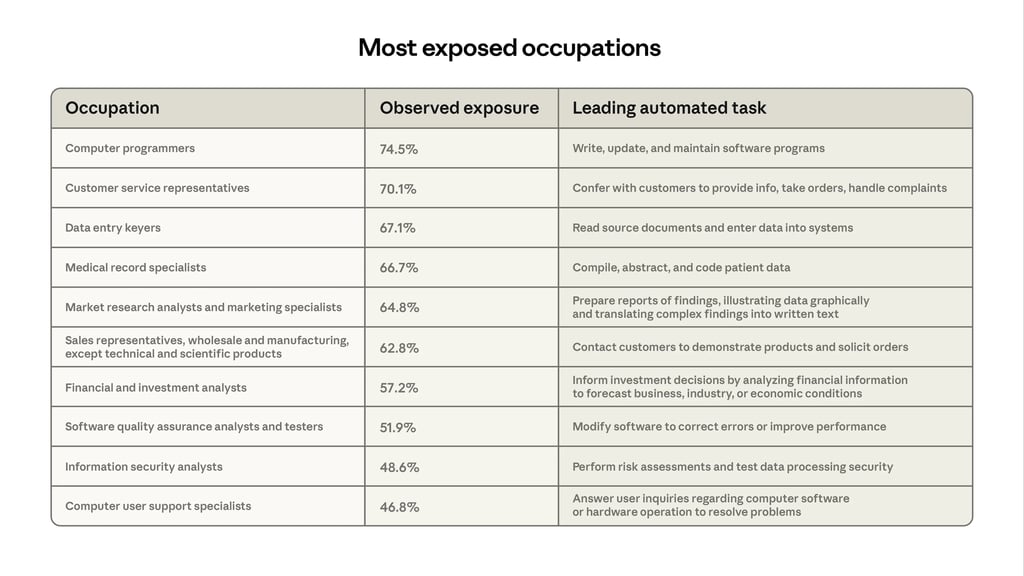
The company, however, argues that AI is far from reaching its true potential, or “its theoretical capacity.”
We’re only seeing a fraction of what's feasible.
Unlock more exclusive Cybernews content on YouTube.