Workers increasingly fear exposure to AI: time for new approach?
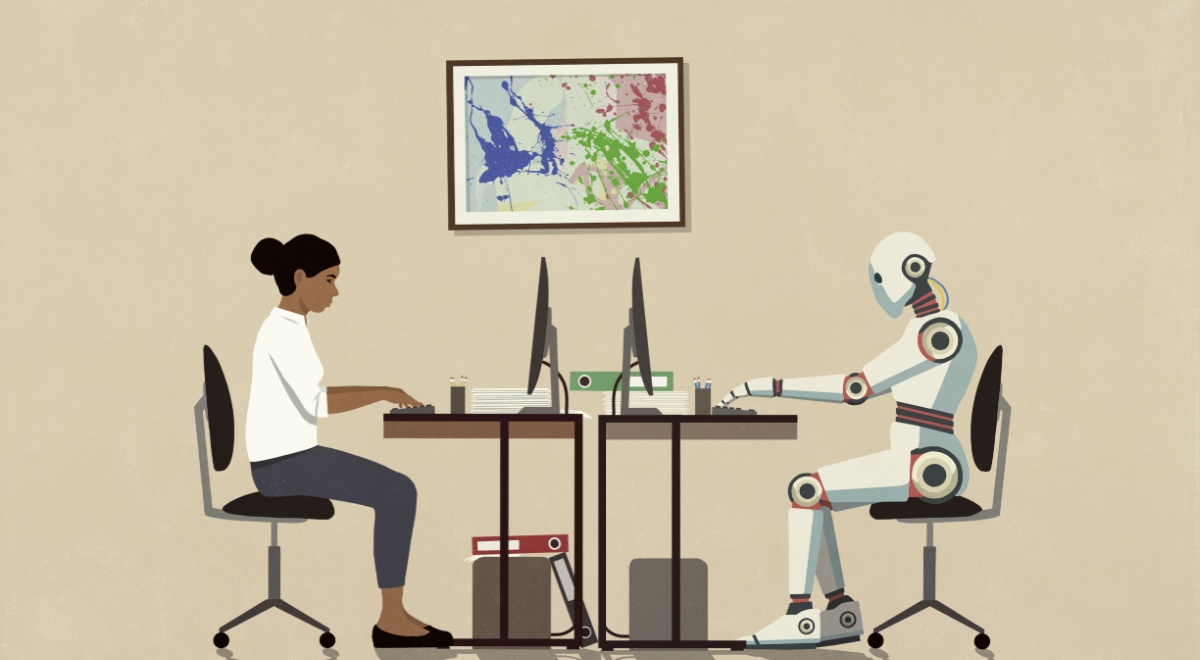
Surveys keep showing a rising number of workers worried about the possibility that artificial intelligence will replace them. To some, that’s practically unavoidable but activists and at least some experts say governments need to be more pro-active in protecting labor rights.
Malte Mueller/Getty Images

 Follow us
Surveys keep showing a rising number of workers worried about the possibility that artificial intelligence (AI) will replace them. To some, that’s practically unavoidable, but activists and at least some experts say governments need to be more proactive in protecting labor rights.
Search for “AI” and “jobs” on the web, and you’ll see that multiple analyses about the situation have already been published in recent years.
You’ll also see that the conclusions are grimmer each time because the AI boom is going nowhere. On the contrary, even if generative AI doesn’t really generate much revenue, businesses are ever more keen to speak about how they’re implementing the technology.




Unsurprisingly, workers don’t really hold much hope for the future. People aren’t stupid and can hear the canaries in the coal mine perfectly well.






Worries about AI are everywhere
Just this week, Stanford researchers found that employment for younger workers (ages 22-25) in AI-impacted jobs — like software development and customer support — has dropped by 16% since late 2022.
“There's definitely evidence that AI is beginning to have a big effect,” economist and Stanford professor Erik Brynjolfsson told Axios. “This is the fastest, broadest change that I've seen.”
Large employers, especially in the technology industry, have indeed said in recent months that advances in AI could lead them to cut jobs. Microsoft saved over $500 million last year in its call centers alone.
In Germany, a fresh YouGov survey has shown that 34% of respondents are worried about AI replacing them at work, especially since a separate poll in June found that more than a quarter of German firms actually anticipate to shed jobs thanks to AI in the next five years.

Finally, in the United Kingdom, half of adults polled for the Trades Union Congress (TUC) said they were concerned about the impact of AI on their job.
The TUC is calling on the government to involve workers and trade unions in AI as it is rolled out across workplaces, in order to protect jobs and provide training to people whose roles are replaced by AI.
“AI could have transformative potential, and if developed properly, workers can benefit from the productivity gains this technology may bring,” said the TUC’s assistant general secretary Kate Bell.
“The alternative is bleak. Left unmanaged and in the wrong hands, the AI revolution could entrench rampant inequality as jobs are degraded or displaced, and shareholders get richer.”
There are more signs that all isn’t well. Apparently, employees aren’t at all against upskilling but the opportunities to learn are actually quite scarce.
Left unmanaged and in the wrong hands, the AI revolution could entrench rampant inequality as jobs are degraded or displaced, and shareholders get richer.Kate Bell.
Data from Hays, a recruitment and workforce solutions consultancy, recently showed that globally, 89% of employees are willing to upskill in AI, yet only 51% of employers offer training. What’s going on?
Are business owners actually clueless?
According to Aaron Whittaker, VP of Demand Generation at web marketing agency Thrive, AI is already giving inequality — already rampant — a boost.
“We are already seeing the rise of that inequality as major corporations use AI to automate away middle-class jobs, with executives and investors pocketing the productivity gains,” Whittaker told Cybernews.
Other companies are simply using AI to make staff redundant, as opposed to empowering staff to better serve the client. For example, TikTok is planning to replace hundreds of content moderators in the UK with AI automation.
Unfortunately (but probably unsurprisingly), business executives have become astonishingly comfortable sharing their hopes that AI will soon make human labor a thing of the past while any worker pushback — entirely legitimate in a fair world — is dealt with ruthlessly.

Eric Vaughan, CEO of a $26 million software firm called IgniteTech, fired 80% of his staff because they simply didn’t share his enthusiasm for AI, according to Fortune. The firm’s profits increased, of course: to leaders like Vaughan, that’s the bottom line.
“This trend sets a dangerous precedent in which advances in technology privilege capital over labor, and creates risk of replacing the people who actually have the expertise and relationships necessary for business success,” said Whittaker.
“The prevailing AI implementations are designed to maximize shareholder value, not promote shared prosperity for workers, communities, and society.”
AI is nowhere near perfect but it is a good excuse for higher-ups to use this as a reason to 'cut costs.’Reddit user.
The mood around Reddit is similar. The platform is full of stories by professionals who feel they’re being slowly but surely pushed out of the market because the managerial class has already embraced AI as a sort of cash-saving deity.
One user said: “AI is nowhere near perfect but it is a good excuse for higher-ups to use this as a reason to 'cut costs.’” Another immediately replied: “And it'll be up to the human staff to pick up the slack because the owners are clueless about what AI can do effectively — which is not a lot.”
The trap of algorithmic capital
Of course, numerous studies also show that AI, while transformative to the global labor market, boosts wages for those who embrace it and actually creates new jobs.
According to a recent talent survey from the non-profit Linux Foundation, the future might be bright as respondents were four times as likely to say that AI is increasing software development jobs rather than decreasing them.
Still, it’d probably be smart for the governments to at least try to be proactive and steer the emerging AI industry towards actually helping the people out, Thrive’s Whittaker told Cybernews.
“An effective policy would mean both government action and a strong worker voice to ensure that AI development promotes human flourishing rather than simply increasing the return to corporate shareholders,” he said.
Whittaker envisions compulsory worker representation in AI decisions, government-funded retraining initiatives, and policies to ensure that the productivity gains from AI are not captured only by technology owners but spread across communities.
“Without systemic interventions to protect workers and promote the public interest, AI is almost certainly going to increase inequality, shifting wealth from human labor to algorithmic capital,” he told Cybernews.
At least in the UK, the TUC has now published a report titled “Building a Pro-Worker AI Innovation Strategy” (PDF) and is calling for conditions to be attached to the billions of pounds of public money being spent on AI research and development, to ensure workers are not replaced by new technologies.
