Flashback: these are the top 5 viruses that bugged us in the eighties
The eighties brought us the first video game consoles, Air Jordans, and the beginning of the end of the Cold War. But it also brought us some of the first-ever bugs, malware, and viruses which – when you think about it – kicked off the industry we know today as cybersecurity.

Image by Cybernews.

 Follow us
The eighties brought us the first video game consoles, Air Jordans, and the beginning of the end of the Cold War. But it also brought us some of the first-ever bugs, malware, and viruses which – when you think about it – kicked off the industry we know today as cybersecurity.
Back then, it was really simple. Computer viruses were quite primitive, created to infect certain files or a network router’s hard drive and then replicate themselves.
Some were harmless, some did some light damage, and some were on a mission to destroy things – and did. Here are five of the most interesting and destructive viruses of that particular decade.
1. The Elk Cloner Virus (1982)
Elk Cloner was one of the first known microcomputer viruses that spread “in the wild,” outside the computer system or laboratory in which it was written. Pretty good for a virus, actually developed as a high school prank, isn’t it?





This is how it played out. In 1982, 15-year-old Rich Skrenda decided to pull a prank on his Pennsylvania pals with whom he was exchanging pirated copies of video games via floppy disk.
Rich altered a few disks with his self-made “booby traps,” and when his friends would pop them into their Apple II home computer, a goofy poem would appear.
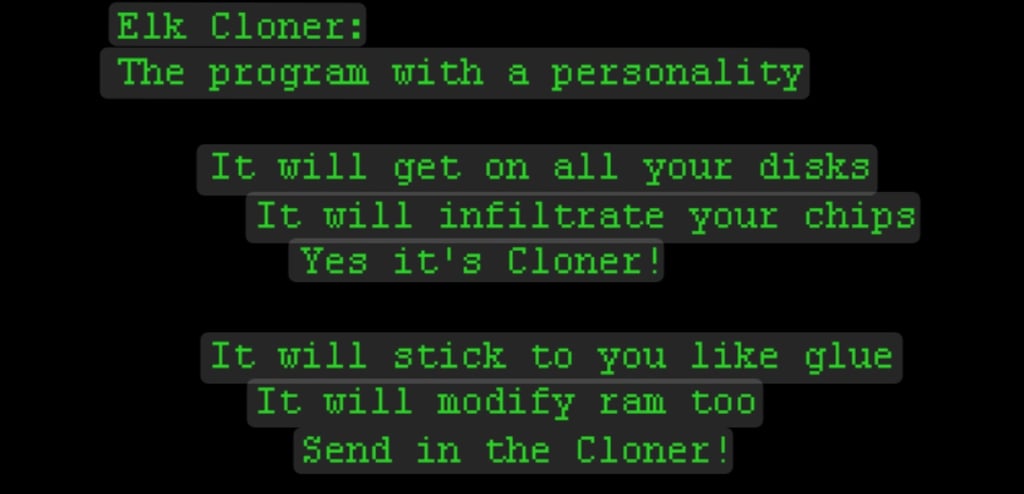
He then realized he could fudge with floppies without even touching them and, as a result, created a program that would hop from disk to disk and from machine to machine, replicating and waiting for a certain code to awaken it from its slumber.
The Elk Cloner, naturally, spread almost like wildfire across the US but was relatively harmless. Furthermore, once Elk Cloner was removed, the previously infected disk would not be reinfected since it already contained the Elk Cloner “signature” in its directory.
2. The Ping-Pong Virus (1988)
In 1988, a playful bug dubbed the “Ping-Pong Virus” was discovered at the University of Turin in Italy. A tiny white ball would begin bouncing all over your screen, touching all four corners.
Sure, rebooting the computer would get the ball to disappear, but eventually it would pong right back at you.
Its two variants are suspected to be active even today, but only MS-DOS machines are susceptible, so you’re probably fine – unless you’re an extremely late tech adopter and haven’t upgraded anything since 1995.
3. The “Friday the 13th” Virus (1987)
In 1987, a virus originated in Israel that would give any paraskevidekatriaphobe – any individual fearing Friday the thirteenth – the heebie-jeebies.
The virus, called the Jerusalem Virus in the beginning, would infiltrate your system via floppies, CDs, and even email attachments. And once it had its sights set on you and your standard MS-DOS files, all was lost when the clock struck midnight on Friday the thirteenth.




All files and programs that were in use would be effectively destroyed. No reboots or sequels for those files, either. They were dead.
However, there was one way those infected could subvert the attack. They could switch their system’s clock to bypass the thirteenth altogether, going straight to the fourteenth.
Today, according to cyber pros, the virus may be extinct, apart from copies in the hands of virus researchers. It can be stopped simply by making .COM files read-only.
4. The MacMag Virus (1988)
Richard Brandow was a magazine editor in Montreal, Canada. Shockingly, the magazine covered computers and was called MacMag.
Richard was also a good human. He asked a mysterious coder named Drew Davidson to help him send out a “universal message of peace to all Macintosh users around the world.”

The message would then disappear. Simple. Unfortunately, a bug within this well-intended bug (not really a sophisticated piece of programming) led to Mac computers crashing, and some users reported files being completely deleted.
What made matters worse was that the MacMag somehow ended up on iterations of Freehand, a vector drawing program that was being commercially sold and shipped out to customers. Thus, it became the first known as an “off-the-shelf” virus.
5. The Brain Virus (1986)
Friendly malware seems impossible, but in 1986, the world’s first-ever PC virus was developed to notify users – nicely – that they were utilizing stolen software.
The virus was created by two Pakistani brothers, Basit and Amjad Farooq Alvi, who developed and sold medical software but were continuously bootlegged and pirated.
Tired of it all, the brothers created a function that would secretly spread from floppy to floppy and calculate the amount of piracy occurring.
When booted up, the non-malicious malware program would essentially fill up the floppy, slowing its speed to a halt and rendering it useless.
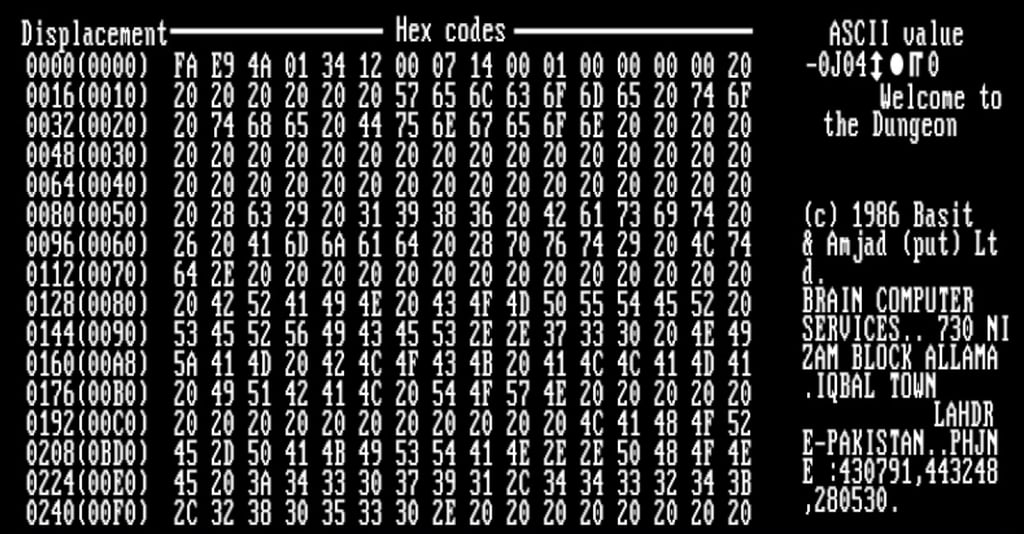
Then, the user would be greeted with a jovial message alerting them to the illegally pirated program, and even provide the names, phone numbers, and store location of the Alvi brothers, so they could help the user fix the software.
Sadly, the happy and benevolent hackers opened Pandora’s box because, as we now know, cybercriminals soon began developing malicious malware that would stay in our machines forevermore.
