Hume Health Body Pod vs InBody – which body composition analyzer is worth it?
Being behind major reports like The Mother of All Breaches and RockYou2024, our in-house cybersecurity experts and journalists provide unbiased, real-world testing and in-depth analysis.
We maintain complete transparency by openly sharing our testing methodologies with our audience.
Learn more
One trend is clear: body composition analyzers have become important tools for health, fitness, and performance. They are often referred to as smart scales, but these devices are much more than that. Body composition analyzers give you a true window into fat, muscle, and even visceral fat, for actionable insights into your body and health.
Among several top devices on the market, I found two that dominate reader questions right now. These are Hume Health’s Body Pod and the InBody Dial H30, with each taking a different approach to body composition analysis.
As a Cybernews expert, together with the research team, I spent weeks researching and reviewing top health tech. I also sifted through hundreds of authentic user testimonies to find out the truth about these devices. My goal with this Hume Health Body Pod vs InBody overview is to help you purchase the right tool for your body, your budget, and your goals.
If you want great value at a lower price, rechargeable battery, and broader wellness metrics, my winner is the Hume Health Body Pod. The InBody Dial H30 is still a good choice for focused fitness tracking, and if you don’t mind AA batteries at a premium price..
Hume Health Body Pod vs InBody overview
| Feature | Hume Health Body Pod | InBody Dial H30 |
| Rating | 4.8 | 4.6 |
| Core technology | Multi-frequency bioelectrical impedance analysis (BIA) with handheld sensors plus a heart rate sensor | Direct segmental multi-frequency BIA via tactile foot electrodes |
| Key metrics | 45+ body metrics (claimed), including fat, muscle, water, bone, heart health | 12 core metrics, including visceral fat, BMR, and upper/lower balance |
| Max user weight | 400 lb | 330 lb |
| Battery life | USB-C rechargeable battery (no official lifespan stated) | Four AA batteries (no official lifespan stated) |
| Price | $183 (discounted from ~$352 retail) | Around $349 (varies by seller) |
| Subscription | Optional coaching via Hume+ app: $9.99/month for premium features | None required |

Both the Hume Health Body Pod and InBody Dial H30 are smart scales for detailed body composition analysis. Hume uses multi-frequency BIA with handheld sensors, claims to measure 45 metrics and includes AI coaching. InBody uses foot electrodes for 12 key metrics, providing quick, accurate results. Both are great for home, fitness, or clinical use to track fat, muscle, and health progress.


Our team of in-house researchers, writers and editors reviews and analyzes health tech products using a research-driven approach. We gather data from multiple sources, fact-check all information, and conduct our research based on peer-reviewed studies, expert opinions, consumer ratings, and regulatory approvals.
You can learn more about how we test health tech products here.
How we test smart devices (methodology)
Cybernews evaluates smart devices using a five-part methodology. Here’s how I applied the research process:
- Accuracy and consistency of results (35%). I tested whether each device delivers precise body composition data (compared to gold standards like DEXA), and whether results remain consistent across multiple uses under the same conditions. Consistent results are crucial when you’re tracking progress over time for informed health decisions.
- Technology and innovation (25%). I assessed the method each device uses to collect data, like multi-frequency BIA. I also assessed how advanced its sensors, algorithms, and analysis are compared to others on the market.
- User experience and app integration (15%). This included setup time, how easy it is to navigate, whether insights are clear, and how well it works with mobile apps. It’s important that the health data is engaging for the user.
- Design, portability, and durability (15%). I examined the device, material quality, and how easy it is to use or move in a variety of settings (home, clinic, and gym). This area is critical because a high-quality device must suit different environments – this impacts user convenience and device lifespan.
- Price-to-value ratio (10%). I weighed the feature set, accuracy, and ecosystem against the price to determine whether the device offers strong long-term value. I focused on whether that value is actually meaningful over time.
Why your body composition matters
Your body fat percentage, lean mass, and other metrics are extremely valuable, much more so than just tracking your weight alone. Your weight will fluctuate from things like hydration, sodium, or hormones, but you won’t know what’s actually changing inside your body.
Body composition analysis gives you clarity that a simple scale cannot. These devices report if you’re losing muscle, the amount of water you’re holding, and whether your fitness plan is really working. That’s critical for anyone trying to improve their health and boost performance, or better understand how lifestyle habits affect long-term physical and metabolic changes.
Higher lean mass, for example, is linked to better metabolic health and greater strength as you age. Lower visceral fat reduces your risk of heart disease, diabetes, and inflammation. So by tracking these internal shifts, you can clearly make vital decisions, thanks to modern body composition analyzer devices.
Hume Health Body Pod vs InBody: accuracy and technology
When it comes to body composition accuracy, the InBody Dial H30 and Hume Health Body Pod take very different approaches, each with impressive strengths.
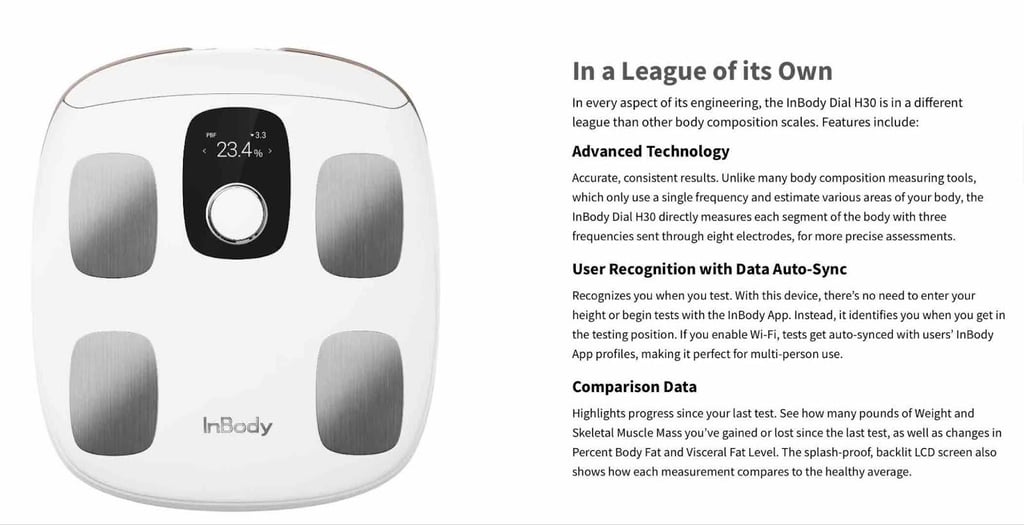
The InBody Dial H30 uses Direct Segmental Multi-frequency Bioelectrical Impedance Analysis (DSM-BIA) with eight electrodes and three frequencies (5, 50, and 200 kHz). Unlike many smart scales that estimate body composition based on just weight and height, InBody sends electrical signals through each segment of the body – arms, legs, and trunk – for more precise results.
While it doesn't include full segmental lean analysis like InBody's professional models, it does offer visceral fat, soft lean mass, waist-hip ratio, and upper/lower body balance, visible in the app. The scale also features Wi-Fi syncing, user auto-recognition, and stores up to 15 tests per user.

The Hume Health Body Pod, on the other hand, uses multi-frequency BIA with eight high-precision sensors and handheld electrodes. It measures muscle mass, body fat, body water, and even heart rate, with claimed 98% accuracy compared to DEXA scans. The company notes a 45-metric breakdown, syncing via Bluetooth, and personalized AI-powered insights in the Hume app.

Hume Health Body Pod vs InBody: metrics measured
| Metric | InBody Dial H30 | Hume Health Body Pod |
| Body Fat % | ✅ Yes | ✅ Yes |
| Lean Mass (Soft) | ✅ Yes | ✅ Yes |
| Total Body Water | ❌ No | ✅ Yes |
| Basal Metabolic Rate | ✅ Yes | ✅ Yes |
| Visceral Fat | ✅ Yes | ✅ Yes |
| Segmental Analysis | ✅ Yes, only upper/lower body balance | ❌ No |
| Heart Rate | ❌ No | ✅ Yes |
Both the InBody Dial H30 and Hume Health Body Pod cover the core metrics you’d expect from a high-quality body composition analyzer, but metric depth and focus determine whether they meet basic or advanced user needs.
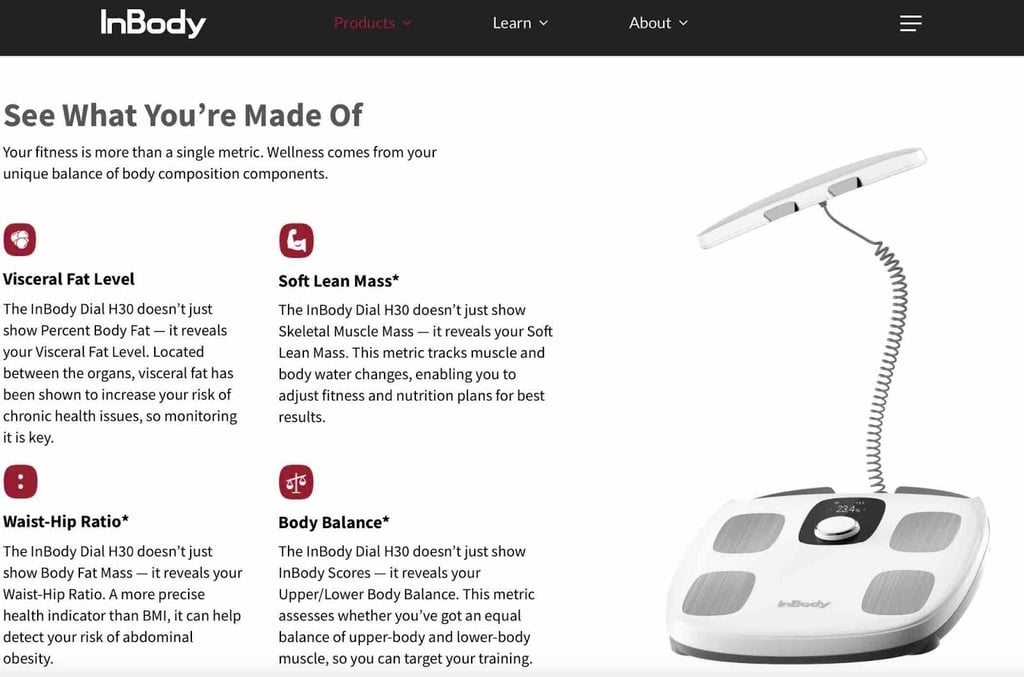
The InBody Dial H30 precisely tracks body composition. It measures body fat percentage, soft lean mass, basal metabolic rate (BMR), and visceral fat – crucial for understanding health risks like heart disease, while BMR helps you customize nutrition and fitness plans effectively It doesn’t offer full segmental analysis like InBody’s professional models, but it does partial breakdowns – like upper/lower body balance – via the app. That’s valuable when you’re trying to optimize muscle distribution or track fat loss in specific areas.
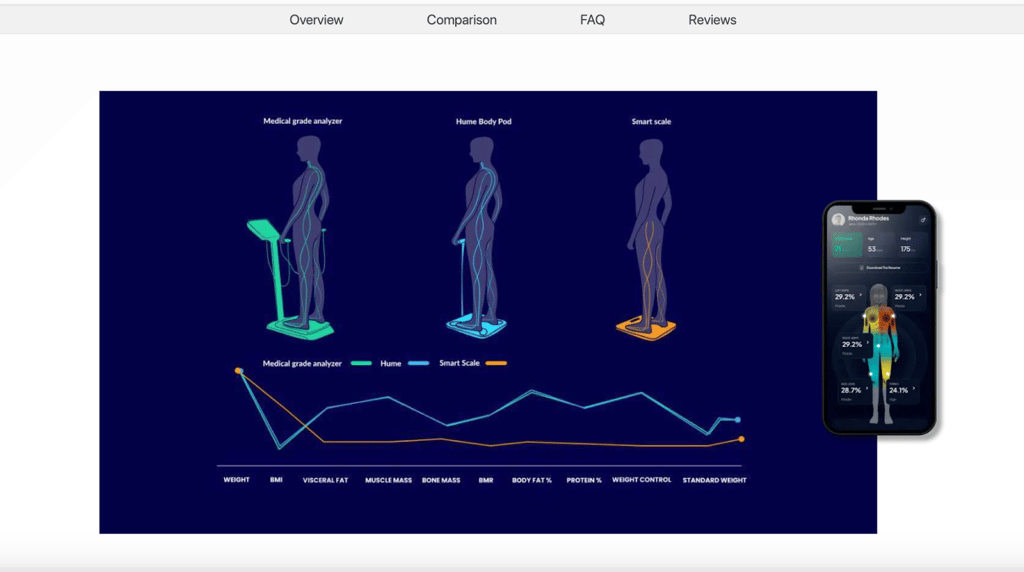
The Hume Health Body Pod leans more toward lifestyle and holistic wellness. It includes total body water and heart rate tracking, both of which InBody doesn’t measure, while also giving you a look at lean mass and body fat data. While it lacks segmental analysis, measuring hydration levels through total body water and tracking heart rate is key for understanding overall health beyond body composition alone.
Hume Health Body Pod vs InBody: app integration and usability
You can sync both the InBody Dial H30 and Hume Health Body Pod with their respective apps. The apps visualize and track your health metrics. However, the experience differs a lot in execution.
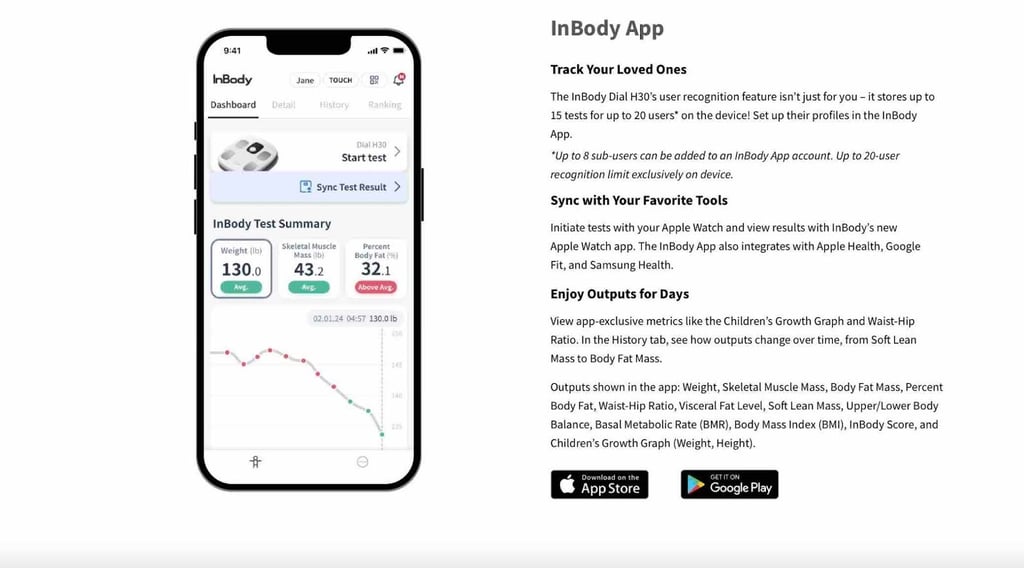
The InBody Dial H30 connects via Wi-Fi, which allows for automatic syncing of test results directly to the InBody App – ideal for busy users who don’t have time to remember manual syncing. Once you are recognized by weight and impedance, the scale syncs data for up to 20 users and stores 15 tests each per user.
The app shows you your visceral fat, soft lean mass, and waist-hip ratio, and integrates with Apple Health, Samsung Health, and Google Fit – helping consolidate your wellness data in one place. Overall, the app interface is minimal.

The Hume Health Body Pod syncs via Bluetooth and connects to the Hume+ app. It’s feature rich, supports up to 24 users and includes motivational dashboards, weekly trend graphs, and optional health coaching. While you must sync manually, and the app feels more lifestyle-oriented than clinical, the Hume Health Body Pod is more family and wellness-friendly.
Hume Health Body Pod vs InBody: design and build quality
Both the InBody Dial H30 and Hume Health Body Pod are premium, sturdy devices. However, they differ in design and build focus.
The InBody Dial H30 is compact, at 12.5 x 14.2 x 2.2 inches and 5.5lbs – great for tight spaces. It has a splash-proof, backlit LCD screen showing essential metrics instantly, enabling setup and use without a phone. Its minimalist design uses eight electrodes for three-frequency BIA. Powered by four AA batteries, it recognizes users automatically via weight and impedance, supporting up to 20 users. This suits home gyms and clinics.
The Hume Health Body Pod has a larger footprint – 12.7 x 12.7 x 1.1 inches, at about 4lbs – with a high-strength, tempered glass platform and ergonomic handles housing multi-frequency BIA sensors – all adding durability, sleek aesthetics, and enhanced comfort. It also adds heart health monitoring alongside body composition. It must be paired via Bluetooth to sync all data. It’s powered by a rechargeable Li-ion battery (lasting several months per charge). It supports up to 24 users – ideal for a family home setting, where you can track multiple profiles
Hume Health Body Pod vs InBody: value for money
The Hume Health Body Pod and InBody Dial H30 are advanced body composition scales, but their value for money varies when considering their features, pricing, and long-term costs.
The Hume Health Body Pod retails at $229 (discounted from $352), costing a lot less upfront than InBody’s device – which costs $349. Additionally, you can save 50% off Hume Health Body Pod with the special coupon code HEALTH50. Overall, its price is a key selling point if you want advanced features without the premium price.
The Hume Health Body Pod also supports more users, and includes a rechargeable battery that lasts several months per charge. However, advanced app features – like coaching and premium insights – require a subscription, and a warranty extension beyond the initial year costs extra. I found these additional costs to be absolutely worthwhile if you’re invested in long-term wellness.
The InBody Dial H30, in contrast, includes all of its features in the purchase price, with no subscriptions in sight – perfect if you dislike ongoing fees. It’s optimized for fitness and performance tracking, with auto-syncing, minimal app clutter, and no ongoing fees. The only issues are that it runs on AA batteries (recurring cost) and only includes a 1-year warranty without an upgrade path.
Hume Health Body Pod vs InBody: who should choose which?
The Hume Health Body Pod and InBody Dial H30 have different use cases. Here’s a quick look at who should choose which device:
- Medical clinics. The InBody Dial H30 offers precise segmental body composition analysis and great accuracy, but the Hume Health Body Pod still delivers very accurate results at a lower cost – perfect for clinics seeking versatility.
- Fitness centers or gyms. Both devices perform well here, however the Hume Health Body Pod’s heart rate tracking, multi-user support, and coaching features boost client motivation, making it a practical gym tool.
- Elite athletes or researchers. The InBody Dial H30 is a solid pick for elite athletes or researchers requiring segmental data. Meanwhile, the Hume Health Body Pod’s user-friendly metrics and AI trends make it competitive even in performance-driven environments.
- General wellness: The Hume Health Body Pod is better suited for general wellness with its broader health overview. It’s ideal for families and wellness enthusiasts, especially for everyday health monitoring.
Both devices clearly have strengths. However, the Hume Health Body Pod came out on top in my analysis.
Other reviews you might be interested in:
Hume Health Body Pod vs Withings Body Scan: which smart scales are more accurate?
Withings Scale vs Garmin: which smart scale tracks your health better?
Withings Body Smart vs Body Comp: which smart scale is best for you?
FAQ
Is the Hume Health Body Pod more accurate than InBody?
The Hume Health Body Pod’s marketing material claims an accuracy of 98% compared to DEXA scans. InBody provides upper/lower body balance, and is assumed to have similar overall accuracy – but this isn’t explicitly verified.
Which device is better for home use?
The Hume Health Body Pod is more affordable, rechargeable, and offers broader health insights, making it better suited for everyday home use. The InBody can still be used at home, but appeals more to data enthusiasts and power users.
Can I use InBody without professional training?
Yes. Simply stand barefoot on the device, hold the handles, and wait about 15 seconds. The InBody app will automatically record your measurements. No special training required.
Do either of these devices require a subscription or ongoing fees?
Neither device requires a subscription for core features. The Hume Health Body Pod offers optional coaching and premium features for a fee. Basic functionalities remain free.
Is bioelectrical impedance safe and reliable?
Yes. Both devices use a low, imperceptible electrical current. However, consult a doctor before use, especially if you have a pacemaker or medical implant. Low-level electrical signals may disrupt medical implant functioning.
-
Adipose tissue dysfunction in obesity, diabetes, and vascular diseases
European Heart Journal
-
Reliability, biological variability, and accuracy of multi-frequency bioelectrical impedance analysis for measuring body composition components
Frontiers in Nutrition, Sport and Exercise Nutrition Section
-
A Comparative Study of High-Frequency Bioelectrical Impedance Analysis and Dual-Energy X-ray Absorptiometry for Estimating Body Composition
Life
-
Reliability and Agreement of Various InBody Body Composition Analyzers as Compared to Dual-Energy X-Ray Absorptiometry in Healthy Men and Women
Journal of Clinical Densitometry