Hume Health Body Pod review 2026: is it worth it?
Being behind major reports like The Mother of All Breaches and RockYou2024, our in-house cybersecurity experts and journalists provide unbiased, real-world testing and in-depth analysis.
We maintain complete transparency by openly sharing our testing methodologies with our audience.
Learn more

Together with the Cybernews research team, I reviewed Hume Health Body Pod to better understand this smart health tool. With growing demand for body composition analysis, devices like Body Pod aim to deliver insights into fat, muscle, water balance, and even heart health.
Many might be familiar with competitors like Renpho or Etekcity, which are strong options in the 2026 tech market. That said, Hume Health outshines them with its claim of high-accuracy body composition readings and AI-driven health coaching.
The Cybernews team and I personally tested this composition scale, analyzing its data, customer reviews, and expert opinions. So, let’s explore whether Hume Health Body Pod is worth it in 2026 by breaking down its promises, features, and where it stands in the fast-paced world of digital health.
Quick overview of Hume Health Body Pod
Before diving deeper into Hume Health Body Pod, I’ve included a quick summary of its key features. This overview highlights the rating, pricing, metrics, and technical specifications, giving you an at-a-glance view to decide whether the smart scale calls for a closer look.
| Overall rating: | 4.8 |
| Description: | Advanced smart health device with 8 frequency sensors for body composition analysis, integrated with AI coaching via the Hume Health app |
| Starting price: | $183.04 |
| Metrics tracked: | 45+, including fat %, lean body mass, segmental muscle mass, and basal metabolic rate (BMR) |
| Weight capacity: | 400lbs (181kg) |
| Warranty: | 1 year (extendable to 10 years) |
| App compatibility: | iOS and Android |
| Battery life: | ~1 year per single charge |
Pros and cons of Hume Health Body Pod
As with any device, Hume Health Body Pod has two sides. Let’s take a look at its benefits and drawbacks to better understand how this advanced body composition scale might fit into your life.


Our team of in-house researchers, writers and editors reviews and analyzes health tech products using a research-driven approach. We gather data from multiple sources, fact-check all information, and conduct our research based on peer-reviewed studies, expert opinions, consumer ratings, and regulatory approvals.
You can learn more about how we test health tech products here.
What is Hume Health Body Pod and how does it work?
Hume Body Pod is an advanced smart health device designed to give users a full picture of their body composition. It’s among the best smart scales on the market, perfect for athletes and health enthusiasts, as well as anyone who’s serious about their fitness journey.
Unlike basic smart scales, Body Pod uses eight high-precision frequency sensors and multi-frequency bioelectrical impedance analysis (BIA) to measure fat percentage, muscle mass, water content, visceral fat, bone mass, and more. The brand claims its accuracy is very high, stating that measurements typically fall within 1–2% of results from a DEXA scan.
What makes it stand out is its cohesive integration with the Hume Health app, which turns raw data into personalized health insights, trend reports, and supportive AI coaching. Users can track how their body responds to diet, exercise, sleep, and stress over time, creating a data-backed health journey tailored to individual goals. This makes Body Pod more of a full home health hub, far from just a scale.
Hume Health Body Pod review: design and features
Hume Health Body Pod looks modern and sleek, and is also a smart, functionally engineered device. It’s compact enough to fit in most bathrooms, while the build is premium and sturdy. It uses high-quality materials that balance durability and elegance.

The platform’s wide surface looks stable, and the embedded eight-frequency sensors, which are spread between the footplate and handheld components, allow full-body scanning, not just the lower half (like cheaper scales).

Portability-wise, Body Pod is light enough to move between rooms, but it’s really designed to stay in one place as a permanent health station.
What sets it apart are its strong features: real-time body composition analysis (muscle, fat, water, bone), personalized health insights, and AI-driven coaching accessible with Hume+. The system syncs via Bluetooth (note: no Wi-Fi), integrating smoothly with popular health apps like Apple Health, Google Fit, and Fitbit. Cloud-based data storage means your results and progress are tracked securely over time, delivering weekly reports and visual graphs that help you spot trends.
It’s priced higher than a typical smart scale, but the combination of cutting-edge sensors, intuitive design, and app-powered insights elevates Body Pod into a category of its own. Plus, you can use the Hume coupon code HEALTH50 to get a 50% discount when purchasing smart scales.
Hume Health Body Pod review: setup and app
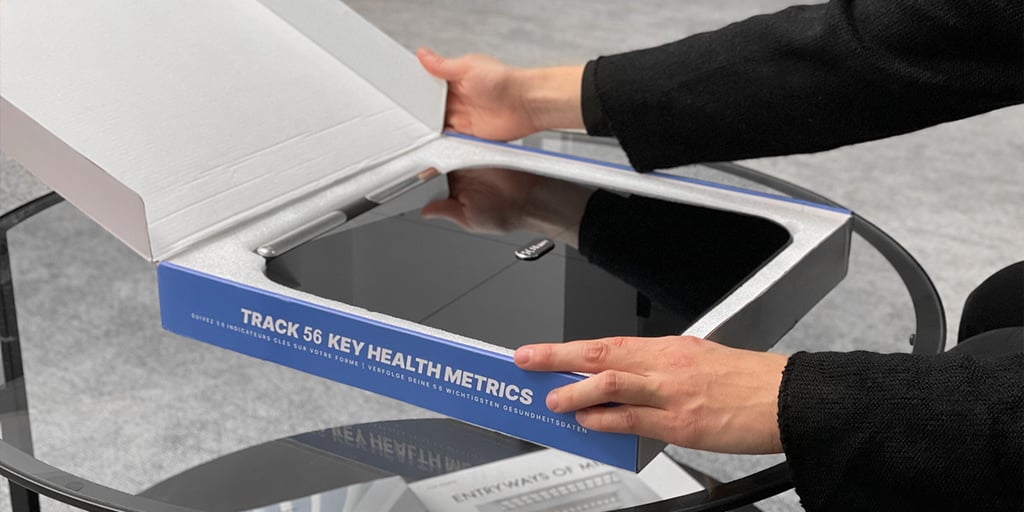
My research indicated that Hume Body Pod setup experience is simple, and there’s no assembly required, which is always a relief.
To begin, simply start by placing the device on a hard, flat surface. For rechargeable models, use the included USB-C cable for the first charge. Next, download the Hume Health app by FitTrack (iOS/Android), create a user profile, and follow any prompts. Pairing is no problem, just enable Bluetooth, tap the scale to wake it up, and the app auto-calibrates for your first reading.
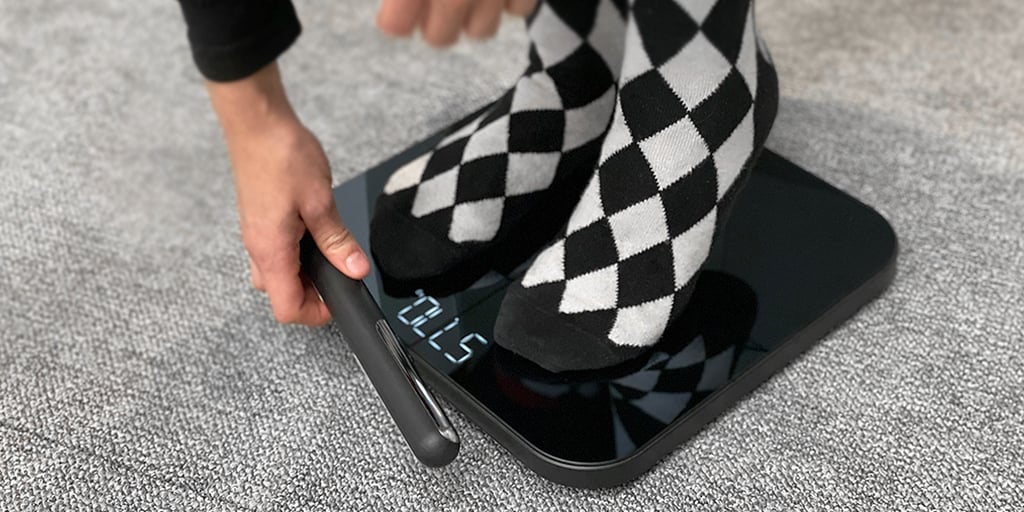
Next, step barefoot onto the tempered glass platform and hold the retractable hand sensor at waist height (if prompted to do so). The app will keep guiding you through.
The app interface is modern and intuitive. According to what users say, it was easy to understand what the health numbers mean. The app tracks over 45 health metrics, including body fat percentage, muscle mass, hydration, and metabolic age, showing your progress in clear, visual graphs.
To sync it, have your phone nearby and open the app (again, no Wi-Fi). My research and the user feedback I read suggest that the Bluetooth syncing is generally smooth. Something else I appreciated was that you can easily connect the app with Apple Health, Fitbit, and Google Fit to unify your health data.
Hume Health Body Pod review: body composition breakdown details
Hume Health Body Pod measures over 45 detailed health metrics. Here are some of the key health metrics it can track and analyze for you:
- Body fat percentage
- Lean mass
- Visceral fat
- Subcutaneous fat
- Body water
- Bone mass
- Muscle mass
- Metabolic rate
- Metabolic age
- BMI
- Protein mass
- Heart rate
Furthermore, Body Pod has eight-frequency bioelectrical impedance sensors, so it presents a clear picture of how fat, muscle, and water are distributed across the arms, legs, and torso. That’s something most regular smart scales can’t do.
With key in-depth insights from the Cybernews team, I found that Body Pod’s readings for weight, body fat, and muscle mass matched closely with DEXA scan results (often considered as clinical benchmarks). In testing, Body Pod’s differences generally fell within 1–2%.
But, like all commercial BIA devices, the real value comes from watching trends over time rather than focusing on small daily fluctuations. For instance, hydration levels or food intake can shift numbers slightly, although consistent weekly measurements give reliable insights into fat loss or muscle gain.
Benefits of Hume Health Body Pod
After combining weeks of in-house research with the help of the Cybernews team, I’ve found that Hume Health Body Pod offers several important benefits that extend beyond what a typical smart scale can offer:
- Better understanding of fitness progress. Body Pod not only tells you your weight, but it breaks down what’s actually changing in your body, like how much fat you’re losing or muscle you’re gaining.
- Personalized health insights. The app gives you custom recommendations and tracks trends over time, which is very helpful. Weekly reports make it easier to figure out what’s helping you move toward your goals and where you could adjust.
- Motivation to reach health goals. Watching your own detailed data change over time can be highly motivating. No matter if you’re aiming to build muscle, improve hydration, or drop body fat, the device shows meaningful changes.
- Multi-user support for families or teams. There’s space for up to 24 profiles, so this isn’t just for solo use, but works great in family or shared setups.
- Advanced detail at home. I especially appreciated how it delivers precise body data, which could be beneficial for discussions with a doctor.
Hume Health user reviews
Looking at feedback from across Reddit, Trustpilot, and our own team members, I found that Hume Body Pod receives quite a mixed reaction. On the positive side, many people love its rich set of health metrics, with one Redditor sharing they compared Body Pod to a DEXA scan and noted that it was only about 1.5% off on body fat, which they considered “decent.” Another person praised it for helping them adjust training and recovery, saying on Trustpilot that it “prevented overtraining a couple times by spotting early warning signs.”
On the other hand, there were some complaints. On Reddit, several people were frustrated, explaining that Body Pod often underestimates body fat, showing flattering but unrealistic numbers like 10% when they estimate themselves closer to 16–18%. On Trustpilot, one customer called it an “expensive paperweight,” saying their app data disappeared the day after setup.
From our own testers, Agne said that Body Pod delivered a lot of fascinating numbers, but that it left her confused because there were no clear in-app recommendations on what to do with the data. Additionally, Mantas said that syncing glitches and strange readings reduced his confidence, though he did praise the lightweight and portable design of the device.
How to use Hume Health Body Pod
Using Hume Health Body Pod isn’t a complicated process, even if you’re a first-time user. Here’s my simple step-by-step guide on how to get accurate and useful results:
- Put Body Pod on a hard, flat surface and make sure it’s charged if you’re using a rechargeable model
- Download the Hume Health app (iOS or Android)
- Then, create your user profile
- Now, pair the device via Bluetooth
-
While barefoot, step on the scale – place your feet correctly on the sensors

-
If the app tells you to do so, pull up the handlebar and hold it at waist height with arms slightly away from your body (for a full-body scan)

-
Wait a few seconds while Body Pod measures your body fat, muscle mass, water, and other metrics
-
Now, check the app for your results
For the best results, scan at the same time each day, preferably in the morning before eating or exercising. This rules out any fluctuations.
Who should avoid using Hume Health Body Pod?
While Hume Health Body Pod is a non-invasive health device, there are some safety considerations due to how BIA works. Individuals with pacemakers, implantable cardioverter-defibrillators (ICDs), or other electronic implants shouldn’t use BIA-based devices and are advised to consult their doctor.
BIA devices use very low electrical current and are considered safe for most people. However, pregnant individuals may want to avoid using the impedance features, as there is no data on how the currents could affect a fetus. Besides, Body Pod’s measurements are not adjusted for pregnancy, so results might be inaccurate.
Finally, it’s important to be mindful when using Hume Health Body Pod. If tracking numbers starts to feel stressful or overwhelming, pause and rest. The scale is a tool to support wellness, but your comfort and mental health are the priority.
Video review
If you’d like a closer look at how Body Pod works, check out our full video review below:
Final word on Hume Health Body Pod
Hands-on testing and extensive research of Hume Health Body Pod have led me to believe it offers solid value for those seeking to elevate their health tracking. The device offers detailed insights into body fat, muscle mass, metabolic age, and hydration metrics.
It’s worth pointing out that Body Pod doesn’t have official clinical validation or FDA approval. Its accuracy claims mainly relate to BIA technology and comparisons with DEXA scans. If you’d like to explore alternatives, check out Hume Health Body Pod vs Withings Body Scan comparison to better understand their key similarities and differences.
Despite that, I think it’s a good fit for both fitness enthusiasts and families aiming to improve their overall wellness. Hume Health Body Pod could be a worthwhile investment for 2026 and a meaningful step toward gaining deeper insights into your health.
Other health tech reviews you might be interested in:
Hume Health Body Pod vs Withings Body Scan: which smart scales are more accurate?
FAQ
Is Hume Health Body Pod worth it?
Yes, the Hume Health Body Pod is worth it especially if you’re after more than just weight tracking. This device gives you insights into areas such as body composition, hydration, and muscle mass. So, you get meaningful long-term data that can really guide your health journey.
Does the Body Pod require a subscription?
No, Body Pod doesn’t require a subscription for its basic functions. However, advanced tools like personalized coaching and those valuable detailed reports need a Hume+ subscription.
Can multiple users share one Hume Health Body Pod?
Yes, multiple users can share one Hume Health Body Pod. It supports up to 24 user profiles, so it’s perfect for large families, companies, or fitness teams.
How accurate is Hume Health Body Pod compared to a DEXA scan?
Hume Health Body Pod is claimed to be fairly close in accuracy to the DEXA scan, but not identical. The brand suggests that it’s within about 1–2% of DEXA results for overall body fat, though that hasn’t been officially peer-reviewed or clinically validated.
How often should I scan myself with Hume Health Body Pod?
Ideally, you should scan yourself once per day with Hume Health Body Pod. For the most consistent tracking possible, you’ll want to scan at the same time every day. Scanning in the mornings, before eating or exercising, may provide the most reliable results.