Withings Body Smart vs Body Comp: which smart scale is best for you?
Being behind major reports like The Mother of All Breaches and RockYou2024, our in-house cybersecurity experts and journalists provide unbiased, real-world testing and in-depth analysis.
We maintain complete transparency by openly sharing our testing methodologies with our audience.
Learn more
Smart scales are now one of the most easily accessible ways of monitoring your health and fitness progress. They don't just tell you your weight. Next-gen models can now measure body fat, muscle mass, heart rate, and even some cardiovascular metrics. That's why the Withings Body Smart vs Body Comp is such a common discussion among consumers looking for the sweet balance of features and price.
As a Cybernews expert, I worked with our research team to dig deep into these two top-selling Withings models. We’ve gone over official specs, reviewed how each scale integrates with health apps, and went through verified user reviews.
So, if you haven’t yet decided which scale offers more value to you, whether you're tracking fitness gains, observing overall health over time, or simply wanting a daily weigh-in buddy, this article will help you make an informed decision.
As per my research, Withings Body Smart hits the balance of daily fitness monitoring within budget. Body Comp may, however, be better for health monitoring with extra features, especially cardiovascular and nerve health measures, over budget.
Withings Body Smart vs Body Comp overview
First off, let’s do a quick overview of what the two Withings scale models offer:
| Withings Body Smart | Withings Body Comp | |
| Rating: | 4.8 | 4.6 |
| Price: | $129.95 | $229.95 |
| Metrics: | Weight, body fat, muscle, bone, hydration, visceral fat, BMI, BMR, heart rate | All Body Smart metrics + vascular age, arterial age assessments, electrodermal activity |
| Heart rate: | ✅ Yes (standing heart rate) | ✅ Yes (standing heart rate) |
| ECG: | ❌ No | ❌ No |
| Atrial fibrillation detection: | ❌ No | ❌ No |
| Arterial age assessment relative to your age group: | ❌ No | ✅ Yes |
| Battery life: | Up to 15 months | Up to 15 months |
| Screen size: | 2.8” High-res color screen | 2.8” High-res color screen |
| Athlete, pregnancy, baby, eyes-closed modes: | ✅ Yes | ✅ Yes |
| Automatic user recognition: | ✅ Yes | ✅ Yes |
| Best for: | Tracking core metrics, budget-conscious users | Health-data enthusiasts, in-depth cardiovascular and nerve insights |



Our team of in-house researchers, writers and editors reviews and analyzes health tech products using a research-driven approach. We gather data from multiple sources, fact-check all information, and conduct our research based on peer-reviewed studies, expert opinions, consumer ratings, and regulatory approvals.
You can learn more about how we test health tech products here.
How we test smart scales (methodology)
To give you a better idea of how we test health tech, including smart scales like Withings, I’ll walk you through the process in detail. I collaborated with our in-house research team to ensure this comparison of the Withings smart scales relies on a multi-perspective and science-backed process. Our refined methodology is based on several reliable sources: peer-reviewed studies, verified user feedback, and official data, combined with the experience of our team to offer input you can trust. Here’s how we break it down:
- Measurement accuracy (35%). We compared significant measurements like weight, BMI, body fat percentage, and overall consistency over time with known standards and collective user feedback.
- App and ecosystem integration (25%). We evaluated setup speed, syncing functionality, compatibility with ecosystems like Apple Health, Google Fit, and Garmin Connect, and tested how actionable and easy to understand the app data is.
- Ease of use and setup (15%). We analyzed the process of pairing the device, onboarding the user, and long-term usability.
- Design and build quality (15%). We looked into the display, visual appeal, physical durability, and the device footprint in the home environment.
- Customer feedback (10%). Verified user reviews were also one of our evaluation points to identify satisfaction trends and common pain points.
What does a Withings smart scale measure?
Like most best smart scales now, Withings smart scales offer much more than a weight readout. They’re designed to provide a holistic view of your health. All Withings models, including Body Smart and Body Comp, track:
- Weight and BMI. Your basic measurements, with BMI (Body Mass Index) calculated from your body composition and weight.
- Body composition. This includes fat mass, muscle mass, bone mass, lean mass %, and hydration (water %). Visceral fat (a fat inside the body that's linked with health concerns) is also included. It provides more granular insight into your composition.
- Basal Metabolic Rate (BMR) and metabolic age. This metric estimates how many calories your body would burn at rest and compares your metabolic profile to others in your age range.
- Standing heart rate. Withings also monitors the resting measure of cardiovascular fitness.
Besides these essentials, Withings Body Comp adds some advanced diagnostics:
- Vascular (arterial) age. The scales estimate your (anecdotal) vascular age, based on the condition of your arteries.
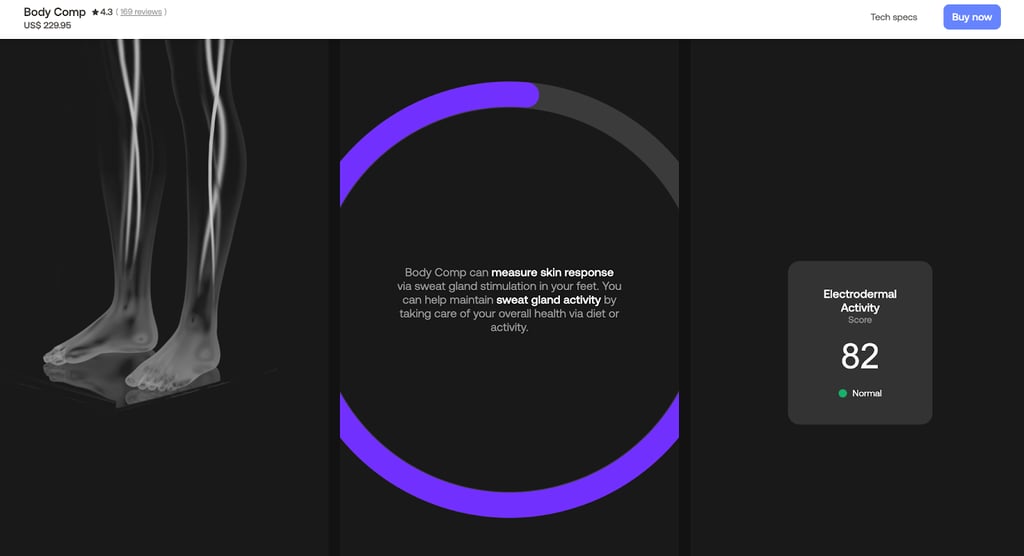
- Electrodermal activity (EDA) score. It may measure skin response through sweat gland stimulation in your feet and provide you with an indicative score.
Withings' indicative scores like vascular age or EDA are meant as general wellness metrics only, not medical advice. If you have any medical concerns, it's always better to check in with your health practitioner.
About Withings Body Smart
The Body Smart offers a sophisticated blend of basic health tracking functionality at a price that doesn't blow the budget. It has Withings' Precision Technology™ and multi-frequency BIA to track weight (to 0.1lbs accuracy), fat, muscle mass, bone mass, visceral fat index, hydration, basal metabolic rate (BMR), and standing heart rate.
I found the design intuitive and slimline, with a tempered glass surface, a colorful display screen. The scale supports up to 8 users. You connect to it via Wi‑Fi or Bluetooth and integrate with health apps like Apple Health, Google Fit, or MyFitnessPal.
Priced at $129.95, Body Smart sits in a good value-for-money spot and appeals to health-aware customer who want core readings without advanced metrics.
About Withings Body Comp
The Body Comp model is one of the best Withings scales in the lineup. It has a premium build (high-strength tempered glass platform, paint-free satin white casing, ultra-slim design).
Body Comp offers advanced body composition analysis: muscle mass, bone mass, hydration, visceral fat, and basal metabolic rates, using multi-frequency BIA.
There are several unique scores/features that set the Body Comp model apart: vascular age, arterial age assessment, and electrodermal activity. These suggestive scores may give you insight into cardiovascular and neurological health via tech like pulse wave velocity and electrodermal activity.
Due to the scale's premium features, the Body Comp model is more expensive ($229.95) than the Body Smart one. You also get a Withings+ service subscription free for the first 3 months.
Withings Body Smart vs Body Comp: additional features
When choosing between the Withings Body Smart and Body Comp, the additional features can make a difference (unless you’re only after the basics).
While both models offer personalized health trends and insights through the app, Athlete, Pregnancy, Baby, and Eyes‑Closed modes, as well as multi-user auto-recognition, and some other specs, Body Comp adds some more guns to the arsenal.

I found that Body Comp is the pioneer with its deeper intelligence and personalization. It offers more insightful wellness indicators like vascular age, arterial age assessments, electrodermal activity, and rich on-device analytics like AutoSync+, as well as personalized nudges in the app.
Body Comp also offers 3 months of free premium Withings+ service use, whereas with the purchase of Body Smart, you only get 1 month free of charge. So, all things considered, the difference is not significant, but Body Comp can be seen as an upgrade.
Withings Body Smart vs Body Comp: user reviews
After analyzing user forums and feedback threads, I’ve seen that both models have significant followings but resonate with unique mindsets. Most Body Smart owners like its basic tracking. Without the extras of a high-end, they feel it offers solid value and makes day-to-day health tracking just enough.
Body Comp users seem to like the more nuanced set of data, but there's a mixed opinion about how often those higher-level measures work like they should. Some say vascular age hardly seems as useful as they'd hoped. Others admit the extra data is exciting initially, but day-to-day, they rely more on the same basic measures offered by Body Smart.

The most consistent criticism I noticed across both models is app syncing bugs and random connectivity delays. Still, people are generally happy overall, and especially those who have realistic expectations of what a smart scale can and cannot accomplish.
Withings Body Smart and Body Comp vs competitors
I compared Withings smart scales models against three strong contenders I kept seeing in user discussions and reviews – the Hume Body Pod, Fitbit Aria Air, and Renpho Smart Scale:
| Withings Body Smart | Withings Body Comp | Body Pod by Hume | Fitbit Aria Air | Renpho Smart Scale (Elis) | |
| Metrics tracked | Weight, BMI, fat, muscle, bone, hydration, BMR, heart rate | All Body Smart metrics + vascular age, arterial age assessments, electrodermal activity | 45+ metrics, segmental analysis | Weight, BMI | 12+ body metrics |
| Subscription requirements | Optional Withings+ for extra insigths | Optional Withings+ for extra insigths | Optional AI coaching | Fitbit Premium for full features | None |
| Price | $129.95 | $229.95 | $349 | From $45 | $22.99 |
| App experience | Intuitive navigation, multi-app sync | In-depth insights, deeper trends | Modern, AI-powered app | Fitbit app, simple to use | Basic but functional |
| Design and usability | Sleek glass, high-res display | Premium glass, larger display | Premium, modern | Minimalistic design, very basic use | Old-fashioned design, basic use |
Withings Body Smart vs Body Comp: which one should you choose?
Following side-by-side comparison and digging through user reviews, my suggestion is to stick with your tracking habit.
I would recommend Body Smart if you want a smart scale that performs basics well: accurate body composition, heart rate, and great app experience, without costing too much. It's the one that I would recommend for casual fitness fans or someone developing good habits without obsessing about complex numbers.
Body Comp, on the other hand, is for data aficionados who enjoy diving into wellness metrics. Vascular age and electrodermal scores add another layer of insight, while not medical advice, but useful trend detectors.
In short, if simplicity is your thing, I’d definitely recommend going for Withings Body Smart. If you're a data enthusiast and want more granular self-tracking, Body Comp is worth the premium price.
Other reviews you might be interested in:
Hume Health Body Pod vs InBody – which body composition analyzer is worth it?
Withings Scale vs Garmin: which smart scale tracks your health better?
Hume Health Body Pod vs Withings Body Scan: which smart scales are more accurate?
FAQ
Do Withings smart scales require a subscription?
No. Core features function without a subscription. You can optionally add Withings+ for detailed insights and guided programs but simple measurements do not require a subscription.
Is the Withings Health Mate app accurate and easy to use?
Yes. The app is easy to use with clear-to-understand scores and trend tracking. As the provider claims, the readings are accurate, however, beware that some readings can be different from day to day and should be considered as an estimate only.
Can multiple users share the same scale?
Yes. Both Body Smart and Body Comp scales automatically recognize up to 8 different users, storing data into each user's profile in the Health Mate app without any need to switch manually.
What’s the difference between vascular age and BMI?
BMI relates weight to height to estimate body mass category. Vascular age is a Withings wellness metric estimating arterial stiffness, providing an insight into cardiovascular trends.
How does Withings compare to the Hume Body Pod?
Withings offers next-gen technology, smart design, and app integration at a lower cost. Hume Body Pod, however, offers more readings and AI-driven insights but at a higher cost. It’s aimed at data-intensive well-being tracking enthusiasts.