Best pulse oximeters for home use: what to look for and top picks
Being behind major reports like The Mother of All Breaches and RockYou2024, our in-house cybersecurity experts and journalists provide unbiased, real-world testing and in-depth analysis.
We maintain complete transparency by openly sharing our testing methodologies with our audience.
Learn more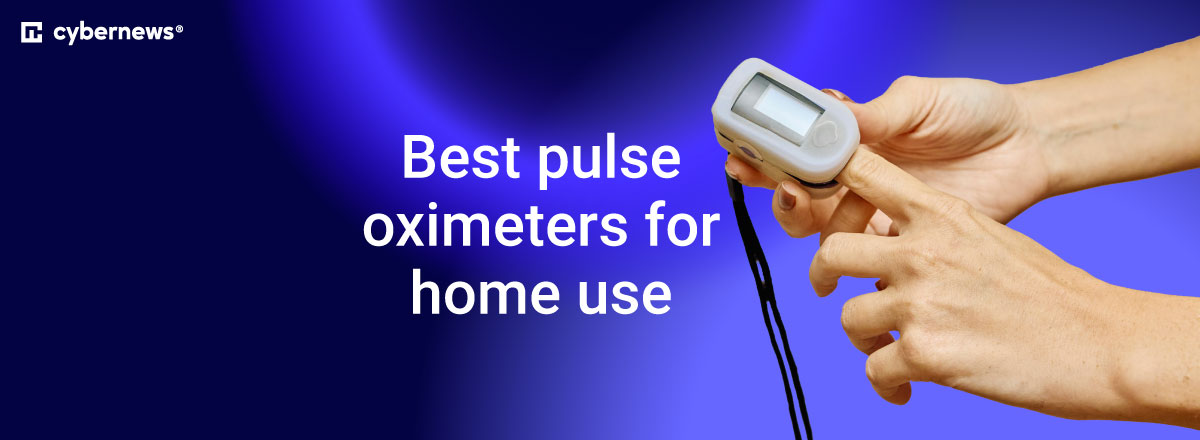
Pulse oximeters became common household devices due to COVID-era awareness, for respiratory self-monitoring, and helping track conditions at home between doctor’s appointments.Today, buyers want a reliable at-home device for monitoring blood oxygen saturation (SpO2) and pulse rate. I, together with the Cybernews research team, reviewed manufacturer specifications, FDA classifications, clinical guidance, and consistent user feedback to identify the best pulse oximeters for home use.
I’ve picked five of the best pulse oximeters for home use and arranged them according to various budgets and needs. I cover the main device types (fingertip vs wearable rings), what “OTC” and “FDA-cleared” mean for you, and factors that affect device accuracy. I also explain how you read results, when to recheck, and how to interpret readings.
5 best pulse oximeters for home use – shortlist
- Oxiline Pulse MD Pro – best overall pulse oximeter for home use
- Oxiline Pulse XS Pro – best fingertip pulse oximeter for quick checks
- NovaMedic Pro – best fast-check for basic SpO2 and pulse results
- Zacurate 500C Elite Fingertip Pulse Oximeter – budget pulse oximeter with audible alarms
- Wellue O2Ring Pulse Oximeter – overnight pulse oximeter with app and PC reports


Our team of in-house researchers, writers and editors reviews and analyzes health tech products using a research-driven approach. We gather data from multiple sources, fact-check all information, and conduct our research based on peer-reviewed studies, expert opinions, consumer ratings, and regulatory approvals.
You can learn more about how we test health tech products here.
5 best pulse oximeters for home use compared
It’s helpful to compare these devices side by side before learning more about each one individually. Here’s a quick table where you can spot the key differences:
| Model | Dimensions | Power source | FDA cleared? | Third-party validation | Mobile app? | Warranty | Trial period (days) | Price range | Best for |
| Oxiline Pulse MD Pro | 150 x 90 x 26mm | Two 1.5V AA alkaline batteries | Yes | Clinically validated | Yes | Lifetime | 30 | Premium | Detailed spot checks (waveform, perfusion index, app trends) |
| Oxiline Pulse XS Pro | 63 x 39 x 36mm | Two AAA alkaline batteries | Yes | Clinically validated | Yes | Lifetime | 30 | Premium | Fast everyday fingertip checks (portable, simple, plus app) |
| NovaMedic Pro | Not specified | “Long-lasting battery” | Yes | Not specified | No | Two years | 30 | Not specified | Basic SpO2 and pulse checks (limited information) |
| Zacurate 500C Elite Fingertip Pulse Oximeter | 2.25 x 1.25 x 1.25in | Two AAA batteries | No | Not specified | No | 12 months | 30 | Budget | Budget spot checks with a simple setup |
| Wellue O2Ring Pulse Oximeter | 4.09 x 3.74 x 2.64in | Rechargeable Lithium Polymer (12-16 hours) | No | Not specified | Yes | Device warranty not specified, 6 months warranty for non-consumable accessories | 30 | Premium | Overnight tracking with vibration alerts plus reports |
5 best pulse oximeters for home use – our detailed list
Below are detailed product descriptions for each pulse oximeter I’ve picked. I’ve included aspects like FDA clearance, price range, and who it’s best for.
1. Oxiline Pulse MD Pro – best if you need at-home waveform and perfusion indexing
| FDA-cleared?: | Yes (FDA 510(k) clearance) |
| Price range: | High-tier |
| Best for: | Those who need more health context than just an SpO2 number |
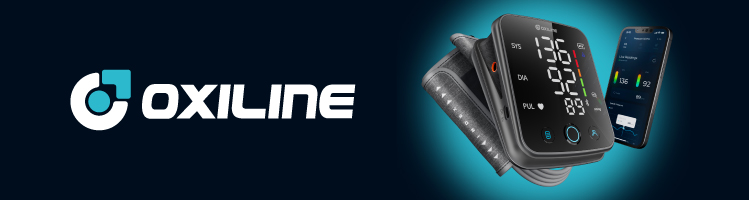
The Pulse MD Pro conducts comfortable, continuous monitoring via a fingertip sensor connected to a base unit. It includes SpO2 and pulse rate readouts, plus perfusion index and live waveform details. Readings take less than four seconds.
Its 3in OLED screen is one of Oxiline’s larger displays and is easy to read. Bluetooth syncs results to the Oxiline app, where results are saved and you can view trend charts. It’s powered by two 1.5V AA alkaline batteries, rated for about 14 hours per set.
2. Oxiline Pulse XS Pro – best if you want a clip oximeter with Apple Health sync
| FDA-cleared?: | Yes (FDA 510(k) clearance) |
| Price range: | High-tier |
| Best for: | Those who want a compact oximeter with exportable data |
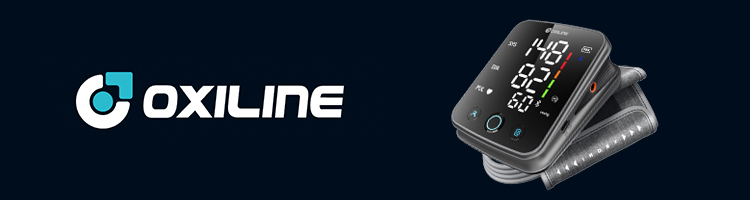
The Pulse XS Pro is a clip-style fingertip oximeter with adjustable alarms. It provides SpO2, pulse rate, perfusion index (PI%), and a live plethysmograph waveform. Readings take less than four seconds.
It has a 1.5in OLED display with 360-degree rotation. You get 35%-100% SpO2 range with an accuracy of ±2% from 70%-100% (±3% below 70%). Pulse rate accuracy is ±2 bpm.
It connects to the Oxiline app via Bluetooth. There’s Apple Health and Android Health Connect support, plus exports in PDF or CSV formats.
3. NovaMedic Pro – best if you want a one-button fingertip check with easy setup

| FDA-cleared?: | Yes |
| Price range: | N/A |
| Best for: | Those who want app-less SpO2 plus pulse checks |
As claimed by the manufacturer, NovaMedic Pro is a “doctor approved” fingertip clip oximeter for quick at-home checks. It delivers SpO2 and pulse rate estimates in about five seconds. It has a color LED display, one-button operation, automatic shutdown, and a “long-lasting battery.” It’s got a 30-day money-back guarantee, and an “accurate data guarantee,” according to the company. Many other key details aren’t shown on the official website.
4. Zacurate 500C Elite Fingertip Pulse Oximeter – best if alarms and a multi-view OLED matter
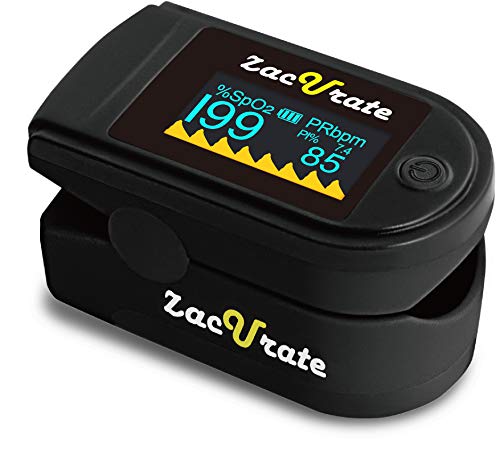
Zacurate 500C Elite Fingertip Pulse Oximeter is a budget clip fingertip oximeter for fast spot checks at home and on the go. It shows SpO2, pulse rate, and a plethysmograph wave plot.
This model has customizable audible alarms if SpO2 or pulse rate fall outside set limits, plus beeps for pulse. The screen brightness is adjustable. Zacurate claims ±2% measurement accuracy, SpO2 range (0-100%), and pulse (30-250bpm). There’s up to 30 hours of battery life via two included AAA batteries, and a 12-month warranty.
5. Wellue O2Ring Pulse Oximeter – best if you want a ring-type oximeter that stores overnight sessions
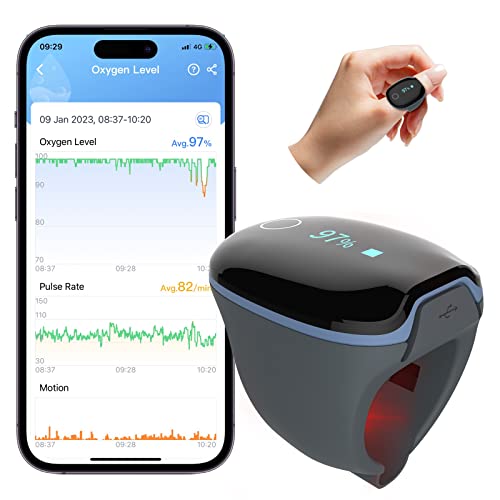
Wellue O2Ring Pulse Oximeter is a wearable ring device designed to be worn continuously. The listing shows vibration reminders and adjustable thresholds. If SpO2 or heart rate fall outside set thresholds, it’s flagged in the reports.
It connects to the Vihealth app via Bluetooth and also supports PC software. PDF/CSV report exports are supported. Built-in memory stores four sessions of up to 10 hours each (oldest overwrites when full). Wellue lists a 70%-99% SpO2 range and claims ±2% accuracy. It provides 16 hours of typical use with the rechargeable cell.
Our methodology
Home pulse oximeters are not diagnostic medical devices or hospital-grade diagnostic tools. I only used publicly available information and aggregated user sentiment to score these devices:
- Accuracy claims and FDA transparency (30%): I picked products with clearly listed accuracy ranges, and an FDA status. I also looked for any validation information.
- Ease of use and display clarity (20%): I weighed screen readability and brightness controls. I also considered how simple it is to complete a reading.
- Build quality and durability (15%): I assessed the described materials’ quality and included accessories. Warranty length was another signal of durability.
- Feature set (Bluetooth, memory, alarms) (15%): I checked for Bluetooth and app support, alarms, and presence of PI/waveform. I also noted if export was possible.
- Value for money (10%): I considered pricing vs features depth. I compared all competitors fairly here.
- User sentiment consistency (10%): I checked for repeated themes in real online user forums. I ignored isolated comments.
What is a pulse oximeter and how does it work?
A pulse oximeter is a compact, noninvasive device into which you insert your fingertip (usually). These devices use red and infrared light to estimate your blood oxygen saturation (SpO2) and heart rate. Light is shone through your finger, and the device analyzes how the pulsating blood absorbs that light.
This is based on photoplethysmography (PPG) which is a noninvasive optical method used clinically to support measurements like arterial oxygen saturation. Basically, PPG detects small changes in blood volume in tissue by measuring variations in light absorption during each heartbeat. Pulse oximeters use this signal to estimate SpO2 and heart rate.
For example, many healthy people read between 95% and 100% for SpO2, though this is variable. Finger placement, cold hands, motion, nail polish, circulation issues, and even pigmentation (can affect light absorption) can shift readings.
Types of pulse oximeters
Before you buy one, match the oximeter type to your lifestyle. Here’s a quick overview:
- Fingertip pulse oximeters (most common): These are ideal for at-home spot checkers. They’re the most portable, and often cheapest.
- Handheld pulse oximeters (with probe): These are more expensive and less portable.
- Wearable/continuous monitoring oximeters: Ideal for overnight/sleep monitoring. These are often app-based and more expensive.
- Pediatric pulse oximeters: Perfect for children. These fit smaller fingers and handle movement better.
Prescription pulse oximeters vs over-the-counter (OTC) pulse oximeters: what's the difference?
There’s a critical difference in how pulse oximeter devices are regulated and marketed. The FDA classifies pulse oximeters intended for medical purposes as medical devices. Those are usually found in medical settings for spot-checking or graphing oxygen saturation to support clinical decision-making.
Some oximeters can be bought over the counter (OTC) after FDA 510(k) clearance, while many consumer devices are also sold online or in stores (as general wellness or sports/aviation products).
Devices that are prescription or FDA-cleared face tighter regulatory rules, so the expectations are much higher and must be clearly defined. OTC and general consumer models are meant for home monitoring, so their readings shouldn’t be treated as medically-faithful. Generally, most home users purchase OTC fingertip models.
Key features of at-home pulse oximeters
Key features should support your home-monitoring oximeter use case. Look out for:
- SpO2 and pulse rate display: The essentials. Quick oxygen saturation and heart rate results are your core metrics.
- OLED or LED display quality: An OLED screen has more contrast, while an LED screen may be brighter. Check if you need brightness adjustment, rotation, or viewing-angle modes.
- Automatic shutoff: This turns the device off if you forget to do so. It reduces battery drain.
- Perfusion index (PI): This metric provides a signal-strength/circulation indicator. It can help you check if a reading is reliable.
- Plethysmograph waveform: This is a visual “pulse wave.” It helps confirm if the sensor is reading reliably.
- Bluetooth/app syncing: This is practical if you want saved charts or results history. Some devices let you export this data to share with a doctor.
- Alarm function: Alarms notify you if readings fall outside set limits. This is helpful for both frequency checks and sleep monitoring.
How to choose the best pulse oximeter for home use?
Match your device to your lifestyle and how you’ll be using it. Here are some valuable tips:
- FDA clearance: For maximum transparency, look for FDA status. Many consumer models are sold as wellness or sports devices.
- Display readability: Large digits, and a clear viewing angle. Rotation and clarity are also practical, especially for seniors.
- Battery type: AAA or AA batteries swap out easily. Rechargeable wearables require charging.
- Bluetooth necessity: Bluetooth allows saved history, trend charts, and exports. It’s unnecessary for occasional checks.
- Return policy: Look for a long return window. Test the device for comfort and performance first.
- Finger size compatibility: If it’s highly uncomfortable, core readings like SpO2 and pulse rate may be off. Check for finger thickness range and comfort before buying.
Budget fingertip models are the cheapest, while FDA-cleared options and tech-wearables cost more. Seniors generally want big screens, while athletes want speedy checks. People with chronic conditions may need detailed trend tracking.
Factors affecting pulse oximeter accuracy
Several factors can alter oximeter estimations. Here are some common factors with explanations:
- Cool skin temperature/poor circulation: Warm your hands first (warm water, rubbing together). Keep your hands still. Don’t squeeze your fists.
- Carbon monoxide poisoning: See a doctor if you suspect poisoning.
- Certain blood disorders: Blood disorders may skew readings (affect how oxygen is carried). Talk to your doctor.
- Dark nail polish: Remove nail polish before measuring. Color may block light.
- Dark skin: Skin color can affect readings.
- Long or thick artificial nails: Remove if possible, or try a different finger. This can block the sensor light.
- Thick skin: Use your pointer or middle finger. The device must fit snugly but not overly tight in the middle.
- Tobacco use: Nicotine tightens blood vessels. Wait 15-20 minutes after a cigarette.
- Unclean skin: Dirt and grease may alter light absorption. Wipe your fingertip clean.
How to read pulse oximeter results?
You’ll generally see two main numbers, sometimes with extras. Look at:
- SpO2 percentage: Healthy people should range between 95% and 100%. However, this can vary by person and even altitude can affect it.
- Heart rate (BPM): At rest, many adults commonly register 60-100 BPM. Overall fitness level, some medications as well as other factors may affect this.
- Signal strength/PI/waveform: If available, this tells you if the device has a good connection to your finger. If the line looks weak or shaky, your numbers might shift.
Your results aren’t intended to be used for a diagnosis. If results are surprisingly low, repeat the measurement by sitting still or trying another finger.
Call your doctor if readings are below 92% or lower at home, or if you have any concerning symptoms, including worsening shortness of breath, chest pain, or confusion. Readings after intense activity (like exercise) can jump briefly due to movement and breathing changes. Wait until you’ve been still for a few minutes.
Final verdict: which pulse oximeter is best for home use?
Ultimately, I picked Oxiline Pulse MD Pro as the best overall and best for seniors because it’s FDA 510(k) cleared, and balances simplicity with extra features like a waveform and perfusion index. It also has a vivid display, which seniors appreciate. It’s also priced realistically among these other best pulse oximeters for home use.
If budget matters, Zacurate 500C Elite Fingertip Pulse Oximeter has your basics covered (plus alarms) at a very low price. If you’re tech-inclined (or want Bluetooth), Oxiline XS Pro is my top choice. If you’re an athlete and want a light device capable of continuous tracking, try the Wellue O2Ring.
Quick buyer checklist:
- Quick buyer checklist:
- Pick a large display (especially if you’re a senior)
- Decide if you need Bluetooth/history
- Check returns and warranty
- Check finger fit
To reiterate, no home device replaces professional medical evaluation. For even more health technology reviews, check out our Oxiline Pressure X Pro vs Omron review, our Oxiline Blood Pressure Monitor review, and our Oxiline Pulse Oximeter review.
FAQ
Are home pulse oximeters accurate?
They can be generally accurate. However, they still only provide estimates that can be thrown off by poor circulation, motion, nail polish, skin color, and other factors. For example, the Oxiline Pulse MD Pro adds extra context (waveform plus perfusion index), helping you take more accurate readings.
What is a normal SpO2 reading?
Generally, a healthy reading is in the mid-to-high 90s. Still, “normal” varies by the specific person’s health record and environmental factors. Always seek clinical tests if you need trustable results.
Do darker skin tones affect pulse oximeter accuracy?
Potentially, because light is absorbed differently depending on skin tone. Still, contact your doctor if your oxygen saturation level is estimated to be 92% or lower. If it falls to 88% or lower, seek immediate medical attention.
Can I use a pulse oximeter during exercise?
Yes, but noise will be introduced to your results due to increased motion and changing perfusion. For a better result, take a reading before or after exercise, when you’ve calmed down and are in a rest phase.
Do pulse oximeters require calibration?
Consumer pulse oximeters generally don’t require this. Accuracy depends on factors like hand warmth, stillness, good fit, and lack of nail polish. It’s best to test under optimal conditions rather than attempting to calibrate an oximeter.
-
Pulse Oximetry
Cleveland Clinic
-
Blood Oxygen Level
Cleveland Clinic
-
Pulse Oximetry
MedlinePlus
-
Updating pulse oximeters
National Heart, Lung, and Blood Institute
-
Pulse oximeter basics
U.S Food & Drug Administration