Sona vagus nerve stimulation review: how it works and who it’s for
Being behind major reports like The Mother of All Breaches and RockYou2024, our in-house cybersecurity experts and journalists provide unbiased, real-world testing and in-depth analysis.
We maintain complete transparency by openly sharing our testing methodologies with our audience.
Learn more
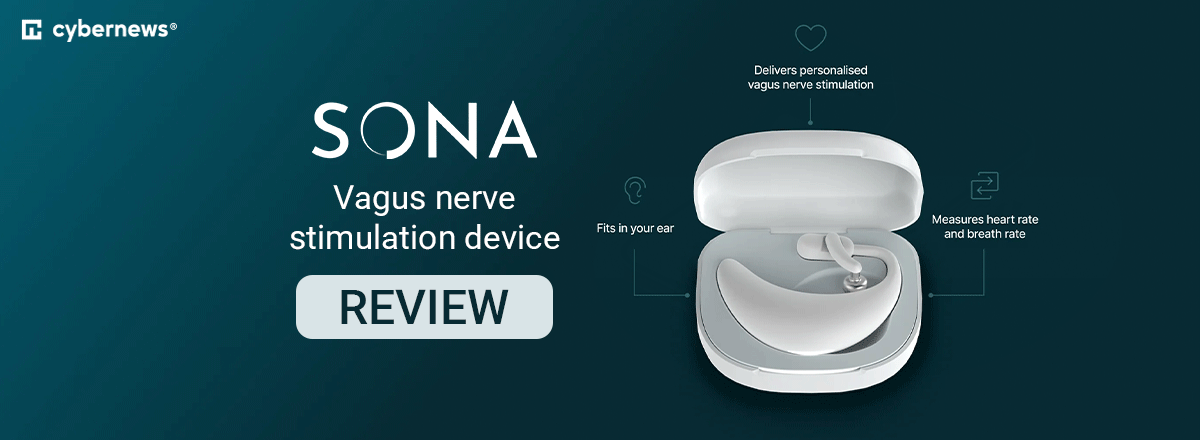
Nowadays, advancements in health and wellness technology are evident, and the latest wave of innovation has even brought us stress relief and relaxation devices. Among them, the Sona vagus nerve stimulation device has stood out to me.
At a glance, it seems like yet another wearable health-tech gadget that might have something to it but mainly offers empty promises. Or, at least that’s what I’m used to when it comes to such devices, as only a rare few truly bring the claimed benefits to the table.
As it turns out, this one is an exception, praised by users for truly delivering relaxation benefits and even better sleep. Naturally curious, I had to dive deeper, and this Sona vagus nerve stimulation review sums up all my findings in one place. Together with my team of Cybernews experts, I checked all the claimed benefits, pricing, and specs.
Quick overview of Sona vagus nerve stimulation
The best way to properly evaluate this device is to check all its features. The table below will show you more about the device before I dive deeper into how it works:
| Rating | 4.8 |
| Device type | Non-invasive vagus nerve stimulator |
| Purpose | Potential sleep quality improvement, stress reduction, relaxation support |
| Technology | External ear stimulation using electrical nerve modules |
| Use case | At-home, in-office, and on-the-go use |


Our team of in-house researchers, writers and editors reviews and analyzes health tech products using a research-driven approach. We gather data from multiple sources, fact-check all information, and conduct our research based on peer-reviewed studies, expert opinions, consumer ratings, and regulatory approvals.
You can learn more about how we test health tech products here.
What is vagus nerve stimulation?
The vagus nerve is the longest nerve in your body, stretching from the brainstem all the way to your chest and abdomen. It controls involuntary body functions, including heart rate regulation, blood pressure, and digestion.
It’s also said that this nerve plays a role in regulating mood. So, it’s thought that the stimulation via electrical impulses might help with relaxation and stress relief.
Still, there are two types of stimulation: invasive and non-invasive. Invasive vagus nerve stimulation is a clinical approach applied by healthcare professionals. It refers to surgically implanting a small device in the chest area that stimulates the nerve in the brain. It’s used for treating conditions like epilepsy and depression.
On the other hand, non-invasive vagus nerve stimulation is a technique that aims to deliver electrical impulses to stimulate the nerve without a surgical approach.
With this method, a small device, such as a Sona VNS, is placed in the ear canal, similar to using headphones. It then aims to send electrical impulses to the parts of the nerve in that area, which is said to have a positive effect on your nervous system.
The main difference between these two approaches is that non-invasive stimulation is not yet as medically backed as invasive methods, and vagus nerve stimulation devices like Sona are classified as wellness devices, not as medical devices, and are only intended for wellness purposes.
What is Sona vagus nerve stimulation, and how does it work?
Sona is a non-invasive vagus nerve stimulation device that aims to send gentle electrical pulses to stimulate the nerve. It targets the nerve’s auricular branch, which is located in the ear area, and the device just fits in your ear without any need for medical assistance.
You need to use a specialized clip to wear it, and it affects nervous system activity by sending gentle pulses for relaxation. The pulses are designed to be as gentle as possible, which results in a comfortable wearing experience.
One thing I’ve seen that confuses potential users is the difference between this one and clinical vagus nerve stimulation systems. The thing is, clinical systems are FDA-approved, which means they are used for treating drug-resistant epilepsy and similar conditions. On the other hand, non-invasive options like Sona are portable, wearable wellness devices and are not considered medical solutions in any way.
Non-invasive methods are still not scientifically approved for treating conditions like depression. Still, they’re tested by many users, and I’ve used their experiences to craft this review.
Sona is straightforward to use. You just need to get the companion app, which will show you exactly how to place the device in your ear. It’s even possible to adjust the stimulation intensity to what suits you best. Most sessions last 15-30 minutes, and you can use in-app programs to prepare for sleep, relieve stress, or sharpen your focus.
Key features and potential benefits of Sona vagus nerve stimulation
I was curious to learn more about the claimed benefits of this device, so my team of Cybernews experts and I got to work. We researched all the stated benefits and key features so that you won’t have to.
Headache
According to user reviews, the Sona vagus nerve stimulation device may help with headache conditions, such as migraines. Though this claim is not yet scientifically backed, some studies suggested that non-invasive vagus nerve stimulation might help reduce headaches - for example, one small study has shown that neck-based tVNS devices may reduce chronic cluster headache frequency.
Still, I’d point out that results may vary significantly from one customer to another. If you’re experiencing constant headaches and looking for a way out, I suggest seeking medical attention rather than relying entirely on devices like Sona.
Sleep problems
The parasympathetic nervous system is involved in sleep, so it’s somewhat logical that devices that stimulate its activity might improve sleep quality and relaxation. I’ve found many users claiming they used Sona before sleep and that it helped activate the “rest and digest” response, though I wouldn’t take that as gospel as research is still extremely limited.
Fatigue
Some studies also point to a direct relationship between vagus nerve stimulation and fatigue. However, I haven’t found any substantial scientific evidence on how effective devices like Sona could be in this regard. Some users dealing with fatigue reported improvements, so that’s at least a good sign.
GI function
As mentioned, the vagus nerve extends into and connects with the digestive system. Some users suggest Sona might help with certain gastrointestinal disorders, and while recent systematic review has suggested nVNS may hold promise as a potential therapy for diverse gastrointestinal disorders, evidence is still extremely limited and I’d still recommend following your doctor’s treatment recommendations and using Sona as an additional tool only if they suggest doing so.
Postural Orthostatic Tachycardia Syndrome (POTS)
Postural orthostatic tachycardia syndrome (POTS) is a condition that causes several unpleasant symptoms when you stand up from lying down, such as a faster heart rate and dizziness.
As far as using Sona in this context goes, some evidence suggests non-invasive vagus stimulation may hold promise in helping manage this condition. . More studies are needed to draw more definite conclusions.
Cognition
One of the easiest claimed benefits to verify was cognition, as the type of vagus nerve stimulation Sona uses has already been studied in this context. Some studies suggest that stimulation leads to cognitive improvements, including increased attention span, better memory, and faster processing speed.
Though the extent to which devices like Sona can entice the nervous system in this way is still questionable. Users have reported certain improvements, so I'd suggest using the device as an assistive tool in cognitive training.
Exercise performance
Finally, there is some research available on how vagus nerve stimulation affects proper heart rate regulation during exercise, and even helps with muscle recovery. Still, with limited evidence, I’d say you should consult your medical professional on this and not rely on Sona to significantly improve your exercise and recovery routines.
Who should and shouldn't buy Sona vagus nerve stimulation?
Everything we’ve covered so far begs the question of who should use the Sona vagus nerve stimulation device. On that note, it’s crucial to state once again how it’s more of a wellness tool than a medical-grade device, and here’s who it’s best suited for:
Who should consider Sona:
- People experiencing chronic stress. Based on user reviews, those frequently dealing with stress and looking for a non-pharmaceutical approach to calming your nerves might find Sona helpful.
- Wellness users practicing mindfulness. I’d also recommend it to those engaged in meditation or other nervous-system-based exercises, though only as a complementary tool.
- People seeking sleep support. As long as your doctor’s ruled out any severe sleep disorders, Sona might help with your bedtime routine and potentially even improve your sleep.
- Users managing occasional headaches. If you’re experiencing cluster headaches, you might want to consider Sona as an additional relief method, as long as you’ve previously contacted your medical professional for guidance.
- Biohackers and early adopters. Finally, I’d recommend Sona to people seeking to adopt new wellness trends to improve their lifestyle.
Who shouldn’t buy Sona:
- Short-term users. I wouldn’t recommend Sona to users who plan to just do a test run, especially given the steep price and the user-reported fact that most of the claimed benefits require constant use.
- Those undergoing medical treatment. I also wouldn’t recommend it to users seeking a solution for medical conditions, as Sona is not a substitute for medical care.
- People with severe medical conditions. While scientific studies on vagus nerve stimulation are still scarce, this type of therapy is generally not recommended to anyone with medical conditions affecting the nervous system, such as cardiac arrhythmias or respiratory issues.
That said, if you have any health concerns or complaints, make sure to consult your healthcare provider first. They’ll make an appropriate diagnosis, recommend evidence-based treatment, and will evaluate whether non-invasive vagus nerve stimulation may be a suitable complimentary approach in your individual case.
Final verdict: is Sona vagus nerve stimulation worth it?
Ultimately, as interest in vagus nerve stimulation continues to grow, devices like Sona represent an entry point into biohacking, which is becoming increasingly popular. While not a substitute for medical treatment or devices, some of its claimed benefits are potentially considerable.
It’s portable, easy to use, and comes with strong community support from existing users sharing their experiences. On the flip side, it’s a bit pricey, and I’d say it still lacks scientific validation, as different users report different reactions to stimulation.
Based on my research and user-reported reviews, the Sona vagus nerve stimulation device could be a valuable tool for stress relief, improved sleep quality, and overall nervous system relaxation. However, it would be reassuring to see more scientific background and tests.
Other health tech devices you might be interested in:
Pulsetto review 2026: does it really work?
Nurosym review for 2026: what it is and does it work?
Hoolest VeRelief Prime review 2026: everything you need to know before buying
ZenoWell auricular vagus nerve stimulator review: does it relieve stress?
FAQ
How does Sona vagus nerve stimulation actually feel when used?
Users report that applying Sona vagus nerve stimulation feels like a gentle tingle or a pulse in the ear where the device is placed. You shouldn’t feel any pain or discomfort.
How often should I use Sona for the best results?
According to the manufacturer, Sona should be used once per day, with sessions lasting 15-30 minutes. However, there’s no scientific evidence that would allow us to know optimal usage time.
Is Sona safe for everyone?
No, Sona might not be necessarily safe for everyone. Consult your healthcare provider prior to use.
Can Sona vagus nerve stimulation replace medication or therapy?
No, Sona vagus nerve stimulation still isn’t medically approved or based on extensive scientific evidence, so it shouldn’t replace real therapy or advice from medical experts.
Where can I buy Sona vagus nerve stimulation, and what’s the price range?
You can buy the Sona vagus nerve stimulation device from the manufacturer's official website for around $925.