Can you get a refund if you are scammed on Venmo? (the hard truth for 2026)
Our in-house experts test identity theft protection services themselves, using real-world scenarios and established testing methods. We look at how well each service monitors personal information, how quickly and clearly it sends alerts, what recovery support it offers, and how it handles customer data.
We assess every provider using the same criteria and explain our testing process clearly, so readers can compare services and make a more informed choice.
Learn more

Most people assume Venmo works like a credit card: with built-in protection, quick chargebacks, and guaranteed refunds. Unfortunately, that belief is one of the biggest financial traps of the digital payment era.
In reality, when you send money via Venmo, you’re not making a protected purchase – you’re initiating a peer-to-peer (P2P) transfer. That distinction is critical because it means once cash leaves your account, it’s usually gone for good. Scammers know this better than anyone, exploiting Venmo’s speed and “finality” to vanish before users even realize what’s happened.
So, how lucky are you to get your money back if you were tricked? The hard truth: not very. While Venmo’s refund system offers little to no relief, there are proactive steps you can take to protect yourself. In this guide, I explore the real limits of Venmo protection – and how tools like Bitdefender can close the refund gap before it costs you.
The “finality” problem: why Venmo refunds are so rare
Venmo’s biggest convenience is also its greatest vulnerability: once you hit Pay, the money moves instantly and almost never comes back. There’s no waiting period, no escrow, and no guaranteed recourse – the transaction clears directly into the recipient’s Venmo balance, often within seconds.
It’s only natural for many users to go searching for a Cancel button once they realize they’ve been scammed, only to discover it doesn’t exist. This is because Venmo’s system wasn’t built for reversals, it was designed for effortless peer-to-peer payments between trusted contacts.
According to Venmo’s user agreement, P2P transactions are final and occur at the user’s own risk.
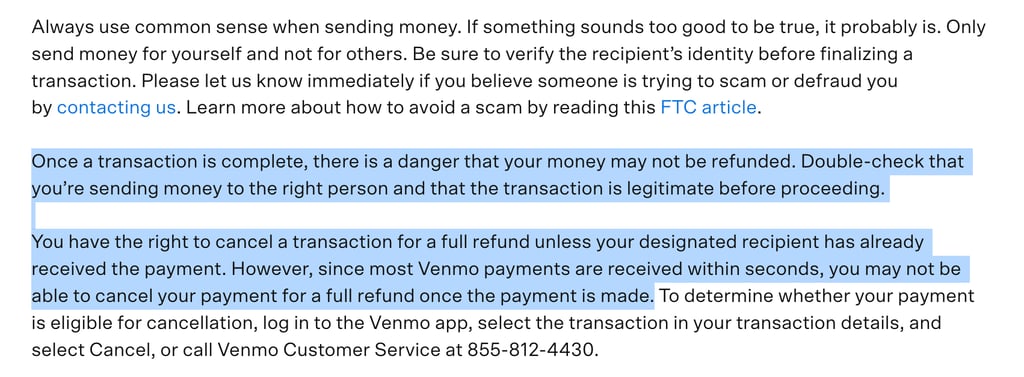
Think of it as the platform treating these payments like handing someone physical cash – once it changes hands, ownership transfers completely. And this is where this policy contrasts sharply with credit cards and traditional bank transfers, where chargebacks and fraud investigations offer significant consumer protection.
As a result, with Venmo, the responsibility rests solely on you. You’re not protected by on-demand refunds or dispute guarantees. This means prevention, not reaction, is your only real defense.
Understanding Venmo purchase protection (the only safety net)
Venmo does offer a form of buyer protection – but it’s far from universal. Refund eligibility only exists if your payment qualifies as a purchase under Venmo’s Purchase Protection Program. That means you must adhere to one of the two available options:
- Sending money to a verified Business Profile
- Manually toggling the Purchase switch before confirming your payment
Only then can Venmo investigate disputes involving tangible goods that never arrive or arrive damaged.
However, this protection excludes a wide range of transactions, including:
- Real estate
- Services
- Digital items
- Person-to-person transfers
- Anything related to investment schemes
If you forget to enable the Purchase toggle or pay someone using a personal profile, you’ve effectively sent unprotected cash, and Venmo won’t intervene.
To stay protected, always follow these 3 steps:
- Verify the seller’s business status
- Confirm the Purchase option is active before sending money
- Document your purchase details
In a system where refunds are the exception, this small checklist is your only real safety net.
Common Venmo scams: from “accidental payments” to smishing
In 2026, Venmo scams have evolved beyond simple trickery – they’re now finely tuned social engineering operations that prey on trust, urgency, and confusion. One of the most damaging is the Accidental Payment scam.
Here’s how it works: a scammer sends you money, claiming it was an honest mistake, and politely asks for it back. In reality, that payment was made with a stolen credit card or a compromised account. When the original cardholder disputes the charge, Venmo reverses the fraudulent transfer – but not the money you sent back. As a result, you’ve reimbursed a scammer and lost real cash in the process.
Another fast-rising threat is Smishing, short for SMS phishing. Victims receive text messages posing as Venmo security alerts, such as “Your account is locked,” “Payment verification required,” or “Suspicious login detected.” These messages lead to fake login pages designed to gather credentials or two-factor authentication codes. Once threat actors gain access, they drain balances, impersonate users, or redirect bank transfers linked to accounts.
Other common Venmo scams in 2026 include:
- Fake seller listings. Fraudsters advertise discounted goods on marketplaces, request Venmo “friends and family” payments, and disappear once funds are sent.
- Phony Venmo support calls. Scammers impersonate customer service, asking for verification codes or access to fix your account – a common route to full account takeover.
- Overpayment scams. Criminals “accidentally” send too much for an item you’re selling, then request a refund before their original, fraudulent payment gets revoked.
- Prize and giveaway scams. Text or email alerts claim you’ve won a Venmo reward or reimbursement, but require clicking a malicious link to claim it.
- Romance or trust scams. Malicious actors pose as long-distance partners or friends in need, slowly building emotional pressure before requesting transfers.
- Verification code hijacking. Scammers trick you into reading your Venmo authentication code aloud, granting them direct access to your funds.
What’s critical to understand is that Venmo itself isn’t being hacked – you are. The app’s encryption holds strong, but the weak point is human psychology. Scammers manipulate trust, fear, and helpfulness, not code – counting on users to act faster than they think. Recognizing these tactics is the first line of defense in preventing irreversible loss.
Damage control: steps to take if you’ve been scammed
If you’ve already fallen victim to a Venmo scam, immediate action is critical – every minute counts. Here’s what you need to do right away:
- Open the Venmo app, locate the transaction, and use the Report a Problem or Dispute option to flag the payment for review.
- Contact your bank or credit card issuer if the payment was made with a linked card, as you may be eligible for a chargeback under their fraud protection policy.
Venmo discourages external reversals, and initiating a chargeback may result in your Venmo account being frozen or permanently banned.
- Document all communication and screenshots related to the scam, and file a report with both Venmo Support and the Federal Trade Commission (FTC) to create a paper trail.
Recovery isn’t guaranteed, but acting fast and staying within official reporting channels gives you the best possible chance.
How Bitdefender orchestrates your pre-emptive Venmo defense
Venmo may lack built‑in buyer protection for peer‑to‑peer payments, but Bitdefender fills that vacuum with intelligent, real‑time fraud detection. The answer to whether Bitdefender can stop a Venmo scam before it happens is a decisive yes.
It does so not by intercepting payments, but by acting as your Identity Command Center, exposing the deceit before you ever tap Send. Bitdefender continuously monitors your digital environment, identifying the red flags that even the most cautious users might overlook. Here’s how it can help:
- Bitdefender Scam Protection Pro is the first line of its defense. It dissects incoming messages and notifications for Smishing attempts – the fake Venmo alerts or refund confirmations designed to capture your login details. The AI scans SMS content in real-time, cross‑checking URLs, sender patterns, and tone for social engineering cues, instantly warning you if a message is a scam.
- Mobile Smishing Protection shields your phone across both iOS and Android. It automatically monitors text messages for high‑risk triggers (e.g., “account locked,” “payment failed,” or “verify login”) that typically signal a Venmo credential trap or payment redirection attempt. With a single alert, Bitdefender security solutions block the attempt before it puts you at risk.
- Bitdefender’s Anti‑Phishing and Anti‑Fraud modules strengthen that barrier further. They intercept malicious web links and mirror sites looking like Venmo’s login portal, ensuring you never enter credentials on a cloned page.
- Digital Identity Protection operates in the background like a 24/7 intelligence network. It monitors the dark web for exposure of your email address, phone number, or linked accounts, alerting you the moment personal data associated with your Venmo identity appears in a breach. The result is protection that acts before thieves can exploit your data for targeted account takeovers.
In a world where P2P payment fraud moves faster than any refund policy, Bitdefender’s digital protection is the only realistic way to stay one step ahead. It doesn’t just react to scams – it prevents them, orchestrating complete digital defense before your money, your trust, or your identity ever come under fire.
FAQ
Can I get my money back from a Venmo stranger?
Highly unlikely. Unless you enabled Purchase Protection or paid to a verified Business Profile, the recipient controls the funds. Venmo treats standard P2P transfers as final cash payments, so recovery depends entirely on the other person voluntarily sending the money back.
Is it safe to use Venmo for Facebook Marketplace?
Only if you toggle Purchase Protection before paying. Never use Venmo’s “Friends & Family” option for strangers, as these transactions bypass coverage entirely. For marketplace deals, it’s best to verify the seller’s business status and avoid anyone insisting on personal payments.
What if I accidentally paid the wrong person?
Since Venmo doesn’t reverse transactions sent to the wrong account, you must message the recipient directly to request a return. If they refuse, there’s no platform‑based solution, so you should always carefully review all the details before sending money to anyone.
Does Bitdefender protect my Venmo app?
Yes, Bitdefender security solutions shield Venmo through Android app scanning, anti‑phishing, and fraud prevention on all platforms. It blocks malicious links and detects fake security prompts targeting your account, keeping payment sessions private and secure.
What is Venmo Smishing?
Venmo Smishing is when scammers send fake Venmo texts about “account issues” or “payment alerts” to steal credentials. Bitdefender Scam Protection Pro scans texts in real time, flagging suspicious links or wording before you click, effectively neutralizing smishing attacks.
Can I file a chargeback for a Venmo scam?
Yes, if you used a linked credit card. However, it’s important to note that chargebacks can result in account suspension or a permanent ban from Venmo. Report the fraud through official channels first before escalating through your bank or card provider.