Aura vs IdentityForce: which identity protection service is worth your money in 2026?
Our in-house experts test identity theft protection services themselves, using real-world scenarios and established testing methods. We look at how well each service monitors personal information, how quickly and clearly it sends alerts, what recovery support it offers, and how it handles customer data.
We assess every provider using the same criteria and explain our testing process clearly, so readers can compare services and make a more informed choice.
Learn more
In 2026, identity theft protection has become essential for protecting your digital and financial identity. With data breaches, scams, and online fraud on the rise, safeguarding your personal information has never been more critical. Among the leading services in this space, Aura and IdentityForce stand out. But which one truly gives you more for your money?
As a Cybernews expert, I teamed up with our research team to deeply analyze these two services. We dug into official claims, product specs, and third-party reviews to compare their features, pricing, and overall performance. We also factored in user reviews and the broader reputation each brand has built over time. Here's everything you need to know before making your decision.
Aura vs IdentityForce overview
Here’s how Aura and IdentityForce compare at a glance:
| Aura Identity Theft Protection | Identity Force | |
| ⭐ Rating: | ||
| 🥇 Overall rank: | #2 out of #20 | #10 out of #20 |
| 💵 Price: | From $8.00/month | From $19.90/month |
| ✂️ Free version: | Yes, 14-day free trial | Yes, 30-day free trial |
| 🖥️ Platforms: | Windows, macOS, iOS, Android | Web, iOS, Android |
| 💰 Credit monitoring: | Yes (3-bureau credit monitoring) | Yes (3-bureau on UltraSecure+Credit) |
| 🔒 Insurance: | Yes, up to $1M/adult | Yes, up to $2M (family) |
| 🔥 Coupons: | Aura Identity Theft Protection coupon 66% OFF! | Identity Force now starting at $19.90/month |

Aura is better suited for families looking for modern protection across devices, while IdentityForce tends to appeal to budget-conscious users focused on credit monitoring. Aura launched in 2019 and has rapidly expanded with modern tools and a sleek interface. IdentityForce, meanwhile, has over 15 years of reputation behind it and is owned by TransUnion.
It’s worth noting that Aura’s innovation pace and design choices give it an edge when it comes to modern UX expectations. On the other hand, IdentityForce's legacy and ties to a major credit bureau add credibility and depth to its financial protection features.
Aura pros and cons
Aura’s biggest strength lies in integration. It brings several features under one roof, saving users the hassle of juggling separate apps for credit alerts, online security, and family controls. However, the lack of flexibility in choosing only the features you need might be a drawback for some.
IdentityForce pros and cons
While IdentityForce might feel dated in design, its functional strength lies in the granularity of the data it offers. Users with a keen interest in financial health tracking and fraud prevention often prefer its depth.




Our in-house experts test identity theft protection services using real-world scenarios and consistent criteria. We assess monitoring, alerts, recovery support, and data handling to help readers compare providers confidently. Learn more about our testing process.
Our methodology
To compare Aura and IdentityForce, I partnered with the Cybernews research team to evaluate each service using real-world criteria and verified provider data. We used a weighted scoring system to ensure a fair and data-driven analysis:
- Identity protection tools (35%). We looked at SSN tracking, dark web monitoring, identity restoration services, and the quality of alerts.
- Credit monitoring (25%). We evaluated the number of credit bureaus monitored, access to credit scores, and fraud alert systems.
- Device security (15%). We considered whether services include VPNs, antivirus software, password managers, and Wi-Fi protection.
- Pricing and plan value (15%). We analyzed plan structures, pricing transparency, and what users get for the money – including family vs. individual options.
- Ease of use + customer support (10%). We reviewed user interfaces, mobile app experiences, cancellation flexibility, and access to live support.
These weighted categories helped us fairly determine which service is best for different user needs – from families to credit-focused individuals. We also used simulated user scenarios to evaluate how real customers might interact with the platforms.
Aura vs IdentityForce: prices and plans
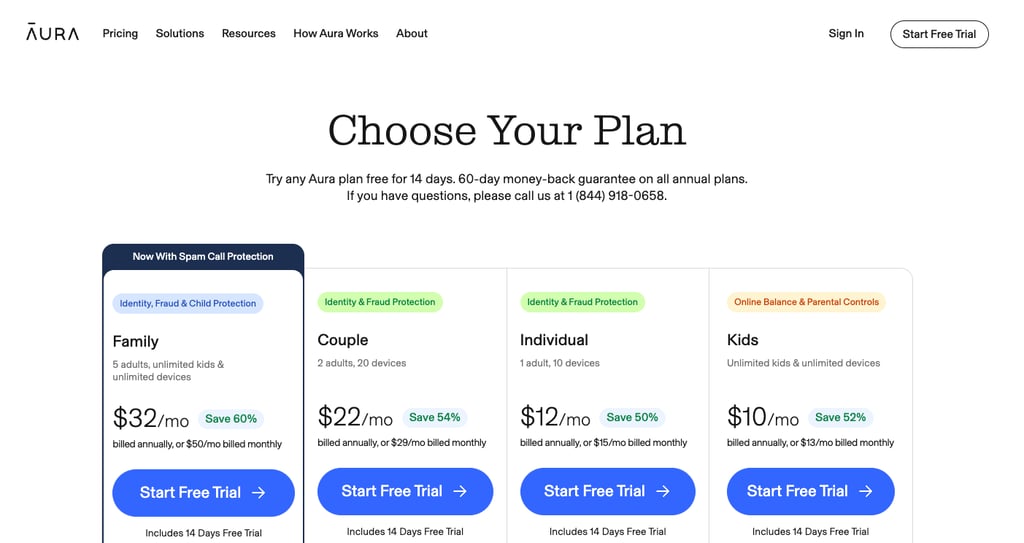
Aura’s pricing starts at around $8.00/month (billed annually) for individuals, and its family plan covers up to five adults and unlimited children. Each plan includes comprehensive coverage that bundles identity protection, credit monitoring, VPN, antivirus, and a password manager in one package. Annual billing brings added savings, and users benefit from consistent feature access regardless of the subscription tier.
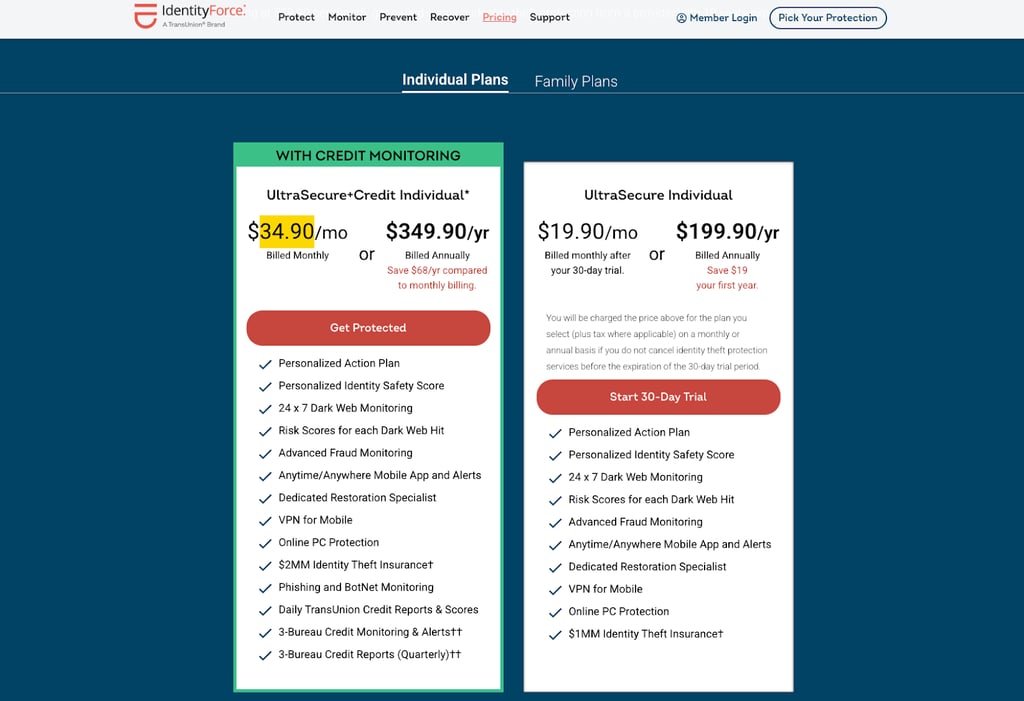
IdentityForce begins at $16.66/month (billed annually) for its UltraSecure plan and goes up to $34.90/month for the UltraSecure+Credit plan, which adds credit monitoring features. While it allows for monthly billing, making it more flexible for short-term use, its family plan lacks the scalability of Aura's. In addition, users will need to pair IdentityForce with separate antivirus or VPN tools if they want full digital protection. That said, its credit-focused plans appeal to individuals with a strong interest in financial monitoring and recovery support.
Aura vs IdentityForce: identity protection
Aura uses real-time SSN monitoring, dark web scanning, and behavioral alerts to proactively flag suspicious activity before it becomes a major issue. The service also scans data broker sites and breach repositories to provide early warnings. Its identity theft insurance covers $1 million per adult on a plan and includes white-glove restoration support that assists with paperwork, account recovery, and fraud resolution.
IdentityForce also provides SSN tracking and dark web monitoring, with robust coverage of public records and identity databases. However, its alerts are not as flexible or customizable, and some users report delays in notification delivery. That said, the service offers strong restoration support with access to certified recovery specialists. Despite its effective backend, the user experience feels dated, with a dashboard that hasn’t kept up with modern design trends or mobile-first usability.
Aura vs IdentityForce: credit monitoring
Aura monitors all three major credit bureaus (Equifax, Experian, and TransUnion) and provides users with monthly credit reports, score tracking over time, and real-time alerts for any unusual or suspicious activity such as hard inquiries or new account openings. Its dashboard presents this information in a clean, user-friendly format and integrates it seamlessly with other identity and device protection features. Aura also includes credit score simulators to help users see how certain financial actions might affect their credit.
IdentityForce, on the other hand, also monitors all three bureaus and offers a deeper level of financial tracking. It delivers detailed credit score history, notification breakdowns by category (e.g., address changes, new tradelines), and additional insights like public record alerts. Its granular reporting is particularly useful for users who want to closely manage their credit profile or detect fraud patterns quickly. The platform includes credit score calculators and historical charts, giving more control and context than Aura in this specific area.

Aura vs IdentityForce: device protection
Aura bundles antivirus, VPN, and a password manager across all plans, ensuring that users have comprehensive device-level protection without needing to purchase separate software. The VPN uses bank-grade AES-256 encryption and allows secure browsing even on public Wi-Fi networks. The antivirus component offers real-time malware detection, phishing protection, and automatic scans, while the password manager helps generate and securely store complex credentials across devices.
IdentityForce, by contrast, does not offer any built-in tools for securing devices or online activity. Users who want features like antivirus or VPN will need to subscribe to third-party services. This limits its appeal for those seeking a unified solution that protects both identity and digital devices in one ecosystem.
Aura vs IdentityForce: additional security features
Aura includes parental controls that allow guardians to monitor screen time and restrict access to inappropriate content, making it an ideal choice for families with young children. It also offers safe browsing extensions to block malicious sites, spam call protection through number blocking and caller ID tools, and easy-to-follow fraud resolution guides for recovering from identity theft scenarios. All of these tools are integrated into Aura's platform for seamless access.
IdentityForce’s extras include lost wallet assistance, which helps users quickly cancel and replace credit cards and IDs, as well as medical ID fraud protection that monitors for misuse of health insurance credentials. It also features identity restoration help with access to certified recovery specialists. While effective, these tools focus more narrowly on core identity restoration rather than broader digital well-being.
Aura vs IdentityForce: privacy policies
Aura outlines a strong privacy policy that emphasizes user control and transparency. The company explicitly states that it does not sell user data to third parties and complies with SOC 2 standards, which require strict auditing of data handling, security, and privacy practices. Aura also gives users options to delete their information and limit data collection, which adds an extra layer of trust.
IdentityForce, while backed by TransUnion, shares user data within its broader corporate structure. This means that data may be used across affiliated companies for internal marketing or analytics purposes. Although the company claims to protect user privacy, its policy is less transparent about data-sharing boundaries, and it lacks independent certifications like SOC 2 that demonstrate adherence to industry-leading privacy protocols.
Final verdict: Aura or IdentityForce?
After researching both services, here’s what I recommend:
Choose Aura if you want a full-featured identity protection suite with device security, modern tools, and affordable family plans. Its all-in-one platform is ideal for households looking for simplicity and coverage. Users who value seamless setup and modern UX will find it especially appealing.
Choose IdentityForce if you’re mainly focused on credit reporting and want a long-standing provider with deep credit insights and monthly plan options. It’s a reliable choice for finance-savvy users who want more visibility into their credit landscape.
FAQ
Which service offers better value for families, Aura or IdentityForce?
Aura offers better family value. Its plans cover more users and include tools like parental controls, VPN, and antivirus at no extra cost.
Can I cancel either service at any time?
Yes, both services allow cancellation. Aura and IdentityForce offer monthly plans, so you can cancel before your next billing cycle.
Is Aura’s VPN and antivirus included in all plans?
Yes, all Aura plans include VPN and antivirus. These tools are bundled in both individual and family subscriptions without requiring extra purchases.
How accurate are the credit monitoring alerts from both providers?
Both services offer accurate alerts. However, IdentityForce provides more detailed breakdowns, while Aura focuses on clarity and ease of use.
Do either services offer mobile apps?
Yes, both offer mobile apps. Aura's app has a more modern design and integrates all features smoothly, while IdentityForce's app is functional but dated.
Are these services available outside the U.S.?
No, both services primarily operate in the U.S. International support is limited and features may not apply outside U.S. regulations and financial systems.