Book review: Algospeak explains new language, placates the boomer doomer like me
Most normies despise influencers, think they’re talking gibberish, and are completely rotten IRL. But if you’re worried about how the almighty algorithm is transforming or even censoring language, content creators can actually help. In fact, one of them has written a book about it.
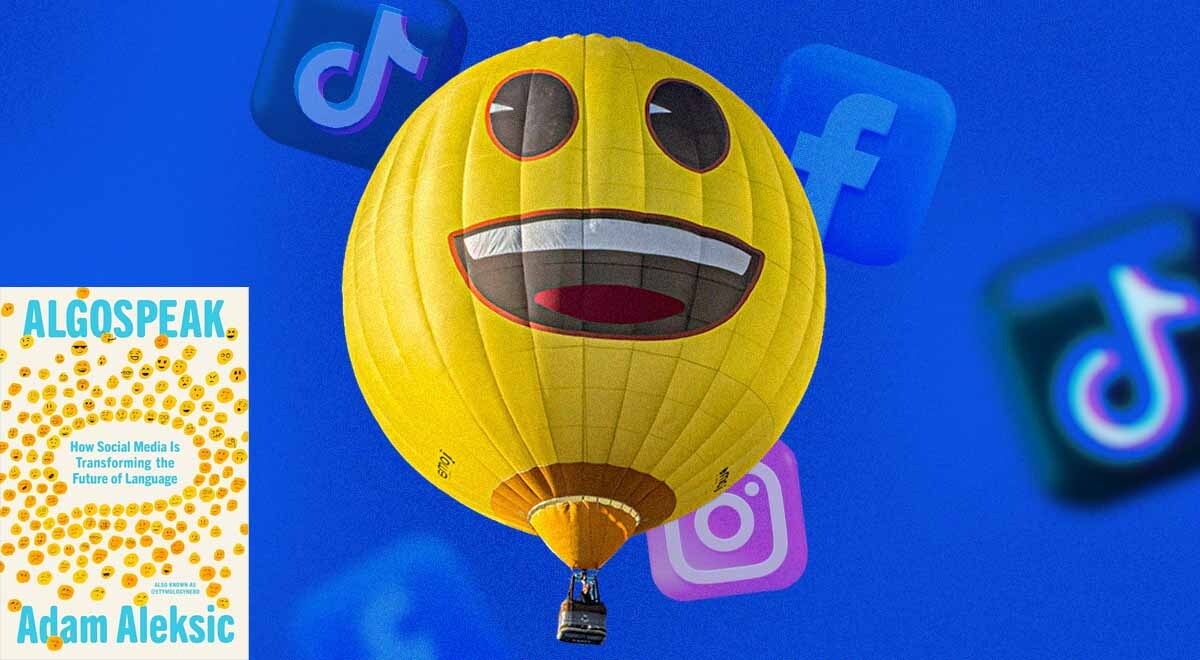
Image by Cybernews.

 Follow us
Most normies despise influencers, think they’re talking gibberish, and are completely rotten IRL. But if you’re worried about how the almighty algorithm is transforming or even censoring language, content creators can actually help. In fact, one of them has written a book about it.
If you’re a really hardcore Nirvana fan, you may have visited Seattle’s Museum of Pop Culture, where Kurt Cobain was recently commemorated. Shocker, though: the exhibit didn’t say he killed himself. It said, and it’s true, that “Cobain un-alived himself at 27.”
The placard was soon changed after the furore. But, actually, for many museumgoers, “unalive” is a word that’s quite normal these days.
Kids even say “unalive” in class, even figuratively. One teacher once overheard their student say: “Let’s go unalive some sandwiches.”
In other words, even if you – like me – are of an older generation and don’t really get what’s going on, “unalive” is very much alive and is only one of the first purely online words, made up to evade the algorithmic censors, to move offline.




There are more such inventions now – “seggs,” “kermit sewerslide,” “skibidi,” “sigma.” Somewhere, surely, there’s a curious subfield of semiotics dedicated to studying all this.
According to Adam Aleksic, a young content-creating linguist with millions of followers on TikTok, “Algospeak” – which is also the title of his 2025 book – is the future of the English language.
“Voldemorting” on social media
What is algospeak? It’s when you mold your online speech around algorithms and try to evade them.
By now, most people who are active on social media know that the algorithm doesn’t like certain words – sex, pornography, kill, and suicide are just a few examples.
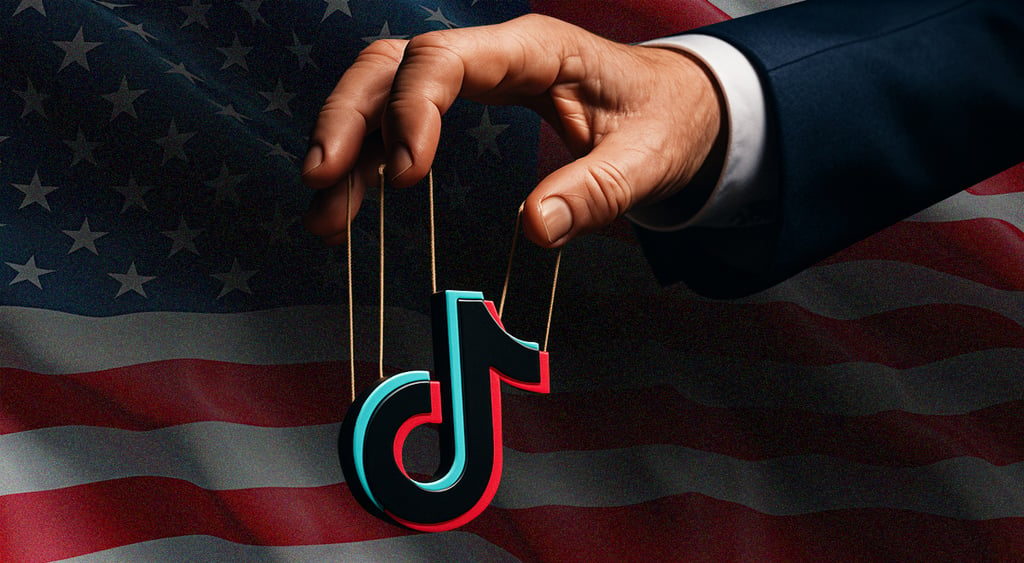
Many creators choose to refer to US President Donald Trump with words like “cheeto,” “45,” and “orange man.” This sort of Voldemorting is a signal that, to them, Trump’s name is filthy, too offensive to be uttered.
If this blunt instrument of content moderation sees them on TikTok, Instagram, or elsewhere, the content piece will be removed, suppressed, or shadowbanned.
In 2022, the Charles Dickens Museum had to try really hard to get itself un-shadowbanned from TikTok, for example, since the algorithm was flagging the museum’s videos as obscene because they included the keyword “dick.”
Content creators receive very few explanations from the platforms, and since they don’t really know whether their videos or posts are doing poorly because they’re bad or because they’re being censored, they – understandably – err on the side of caution to avoid a potential penalty.
Inevitably, then, the online language changes – and the faster and better the moderation tools are, the more words will be created.






Even medical professionals will regularly write “p3nis” and use the eggplant emoji on social media. There’s also “nip nops” for “nipples.”
But that’s easy. The more sensitive a topic is, the more it will be censored, and the more we’ll find ways to talk about it. That’s why if someone wants to discuss sexual assault, they will use the abbreviation “SA.”
Others avoid direct translations or euphemisms. In one 2023 video, a TikToker referred to Hitler as “the top guy of the Germans” because he was afraid of uttering his actual name on the platform.
As Aleksic points out, the social media researcher Emily van der Nagel calls this “Voldemorting,” since people are deliberately avoiding keywords in the same way wizards avoid saying the name “Voldemort” in Harry Potter.

Many creators choose to refer to US President Donald Trump with words like “cheeto,” “45,” and “orange man.” This sort of Voldemorting is a signal that, to them, Trump’s name is filthy, too offensive to be uttered.
Are we cooked? Almost certainly not
Once again, to many, all this (and more) sounds completely nonsensical. Aleksic himself notes that the developments in the space of online language could be seen by some as an almost apocalyptic, “these-kids-are-ruining-how-we-talk scenario.”
The author is more keen to see this as “an extra way of expressing ourselves that we’ve developed to fit a specific environment with specific constraints.”
“We have the power to both use and not use it, and can seamlessly slip in and out of it to best articulate our thoughts depending on the domain,” writes Aleksic.
Has your password leaked?
And yes, it’s true that essentially all influencers are “purposefully minimizing their own creativity in order to pander to perceived algorithmic tastes,” and that’s why everybody sounds the same online.
Aleksic then diverts, rather inexplicably, to muse about what it’s like to be an influential content creator and how many of his videos trend and why. So if you’re expecting the whole book to be about today’s language online, you might be disappointed.
But he’s very right that we shouldn’t be afraid of slang. Language is a constantly evolving thing, and its ability to change is beautiful and probably even necessary.
“Social media isn’t monolithically good or bad. It’s a mess, like any new technology. Language change has always been beyond our control and shaped by invisible factors,”Adam Aleksic.
“There’s always someone bemoaning the ‘corruption of the English language’ or saying that the slang words irritate them because they’re ‘grammatically wrong.’ In reality, of course, ‘correct’ English is a construct,” says Aleksic.
“The purpose of language is simply to be understood, and people can get their point across in many different ways.”
It even works in countries like China, where censorship is prolific. Social media users there are still able to sneak through algospeak substitutions.
When the Mandarin word for “censorship” began to be censored in the early twenty-first century, people pivoted to use the word héxié, meaning “harmonious” in an ironic reference to the CCP’s goal of building a “harmonious society.”

Then, once héxié also began to be censored, users switched to the homophone héxiè, which technically meant “river crab” but was understood as standing in for “harmonious.”
At a certain point, other users also started using shuǐchǎn, a phrase meaning “aquatic product,” in substitution for “river crab.” Yes, even in mighty China, censors find it hard to win the Whack-A-Mole.
“Social media isn’t monolithically good or bad. It’s a mess, like any new technology. Language change has always been beyond our control and shaped by invisible factors,” writes Aleksic.
“The underlying patterns are the same as they’ve always been – humans tenaciously coming up with new ways to express themselves – but it’s all happening in this entirely new medium and with rapid speed.”
Unlock more exclusive Cybernews content on YouTube.