Tesla driver manually overrode FSD before crashing into house and killing a woman
The victim’s daughter sued Tesla for at least $1 million in damages in late June
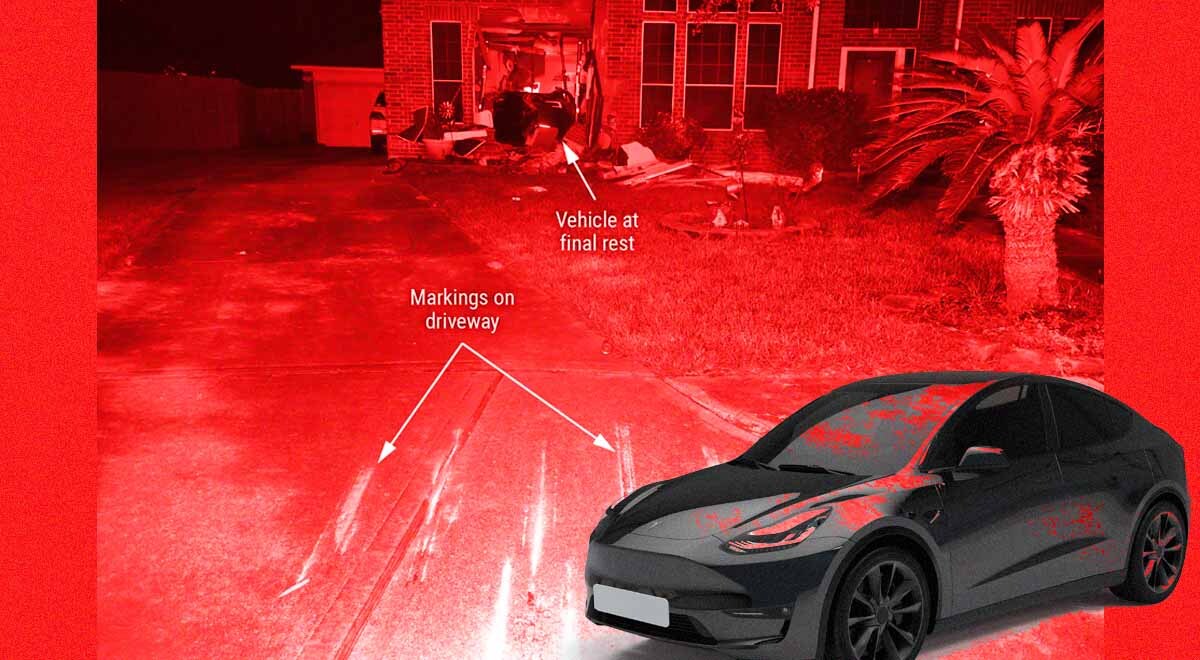
Image by Cybernews.

 Follow us
- NTSB found the driver, not Tesla's FSD software, was fully responsible for the fatal Texas crash
- Vehicle data showed the driver pressed the accelerator to 100%, reaching over 70 mph before impact
- Driver's Google searches for "Tesla FSD not aggressive enough" undermine his claim of using autopilot
A fatal Tesla crash into a house in Texas cannot be blamed on the company’s full self-driving technology, the US National Transportation Safety Board (NTSB) says. The driver overrode the software and caused the accident.
To many, an accident in Texas when a Tesla car struck a house and killed 76-year-old Martha Avila seemed just like another example of the company’s full self-driving (FSD) technology failing.
In fact, the Tesla driver himself told the police he was using FSD at the time of the crash. Unsurprisingly, the victim’s daughter accuses Elon Musk’s company of defective design and negligence for promoting unsafe technology.
That assumption is entirely reasonable. The wreck happened just as the National Highway Traffic Safety Administration is investigating approximately 3.2 million Tesla vehicles with FSD technology for various safety violations.
However, in this particular case, it looks like the driver was entirely responsible for the crash. The NTSB said Wednesday that he pressed the accelerator pedal to 100%, overriding the company’s FSD software.
Has your password leaked?
Electronic data recovered from the vehicle also showed that the Tesla Model 3 car was traveling more than 70 miles per hour when it departed the roadway, partially entered a driveway, and struck a house in Katy, Texas.
The findings aren’t final, but it seems the driver, who told investigators an automated driving assistance system was engaged at the time of the crash, wasn't telling the truth. He has also been sued by the victim’s family and faces a manslaughter charge.
Police found the driver’s recent Google searches, including the terms “Tesla FSD not aggressive enough 2026,” “Tesla not aggressive enough,” and “Tesla FSD too timid.”
Musk can now feel vindicated. Soon after Tesla was sued, he wrote on X: “This makes no sense. FSD drives slowly through neighborhood streets, and this was a high-speed crash!”
Tesla’s vice president of AI software, Ashok Elluswamy, followed up with a comment: “Yup. In this case, the driver manually overrode self-driving by pressing the accelerator all the way to 100% of the accelerator pedal in this residential area. They reached a speed of 73 mph during the crash, and had the accelerator pressed even after the crash.”
Now, the NTSB preliminary findings confirm Tesla’s account. The driver of the car had previously told the police he “passed out,” so it’s possible he could have pressed the accelerator involuntarily.
But a local ABC News affiliate, KTRK TV, also reported that police found the driver’s recent Google searches, including the terms “Tesla FSD not aggressive enough 2026,” “Tesla not aggressive enough,” and “Tesla FSD too timid.”
Court records additionally state that the driver rolled through a stop sign and at no time tried to press the brake pedal or turn away from the house.
