MCP and the Rise of Agentic AI: The Future of AI-Powered Web Workflows

 Follow us
AI is everywhere lately. We’ve all seen the hype cycles: chatbots that answer questions, image generators that spit out art, code assistants that autocomplete functions. They’re impressive, but when it comes to actually doing work, they fall short.
That gap is exactly why the tech world is buzzing about a new standard called MCP (Model Context Protocol) and why the phrase “Agentic AI” is suddenly everywhere. MCP is the infrastructure that turns AI from a helpful sidekick into an active participant in your workflows. And for web creators, it’s a breakthrough that could finally let AI update, build, and automate website workflows in ways that were previously unthinkable.
In this article, we’ll break down what MCP is, why it matters for the future of websites, and how Elementor’s upcoming Agentic AI, Angie, shows what’s next.
Why Today’s AI Still Feels Limited
Large language models (LLMs) like ChatGPT, Claude, and Gemini are impressive. They can:
- Generate content on demand
- Brainstorm headlines and layouts
- Even write snippets of code
But here’s the truth: today’s AI is still mostly about talking, not doing. Many of us get stuck in an endless copy/paste loop — pulling content from an AI, reformatting it, and trying to make it fit. To get anything half-relevant, you end up writing long prompts stuffed with context and background details, only to repeat the cycle again.
The problem isn’t intelligence. It’s context. LLMs don’t know the context of what you’re working on or your workflow. Without that context, they guess. LLMs are powerful with language, but at their core, they’re predictive text engines.
They generate words based on probability, not understanding. Without access to your actual tools or structured data, they can’t perform meaningful tasks. And that leaves you double-checking, editing, and doing the heavy lifting yourself.
Enter Agentic AI
This is where Agentic AI comes in. Unlike traditional generative AI, which hands you outputs to polish and paste, agentic AI combines reasoning with access to tools, memory, and goals.
That shift, from suggestion to execution, is what makes agentic AI so compelling. But to get there, AI needs a universal way to communicate with the apps, plugins, and systems it’s acting on.
That’s where MCP makes all the difference.
What is MCP?
MCP (Model Context Protocol) is an open-source standard first developed by Anthropic in 2024 to help Claude Desktop work more effectively with local files and system data. It acts like a universal connector between AI models and digital tools. At its core, MCP is a shared standard that lets AI systems speak the same language as your tools and data sources.
Instead of one-off integrations, MCP provides:
- Shared language: Tools expose their capabilities in a standard way.
- Tool discovery: AI agents can “see” what actions are possible.
- Structured context: Models understand where they are acting (e.g., which page, plugin, or dataset).
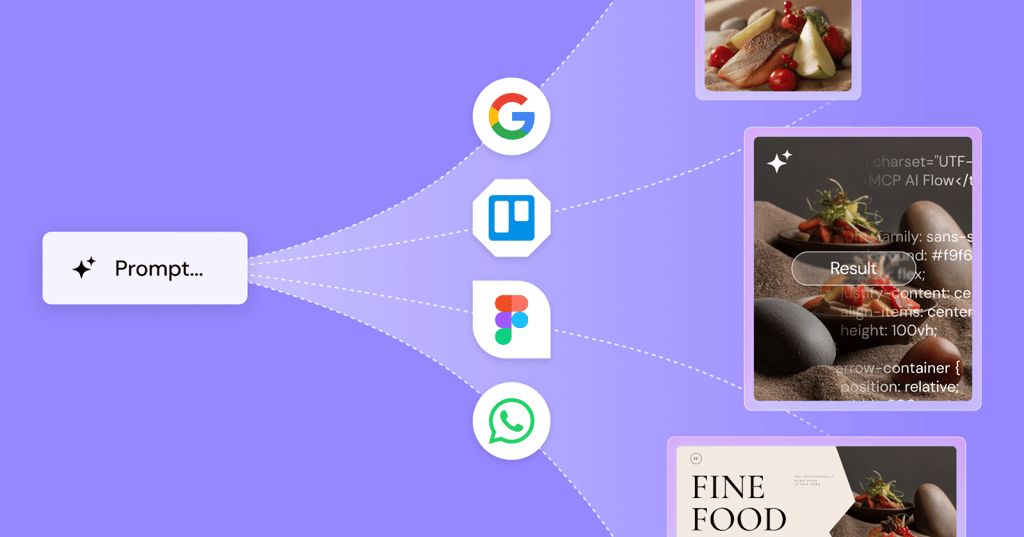
The result: AI can reliably perform multi-step tasks and power real automation behind the scenes, across different tools, without custom wiring each connection.
From Chat to Action: Why MCP Matters
For web creators and businesses, MCP bridges the gap between intent and outcome.
Here’s what becomes possible:
- Bulk content updates: Upload a CSV of hundreds of products and have the AI map data into WooCommerce automatically.
- Smarter workflows: AI assistants that understand your page layout, plugin stack, and content structure.
- Cross-tool automation: Sync CRM, CMS, and forms without custom scripts.
- Real-time execution: From building menus to updating banners, tasks are carried out inside your site, not just suggested text that you need to copy/paste from a chat window.
Instead of juggling tabs and repeating instructions, MCP allows your AI to truly understand and act.
Why Websites are the Perfect Testbed
The web is messy. Every WordPress site is different:
- Some run WooCommerce
- Others layer in Advanced Custom Fields
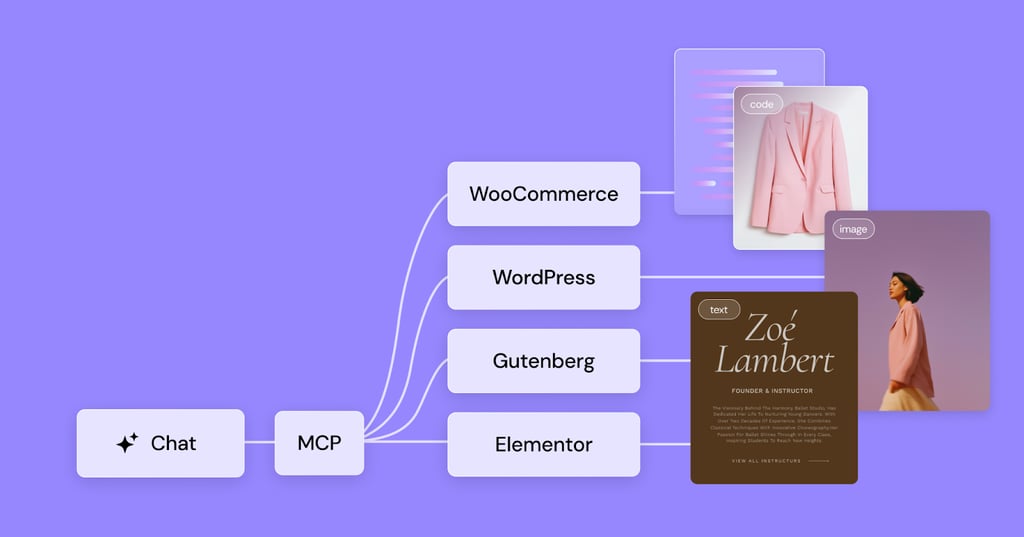
- Many rely on Elementor, Gutenberg, or niche plugins
- That complexity is exactly why AI has struggled in this space — but it’s also why MCP is so important. If AI can operate reliably across WordPress, it can operate anywhere.
Here’s one example, consider the following:
- Before MCP: You get a CSV from a supplier or client. Dozens of SKUs. Prices, stock levels, sizes, and colors. You log into WooCommerce. Create products one by one. Paste. Reformat. Double-check fields. Hours disappear.
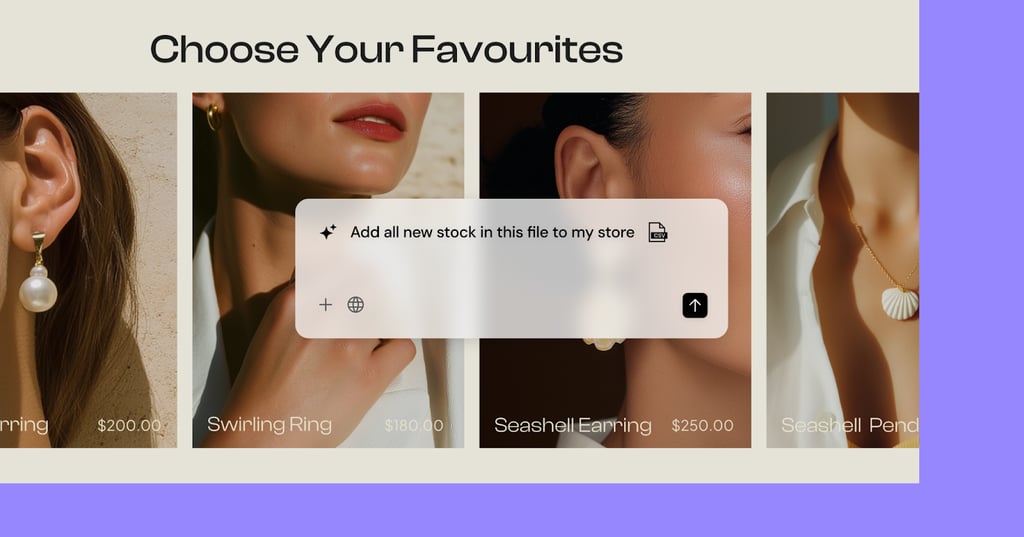
- With MCP: You write, “Add everything in this file to my store,” Angie reads the CSV, creates the listings, and maps every detail including price, image, and variant, right into WooCommerce.
Angie: Agentic AI for WordPress
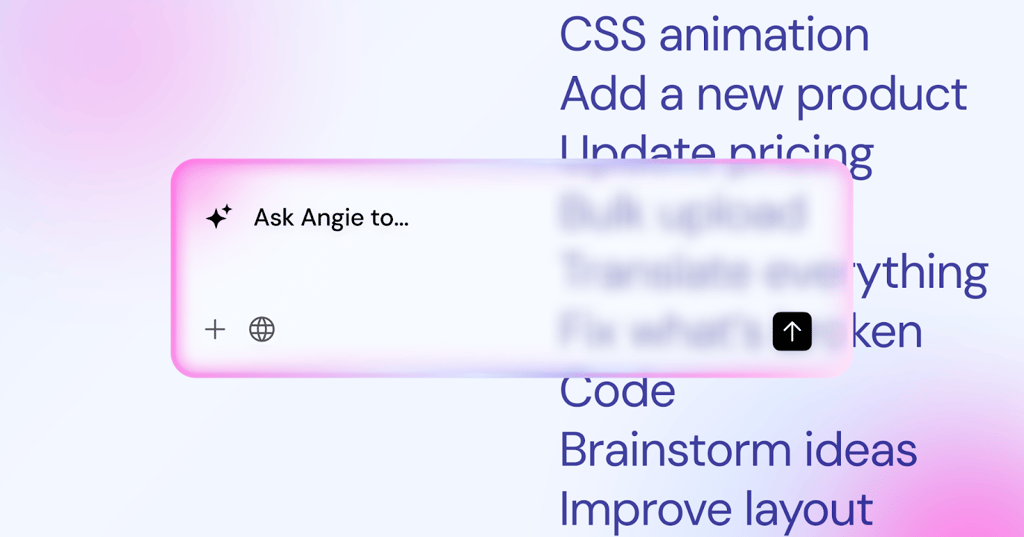
This is where Angie enters the picture. Built by Elementor, Angie is the first MCP-powered, agentic AI assistant for WordPress.
Instead of suggesting edits, Angie executes them:
- Create and publish new pages in minutes.
- Bulk-upload and categorize store products.
- Apply campaign-wide design or content updates.
- Automate repetitive tasks across your unique stack.
You stay in control, with every action visible and reversible. But the AI handles the heavy lifting, so you can scale projects faster, with fewer bottlenecks.
Why this Matters Beyond WordPress
Yes, Angie is launching inside WordPress, but the implications go far beyond it. MCP provides the blueprint for how agentic AI will work across all platforms: SaaS apps, enterprise systems, even consumer software.
Web creation is simply the proving ground, and if it works here, it can work anywhere.
Final Thoughts: From Hype to Infrastructure
Agentic AI isn’t just a buzzword. With MCP, it’s becoming real infrastructure. For the first time, AI can stop talking and start doing.
For web creators, that means less copy-pasting and more building. For businesses, it means faster workflows and fewer integration headaches. And for the AI industry, it means moving from impressive demos to real execution.
Try it First: Angie Early Access
Want to see MCP and agentic AI in action? Sign up for Angie’s Early Access and be among the first to experience an AI that understands your WordPress site, your tools, and your goals, and actually acts on them.