GrapheneOS says “fearmongering” over Sony age verification partner flagging users is suspicious
Users are fuming over complaints that Yoti, an age-verification service provider used by Sony, Facebook, and TikTok, automatically reports privacy-first GrapheneOS users to authorities.

Image by Cybernews.

 Follow us
Users are fuming over complaints that Yoti, an age-verification service provider used by Sony, Facebook, and TikTok, automatically reports privacy-first GrapheneOS users to authorities. The OS maker believes Yoti’s customer support agent “went on a power trip.” Meanwhile, Yoti denies having record of conversation about flagging GrapheneOS users.
- Yoti allegedly auto-reports GrapheneOS users to authorities during age verification processes for services like Sony PlayStation and social platforms.
- GrapheneOS moderators dismissed Yoti's claims as fearmongering, suggesting a customer support agent made exaggerated statements to close a ticket.
- Yoti denied ever reporting users based on operating systems, stating the circulated customer support email doesn't match company records and is working with GrapheneOS.
- Yoti was fined $1.1 million by Spanish regulators in March 2026 for mishandling biometric data within its digital identity application.
Key Takeaways by nexos.ai, reviewed by Cybernews staff.
The uproar on social media was sparked after a now-removed post on r/privacy on Reddit shared a Yoti response about its unsuccessful age-verification process. Yoti is a major player in the age verification industry, providing services for heavy hitters such as TikTok, Sony, Meta, Spotify, and many others.
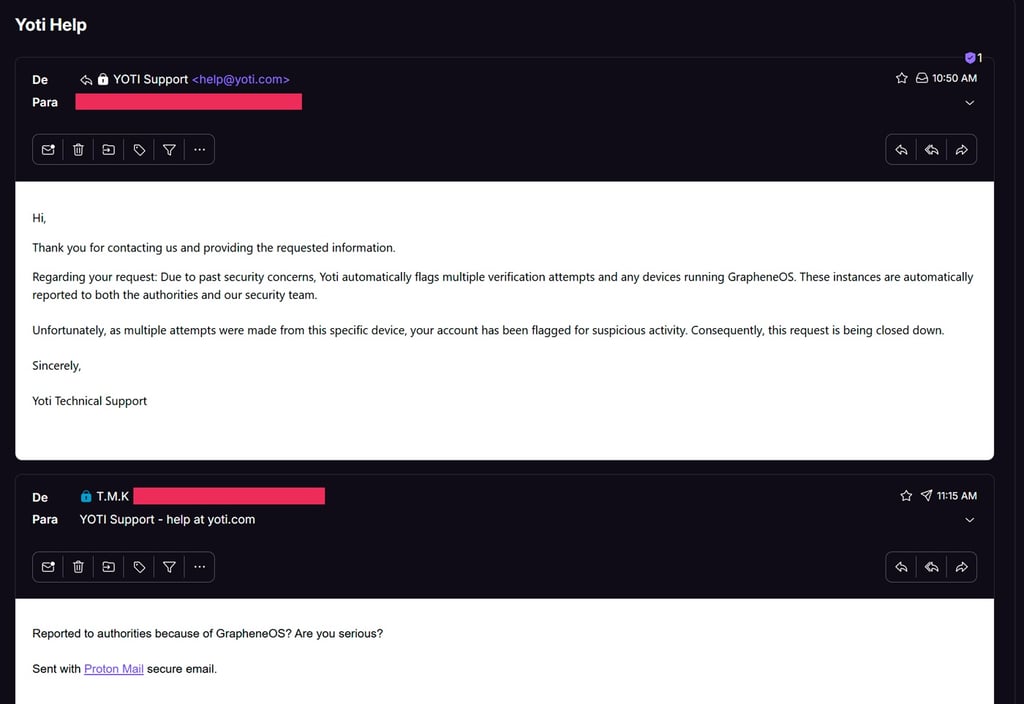
According to screenshots of the conversations, seen by Cybernews, the London-based company’s customer service told the user that the company flags “multiple verification attempts and any devices running GrapheneOS.”
“These instances are automatically reported to both the authorities and our security team,” reads the alleged Yoti customer support message.






Moreover, the customer support agent allegedly told the customer their account had been flagged for suspicious activity and, as a result, the customer’s request was closed down.
GrapheneOS is an open-source mobile operating system built on the Android Open Source Project (ASOP), the base version of Android that anyone can modify. The OS has most of Google’s data collection components removed, making it a favorite for the privacy-first crowd.
However, there’s nothing intrinsically illegal about GrapheneOS, which leaves the reporting of all of the platform's users to the authorities questionable.
The Cybernews community is talking about this. Be a part of the conversation.
Yoti explained to Cybernews that the company “would never report any user to the authorities based on their choice of operating system or device.”
“The image of the customer support email being circulated online does not match anything in Yoti’s customer support records. Yoti has engaged with GrapheneOS to better understand any issues their users may be experiencing and explore ways to securely resolve those issues,” Yoti's spokesperson told Cybernews.
“The image of the customer support email being circulated online does not match anything in Yoti’s customer support records”Yoti's spokesperson said.
Meanwhile, GrapheneOS moderators tried to calm down users on the GrapheneOS discussion forum, putting the blame of the incident on the customer support agent. Moderators called Yoti’s reply “fearmongering.”
“This is fearmongering based on customer support making ridiculous claims to someone. There's nothing illegal about using GrapheneOS and the customer support is nearly certainly making it all up to get the person to go away so the ticket can be considered closed,” GrapheneOS moderators said.
The open-source OS’s admins explained that it’s highly unlikely Yoti has done anything to detect or ban GrapheneOS, as it’s only able to notice that the user is not using a Google Mobile Services OS.
“This customer support person went on a power trip to scare someone and get the ticket closed,” the forum admins said.
Users fuming over Yoti’s practices
Meanwhile, Reddit users spared no punches for Yoti and companies that use its service. While it’s unclear what service the user who posted the conversation was trying to access, the consensus online is that it was a Sony PlayStation environment.
“Soooo, no more buying Sony,” the first comment on the thread said.
“This, buy a PC and start pirating. It's the only way to have anything resembling rights and privacy,” another one replied.

Others were quick to point out that Yoti’s behavior could be violating the EU’s General Data Protection Regulation (GDPR).
In March 2026, Yoti was fined by the Spanish data protection regulator AEPD for the handling of biometrics and other data within its digital identity app. Yoti was ordered to cough up $1.1 million (€950K).
“This post highlights the insanity. Imgur is blocked in the UK, so some can't see the OP image of Yoti saying privacy tools and hardened OS are security issues and reporting to authorities. You can't even play on a PlayStation without verifying an ID, let alone 18+ R titles. The list goes on,” another Reddit user pointed out.
More countries adopting age verification
Numerous countries have implemented various age-verification regulations to limit underage users’ access to explicit content. However, the push hasn’t been without its flaws. For one, researchers believe lawmakers expect age verification to serve as a silver bullet to all problems.
Regulation has spawned entire industries designed to bypass age verification for paying users. So-called age-verification marketplaces, often outside the control of Western jurisdictions, charge several dollars to confirm users' ages.
Meanwhile, the EU government’s attempts to develop its own solutions have been met with skepticism. After the EU Commission unveiled its age verification app, researchers claimed they managed to bypass it in less than 2 minutes.






Despite setbacks, more countries are pressing on to implement age-verification laws.
EU lawmakers previously backed social media age limits, proposing bans for children under 13 and parental consent requirements up to age 16. The United Kingdom took an aggressive stance under its Online Safety Act, requiring adult sites to implement age checks by mid-2025.
Meanwhile, Australia became the first country to ban social media outright for under-16s, with Meta, TikTok, and Snapchat complying. Following the ban, adult sites like Pornhub and xHamster started blocking unverified Australian users entirely.
Updated on June 9th [07:35 a.m. GMT] with a statement from Yoti.
Unlock more exclusive Cybernews content on YouTube.