Vaultcard RFID blocking card review: features, performance and price

Contactless payments and the RFID technology are now everywhere – from your credit cards to your ID to your hotel key. With them, you can make a payment or verify your identity with just a tap, but this convenience also brings risks. Contactless use opens doors to RFID skimming and unauthorized scans, especially in crowded spaces and during travel.
Luckily, a RFID-blocking card can become a great, simple protection from frauds, ensuring your peace of mind. All you need to do is place it in your wallet, and forget it’s even there.
Together with the Cybernews research team, I studied and reviewed the Vaultcard RFID blocking card to see how it compares against other options on the market – and if it’s worth your time.
In this article, we’ll take a closer look at Vaultcard features, performance and price, examine where it stands compared to other models, and explain how RFID blocking cards work.
Quick overview of Vaultcard RFID blocking card
Before taking a closer look at its performance, design and price range, I summarized some of the Vaultcard’s key characteristics below. Here’s a quick overview of the Vaultcard RFID-blocking card based on manufacturer statements
| Pricing | Medium |
| Color | Black |
| Thickness | Around 1.1 mm |
| Range | Over 6 cm |
| Standout features | Advanced jamming technology, self-powered, auto-adjustable power of jamming signal, easy to use, orthogonal antenna design |
| Charging | Not required (self-powered) |
| Best for | Travel and everyday use |
My methodology
For this article, I worked together with the Cybernews research team to provide a detailed analysis of the Vaultcard RFID-blocking card. While I did not physically test the card myself, I evaluated it based on specifications and provider statements, user feedback and expert commentary.
Here are my key criteria:
- Security effectiveness (30%). I looked at the card’s RFID and NFC frequency coverage, blocking technology, range and coverage to better understand how effective it is in keeping your cards safe.
- Design and wallet compatibility (20%). Aspects like the card’s thickness, weight, size and overall design mattered too. I also looked at how well it would fit most wallets.
- Performance and reliability (20%). I reviewed real users’ experiences to understand how well the card performs and what’s the probability of failure.
- Price and value (15%). I compared the cost to similar products to determine whether it falls into the budget-friendly or premium category.
- Brand transparency and user feedback (15%). I analyzed the company’s maintenance, shipping and refund policies, as well as user feedback on the card’s pros and cons.
How do RFID blocking cards work?
RFID, also known as Radio Frequency Identification, is a technology that allows contactless cards to transmit data when they’re close to a reader, identifying and tracking objects through radio waves. RFID is often used in credit cards, IDs, or door keys, and doesn’t require direct contact with the reader in order to transmit data.
That’s also where a potential threat lies, as the reader can transmit sensitive information, like your passport or credit card details, into the wrong hands – and while RFID-skimming isn’t highly common, an additional security level may prove crucial.
Unauthorized scanning can be blocked by a RFID-blocking card which uses conductive materials (for example, aluminium) to disrupt radio waves and prevent the reader’s signal from reaching your cards. It doesn’t require any setup or charging; all you need to do is place the card in your wallet.
With most models, it’s important to position your card correctly, so there are no breaches in the protective barrier. Effectiveness may also depend on your wallet design and how well the card fits there.
What makes Vaultcard RFID stand out in the market?
Based on my research with the Cybernews team, there are several features that make Vaultcard RFID stand out. Here are the key aspects:
- Broad blocking capabilities: Vaultcard claims to stand out among competition due to its enhanced coverage and ability to work even when misaligned – with the range exceeding 6 cm. The orthogonal antenna design aims to ensure maximum efficiency, capturing both electric and magnetic waves for a powerful jamming signal, while the power adjusts to different skimming systems automatically.
- Slim, wallet-friendly design: Thickness is critical for RFID-blocking cards, and Vaultcard is designed specifically to fit into wallets easily, without compromising comfort or standing out too much. Vaultcard is similar to your regular credit card and is around 1.1 mm thick, with users complimenting its compact size and overall design.
- No battery or charging required: Vaultcard is self-powered and doesn’t rely on charging. It harnesses electromagnetic signals from nearby RFID devices, eliminating the need for maintenance or battery change – and creating a more eco-friendly solution.
- Compatibility with most wallets: Vaultcard is developed with different wallets in mind as long as they are no more than 8 cm thick, with most users saying the card fits into their wallet perfectly.
- Long-term usability: Vaultcard is created with sustainability and long-term use in mind. You don’t need to worry about the battery wearing out, meaning it’s more of a one-time purchase rather than a disposable accessory.
- Low effort protection: Vaultcard doesn’t require any setup or maintenance. All you have to do is place the card into the wallet, and forget it’s there.
Vaultcard RFID: design
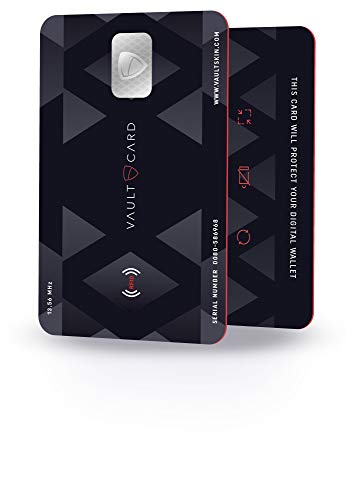
Vaultcard RFID is the size and form of a standard credit card, 1.1 mm thick and weighing just 13.9 grams. With simple plastic casing, it’s thin enough to fit into most wallet slots without creating a noticeable bulk, which is essential to comfortable use – even though it’s not the slimmest option available on the market.
In terms of usability, it seems to get overwhelmingly positive user reviews, with no widespread reports of the card bending or cracking. Slim and small, it doesn’t seem to interfere with normal card operations, while providing all-rounded protection.
For many customers, the card’s stylish but subtle looks were one of its biggest benefits, providing protection without standing out and merging with different wallet designs easily.
Vaultcard RFID: technical insights and performance
According to the manufacturer, Vaultcard uses the same principle as military jamming systems. It automatically switches on when it senses an electromagnetic wave, adjusting depending on the specific scanner and creating a powerful blocking signal – claiming it’s 1000 times stronger than other models.
It uses an orthogonal antenna for consistent protection, and aims to eliminate blind spots with its design – in contrast to blocking cards that tend to leave safety gaps when not properly aligned. Most users' reviews seem to support the manufacturer statements, with customers often saying Vaultcard works smoothly and provides all-rounded protection. Only a few reported it failing to block signals.
While the information on any independent testing is limited, there are no widespread reports of performance issues, as the overall user and expert feedback seems positive.
Vaultcard: price and availability
For those considering purchasing Vaultcard, the most reliable option will be its official website, with PayPal, shop, ApplePay and GooglePay supported. The order will also include a 30-day money-back guarantee, a 2-year warranty and an easy return process if needed. Additionally, you can buy the card via Amazon.
While Vaultcard RFID is in the medium price range overall, it can seem quite pricey for a RFID-blocking card, especially compared to most competitors – with some users even noting the lack of price-to-quality balance. Still, it makes up for the pricing with the advanced technologies used and the promise of all-rounded protection.
While it may feel a bit overpriced for a single card and lack advanced or customizable features, it stands out due to its powerful range and jamming signal, aiming to provide both protection and peace of mind.
Vaultcard RFID blocking card vs competitors
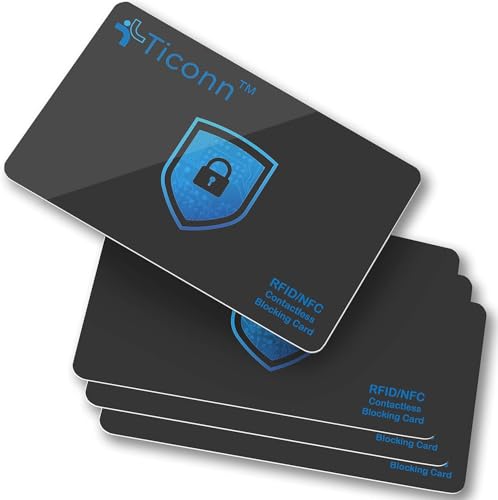
When choosing a RFID-blocking card, it’s important to understand how different options compare against each other. Below, I outlined the key features of Vaultcard RFID and its closest competitors – TICONN and SaiTech IT.
|
|

|
|
| Title | VAULTCARD | TICONN RFID Blocking Cards – 4 Pack | SaiTech IT |
| Price | $34.99 | $6.99 $7.99 -13% | $9.99 |
| Material | Plastic | Plastic | Polycarbonate (PC) |
| Best for | Travelers or users who want premium protection with tested performance | Users needing affordable multi-card protection in a single pack | Everyday users who want a simple, passive blocker |
| Drawbacks | Higher price and bulkier design | Less effective against older low-frequency 125 kHz systems | Limited details on testing standards |
| More info | Buy on Amazon Details | Buy on Amazon Details | Buy on Amazon Details |
While other options stand out due to its affordable pricing (with TICONN even available in multiple-card bundles), Vaultcard makes up for the price with its durability and stable performance.
Final verdict: is Vaultcard RFID worth it?
Easy to use and fit into the wallet, Vaultcard RFID can prove a great, reliable solution for both travelers and casual users – or even simply safety-conscious customers who want to ensure an additional level of card protection.
While it may feel pricey compared to other models and lacks advanced features (while for some, limited independent testing may also be a disadvantage), its signal range and reported consistent protection is what matters most. If you’re looking for a straightforward solution and don’t mind paying a bit extra for your peace of mind, Vaultcard may prove a great fit for your goals.
Other reviews from Cybernews:
TICONN RFID blocking cards review: a closer look at security, value and reviews
SaiTech IT RFID blocking card review: Does it really protect your cards?
6 best RFID pet feeders: reviews and buying guide
NFC vs RFID: understanding the key differences
FAQ
Does Vaultcard RFID block all RFID and NFC frequencies?
No, while Vaultcard is designed to protect against common high-frequency RFID and NFC skimming (especially the standard 13.56 MHz band), it does not claim, nor does it guarantee, universal RFID coverage. However, its overall blocking capabilities are believed to be reliable.
Can Vaultcard RFID damage my credit or debit cards?
No. According to the manufacturer, Vaultcard uses the low end of the electromagnetic spectrum which provides no threat to your cards. The magnetic component of its wave is extremely small, meaning it won’t be able to demagnetize other cards.
How many RFID cards does one Vaultcard protect?
It depends. According to the product description, if it’s placed in the middle of the wallet up to 8 cm thick, all RFID-enabled cards within 4 cm will be protected.
Does Vaultcard RFID work in slim or minimalist wallets?
Yes, usually. Most users report success and smooth performance, with the manufacturer claiming broad 360-degree protection for your cards and even high tolerance for misalignment.
Is Vaultcard RFID legal to use worldwide?
Yes, RFID-blocking cards, including Vaultcard, are generally legal and can be used freely worldwide – since data laws usually address data collection not blocking it. However, it’s always helpful to double-check with the regulations of the country where you are currently to ensure compliance.