Attackers claim 150K users via data breach of insurance firm AIL
American Income Life (AIL), a major American supplemental insurance company, has allegedly had hundreds of thousands of customer records stolen, exposing personal details and insurance data.

Image by Cybernews.

 Follow us
American Income Life (AIL), a major American supplemental insurance company, has allegedly had hundreds of thousands of customer records stolen, exposing personal details and insurance data.
The post allegedly containing AIL data was uploaded to a popular data leak forum, which attackers use to sell and share often illegally obtained details. The post’s author claims the data was recently taken from the insurance company’s website.
Texas-headquartered AIL is one of the largest supplemental insurance providers in the US. The company is a subsidiary of Globe Life Inc., a financial services holding with yearly revenue exceeding $5.7 billion.
We’ve reached out to AIL for comment and will update this article once we receive a reply.
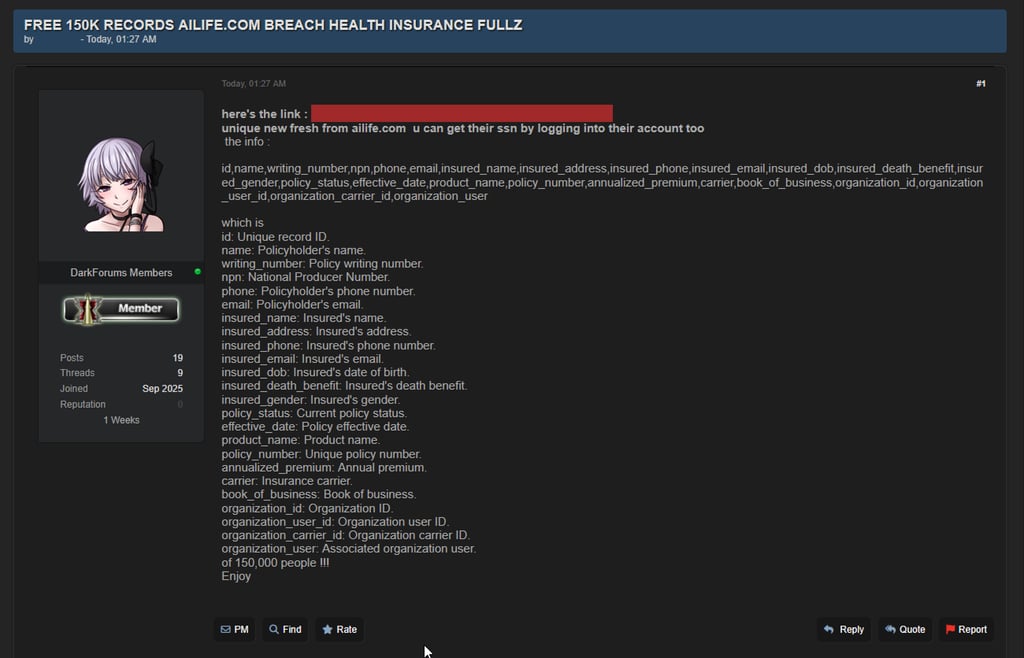






Meanwhile, the Cybernews research team investigated the data sample provided in the attackers’ post. While it’s unclear how old the data is, the information in the sample appears to coincide with the attackers’ claims.
“The data sample has about 150k AIL user records, which include full names, dates of birth, addresses, contact information, and some info about their insurance, including policy status and insurance plan names,” our team said.
While the AIL data breach has not been confirmed, at least in theory, attackers could use exposed details for nefarious purposes, such as identity theft. Combinations of full names, dates of birth, and other personal identifiers enable attackers to convincingly set up fraudulent accounts, often financially harming victims or their credit scores.
The potentially exposed data also allows malicious actors to carry out targeted phishing attacks. Armed with knowledge of whose information they have, cybercrooks can impersonate insurance companies, health specialists, and other service providers to coax victims into revealing more sensitive details. \






Cybercriminals generally crave healthcare-related data, as it is among the most valuable pieces of personal information. Attackers can use healthcare information to submit fraudulent medical claims, which enables the illicit purchase of prescription drugs.
What makes matters worse is that medical and biometric data are non-recoverable, which means that, unlike passwords or credit cards, users cannot change their medical histories once they've been compromised.
Healthcare institutions and insurers are often on the attackers’ radar. Last week, the Brain Cipher ransomware gang targeted Baltimore Medical System (BMS), a federally funded US health system.
In late August, attackers claimed they had obtained details of nearly half a million US doctors. The information was posted on the same data leak site as the post claiming the AIL data breach.
Unlock more exclusive Cybernews content on YouTube.