Android app detects smart glasses via Bluetooth signals
A German researcher, frustrated with the rise of covert smart glasses and the intrusion of privacy, has built an open-source Android app that detects such devices nearby using Bluetooth signals. Its sole job is just to alert users when a pair of spy-spectacles appear nearby.


 Follow us
A German researcher, frustrated with the rise of covert smart glasses and the intrusion of privacy, has built an open-source Android app that detects such devices nearby using Bluetooth signals. Its sole job is just to alert users when a pair of spy-spectacles appear nearby.
It’s not easy to distinguish smart glasses from regular eyewear, but a new app called “Nearby Glasses” can notify users when smart glasses are nearby. It was published on GitHub, is available on the Google Play Store, and is likely coming to iOS soon.
PD Dr. phil. Yves Jeanrenaud, who developed the app, detailed the reasoning clearly.
“Because I consider smart glasses an intolerable intrusion, consent-neglecting, horrible piece of tech that is already used for making various and tons of equally truly disgusting ‘content,’” the author said in the readme file on GitHub.
While some smart glasses turn on a small LED to indicate the device is recording, it can be easily disabled. Manufacturers usually take zero responsibility for what the users do with their tech.





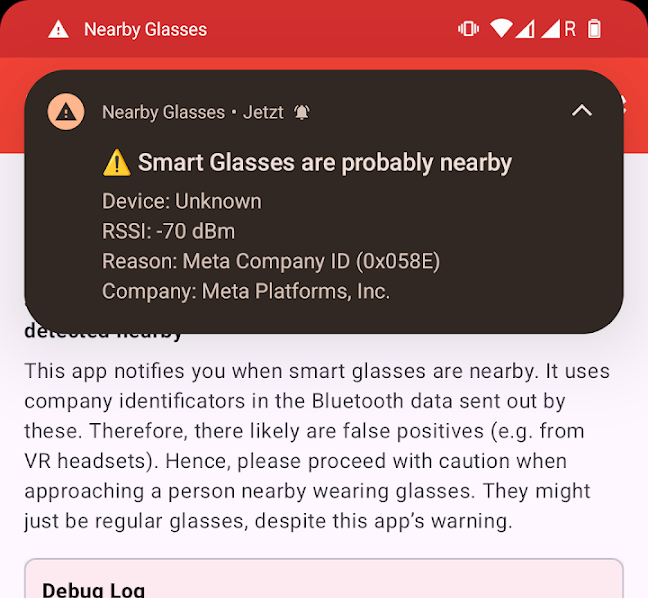
The researcher is worried that smart glasses are increasingly being used for instant facial recognition, putting a lot of people in danger.
The app only contains the bare minimum functionality. It doesn’t collect any information, doesn’t send any telemetry, and has no ads or other nuisances. The current 3.6-star (out of 5) rating also reflects that there are still some bugs to iron out to make the app work on all devices.
“I am no graduated developer. This is all written in my free time and with knowledge I taught myself,” Jeanrenaud said.
“An iOS app might be possible, too. I have the toolchain now, but I will need a Mac to submit it to the Apple App Store in the end. And I need to dig deeper into iOS development.”






How does the app work?
The detection method is ingeniously simple – all smart glasses, as well as other wearables, communicate with the smartphone via Bluetooth. Each device sends advertising headers containing manufacturer-specific data, such as company ID.
“The manufacturer company's name shows up as number codes in the packet advertising header (ADV) of BLE beacons,” the researcher explains.
The app scans for Bluetooth SIG (Special Interest Group) assigned numbers used by the following companies:
- 0x01AB for Meta Platforms, Inc. (formerly Facebook)
- 0x058E for Meta Platforms Technologies, LLC
- 0x0D53 for Luxottica Group S.p.A (who manufactures the Meta Ray-Bans)
- 0x03C2 for Snapchat, Inc. (that makes SNAP Spectacles)
This method has a drawback. While the app will detect nearby Meta Ray-Bans or Snap Spectacles, other VR headsets from the same companies will also appear as false positives.
“But if you can’t see someone wearing an Oculus Rift around you and there are no buildings where they could hide, chances are good that it's smart glasses instead,” Jeanrenaud said.
The researcher considered scanning for the product name that is transmitted during pairing. However, this process rarely happens in public places.
The app pushes an alert message when it recognizes the Bluetooth Low Energy (BLE) device with a sufficient signal strength.
Users can select the Received Signal Strength Indication (RSSI) threshold. The default value is -75 dBm (decibel-milliwatt), which corresponds to a rough distance of around 10-15 meters (33–50 feet) radius in an open space and up to 10 meters indoors or in crowded spaces.
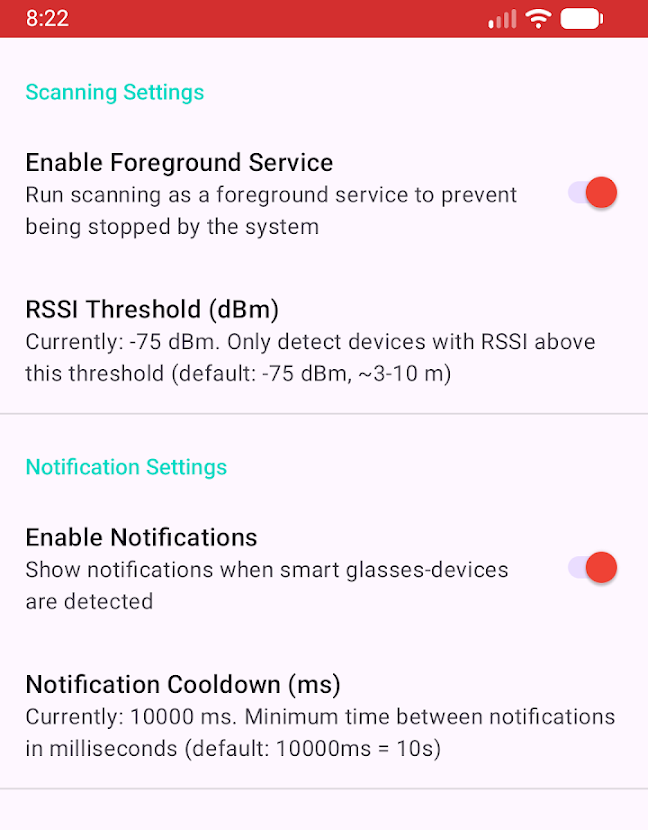
This detection distance can be increased up to 30-100 meters when selecting to detect very weak signals. For persistence, the app uses Android’s Foreground Service.
The app is open source, and anyone can review and change the code to their liking. Jeanrenaud takes no liability for its use or functionality.
“Use with extreme caution,” the author warns.
“There is no guarantee that detected smart glasses are really nearby. It might be another device looking technically similar to smart glasses. Please do not act rashly.”
The readme description on GitHub starts with ample warnings against harassing anyone – suspecting someone of wearing a “covert surveillance device” is not grounds for confrontation, which can be a criminal offense.
Jeanrenaud acknowledges that society still needs a better solution to curb surveillance and privacy intrusion.
“I am aware this is a technical solution to a social problem, which is itself amplified by tech. I do not want to promote techsolutionism, nor do I want people to feel falsely secure. It's still an imperfect approach and probably always will be.”
Unlock more exclusive Cybernews content on YouTube.