Epstein allegedly had a “personal hacker,” was into cyberwar and malware
Financier, child sex offender, serial rapist, human trafficker – Jeffrey Epstein had many faces. Now, a new batch of files suggests he was interested in hacking and malware, and might even have had a personal hacker.

Jeffrey Epstein. Image by Cybernews

 Follow us
Financier, child sex offender, serial rapist, human trafficker – Jeffrey Epstein had many faces. Now, a new batch of files suggests he was interested in hacking and malware, and might even have had a personal hacker.
- Newly surfaced FBI informant files allege Jeffrey Epstein employed a highly skilled “personal hacker” involved in zero-day exploits, cyber surveillance, and dealings with governments and militant groups.
- The hacker, whose identity is redacted but widely speculated to be Vincenzo Iozzo, later became a senior figure at CrowdStrike, blurring lines between elite cybersecurity, crime, and intelligence work.
- While many claims remain unverified, Epstein’s emails show a sustained interest in hacking, malware, and cyber warfare, reinforcing theories that technology played a role in his broader influence and alleged blackmail operations.
A report from a Federal Bureau of Investigation informant filed in 2017 has revealed the existence of an alleged “personal hacker” in the employ of Epstein.
The name of the hacker has been redacted, alongside many other details provided by the informant. Otherwise, the document notes the activities of the individual in detail.
“[REDACTED] was Epstein’s personal hacker. [REDACTED] was an Italian citizen born in Calabria who developed zero-day exploits and offensive cyber tools and sold the tools to governments,” the document reads.


“[REDACTED] established the Saudi government’s cyber surveillance program. [REDACTED] sold a zero-day to Hezbollah. [REDACTED] was known as the first person to hack and find vulnerabilities in Blackberries and iOS.”
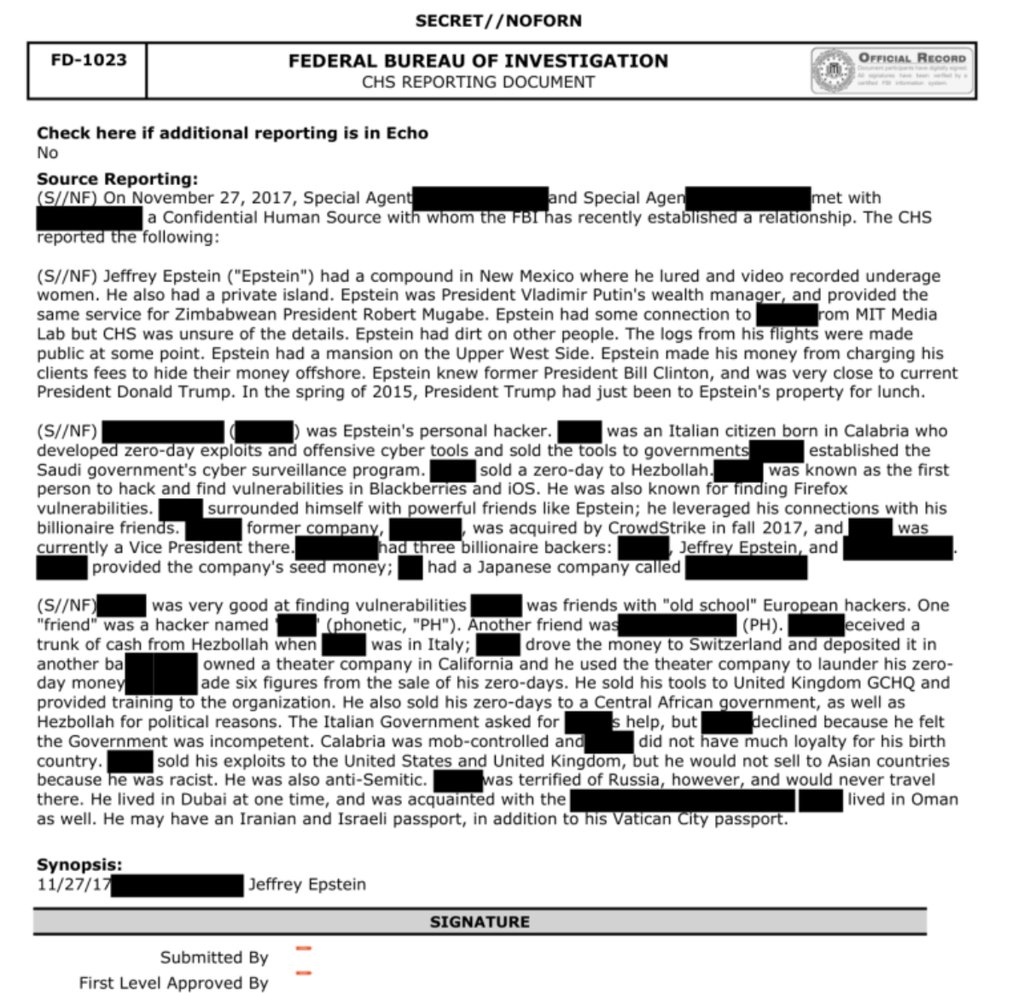
The alleged hacker was also known for finding Firefox vulnerabilities and, as per the informant, surrounded himself with powerful friends like Epstein.
A man of many talents
Additionally, he leveraged his connections with his billionaire friends, and three of them backed him financially. One of the billionaires – but not Epstein – allegedly provided seed money for the hacker’s new company.
The firm was acquired by CrowdStrike in 2017, and the hacker even held the position of senior director at that particular cybersecurity giant.
According to the informant, the hacker had links to several other “old school” European hackers and was connected to organized crime and terrorist organizations. The individual was also “very good at finding vulnerabilities.”
The informant claimed that Hezbollah – the hacker provided the militant organization with a zero-day – sent him a trunk of cash to Italy. The hacker then drove the money to Switzerland and deposited it in a bank account.
The hacker also allegedly owned a theatre company in California, using it to launder his zero-day money.
The document goes on to outline how the individual allegedly “sold his exploits” to both the UK and US governments, but not to Asian countries, as he was – again, according to the FBI’s informant – deeply racist.






The hacker was once asked for help by the Italian government, but declined “because he thought the government was incompetent.” He was also allegedly antisemitic and wouldn’t ever travel to Russia as he was terrified of it.
Unverified by the FBI?
While the name of the alleged “personal hacker” was redacted, enough details remain to help piece together his identity.
According to several well-informed sources, the individual referred to in the FBI report is Vincenzo Iozzo, the Calabrian-born founder of mobile security company Iperlane, which was acquired by CrowdStrike in 2017.
Iozzo held the position of senior director at CrowdStrike until 2021 and is currently the CEO of identity security firm SlashID. He has an X account, where he occasionally posts regular cybersecurity-related content.
Importantly, almost all of the above is just what the informant told the FBI. It’s unclear whether the agency had verified his statements as accurate.
However, the same informant also states that Epstein was Russian President Vladimir Putin’s wealth manager, and provided the same service for Zimbabwe’s late President Robert Mugabe, and that’s simply impossible to prove.
Still, Iozzo’s name does appear in several other Epstein documents, including a 2015 email where Iozzo is seen trying to get Epstein to attend the Black Hat hacking conference. His LinkedIn page says that Iozzo has been a board member of Black Hat since 2011.
Vx-underground, an anonymous threat analyst group, speculates that Epstein visited several Black Hat conferences, but the email doesn’t say that.
However, in a 2009 email to “Boris,” Epstein writes: “I think we should find great hackers at the Black Hat convention.” This might mean he went to the conference that year.
Interest in cyber warfare
Furthermore, Epstein's emails show he kept abreast of security-related technology, including cyber warfare articles, and sought to connect private money with public surveillance opportunities.
A few emails from 2009, for example, show that Epstein was concerned about a macOS keylogger and complained that “the keyboards are hardwired.” In 2013, he wanted to talk about malware with Joi Ito, a Japanese venture capitalist.
Another email to Epstein from 2010, this time from Al Seckel, a controversial author, explains how “they” were hacking Wikipedia to remove the financier’s mug shot from his page and replace it with the photo Epstein himself sent. Epstein’s page also had his description as a “sex offender” removed.
Earlier reports say Epstein frequently emailed articles about cyber warfare, Russian nanotechnology, and Unit 8200, Israel’s signal intelligence agency.
In 2019, The New York Times quoted a shadowy hacker who claimed to have Epstein’s sex tapes and an entire archive of the financier’s data, stored on encrypted servers overseas.
One unproven theory claims Epstein’s archive of compromising content helped him run a sprawling blackmail operation.
Who was Jeffrey Epstein’s alleged personal hacker?
According to 2017 FBI informant files, Epstein employed an Italian hacker born in Calabria who sold offensive cyber tools to governments. While the name is redacted in official documents, details—such as the sale of his company to CrowdStrike—point to Vincenzo Iozzo, a security researcher and former CrowdStrike senior director.
What kind of cyber tools did Epstein’s hacker develop?
The informant claims the hacker developed zero-day exploits (unknown security vulnerabilities) for iOS, BlackBerry, and Firefox. He allegedly established a cyber surveillance program for the Saudi government and sold exploits to the US and UK governments, as well as the militant group Hezbollah.
Did Epstein use hackers to change his Wikipedia page?
Yes. Emails from 2010 suggest that associates targeted Wikipedia to sanitize Epstein’s public image. The correspondence details how they removed his mug shot, replaced it with a preferred photo, and deleted the description identifying him as a "sex offender."
Unlock more exclusive Cybernews content on YouTube