New TOAD phishing campaign targets Microsoft Entra guest invitees with fake invoices
Cybercriminals are targeting recipients of Microsoft Entra B2B guest invites, taking advantage of Entra’s cloud-based infrastructure to bypass email filters in a new Telephone-Oriented Attack Delivery (TOAD) phishing campaign.

Image by Cybernews.

 Follow us
Cybercriminals are targeting recipients of Microsoft Entra B2B guest invites, taking advantage of Entra’s cloud-based infrastructure to bypass email filters as part of a new Telephone-Oriented Attack Delivery (TOAD) phishing campaign.
- Scammers weaponize Entra ID B2B guest invitations to slip past email defenses with fake Microsoft invoice alerts.
- Attack combines cloud-based trust manipulation with telephone scams, urging victims to call fake "Microsoft Billing Support" about non-existent $446 charges.
- Messages arrive from actual "[email protected]" address, making traditional security tools ineffective against this social engineering technique.
Key Takeaways by nexos.ai, reviewed by Cybernews staff.
The reverse phishing scam was uncovered by threat researcher Matt Taggart and “a few friends” over the weekend.
The new attack exploits Microsoft Entra – the tech company’s cloud-based suite of identity and network access products that secures access for employees, customers, and various workloads, for example, Microsoft 365.
Businesses using the Entra ID system (formally known as Azure Active Directory) can send a “guest invitation” via email to a known recipient, allowing that recipient to create a guest account and engage in secure communications with the user.






Taggart says the criminals are abusing the Microsoft Entra tenant invitations to send the malicious email, and then hoping “to trick recipients into calling a telephone number, referencing a fictitious bill,” which, for those unfamiliar, also categorizes it as a TOAD attack.
Actual threat intelligence! A few friends and I identified a new reverse phishing campaign leveraging Entra Guest User invitations. This campaign was newly discovered and corroborated. I recommend reviewing organization email for these invitations. taggart-tech.com/ent...
undefined Taggart (@taggart-tech.com) November 14, 2025 at 1:12 PM
[image or embed]
Ensar Seker, CISO at threat intelligence firm SOCRadar says the Entra TOAD campaign is a prime example of how attackers are increasingly repurposing legitimate cloud-native features for malicious purposes.
"By abusing Microsoft Entra’s guest invitation system, the threat actors bypass traditional email filters and exploit the trust users place in official Microsoft-branded messages," Seker explains.
What’s more, Seker points out that because Entra invitations are “often whitelisted and routed through Microsoft’s infrastructure, they have higher deliverability and lower suspicion thresholds.”
With human interaction as the initial "payload" (as opposed to code execution), traditional email filtering, sandboxing, and EDR tools become way less effective, the CISO says.
Breaking down the TOAD attack
In a phishing attack, a bad actor typically targets their victim with a fraudulent email, hoping to trick them into clicking on a malicious link and downloading malware or redirecting them to a fake site, ultimately allowing the bad actor unauthorized access to their device to steal sensitive information.
A TOAD attack adds an extra step to the phish.






Instead of clicking a malicious link, the email will attempt to trick the victim into calling a phone number provided in the email. On the other end, a scammer lies in wait, hoping to pressure the victim into a similar malicious scenario, resulting in the handover of personal or financial information.
Taggart says, once the recipient calls, “From the phone number, normal TOAD TTPs are in play." The typical attack lifecycle begins with the deceptive phishing email, includes threat actor caller impersonations, and often culminates in the installation of hacker-controlled software.
“Hello, Your Microsoft 365 annual plan has been renewed and processed,” the email in this case states to the recipient. The message then continues with a long-winded explanation of how the email was sent to the victim securely through the Microsoft 365 tenant.
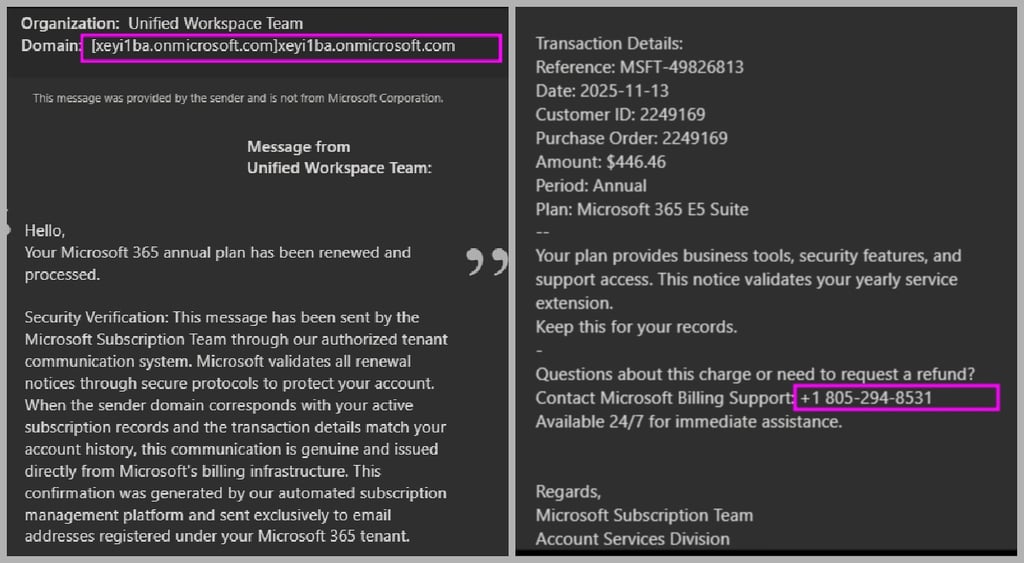
The email then provides information meant to trigger the victim to act. This includes the invoice purchase date, invoice number, and customer number, listing the amount billed – $446.46 – which is more than enough to spur anyone to call the fake "Microsoft Billing Support" phone number provided (available 24/7 for immediate assistance) and dispute the charge.
Seker says the Entra TOAD attack blend cloud abuse, social engineering, and trust manipulation, making the campaign particularly dangerous.
Calling it “part of a broader trend in adversary-in-the-middle techniques,” Seker breaks down the attack into three parts:
- Trusted delivery mechanisms (Microsoft Entra infrastructure)
- Minimal technical indicators (no malicious attachment or link to analyze)
- Social pressure (urgent account issues prompting a phone call)
TOAD phishing attacks differ from traditional credential harvesting because they rely on inducing the user to take offline action usually by calling a phone number.
In this case, embedding the phone number within a trusted Microsoft invitation gives the scam an air of legitimacy. Once the victim initiates the call, attackers may request remote access, payment details, or PII under the guise of “fixing” an account issue or refunding a charge.
What can organizations do to protect themselves?
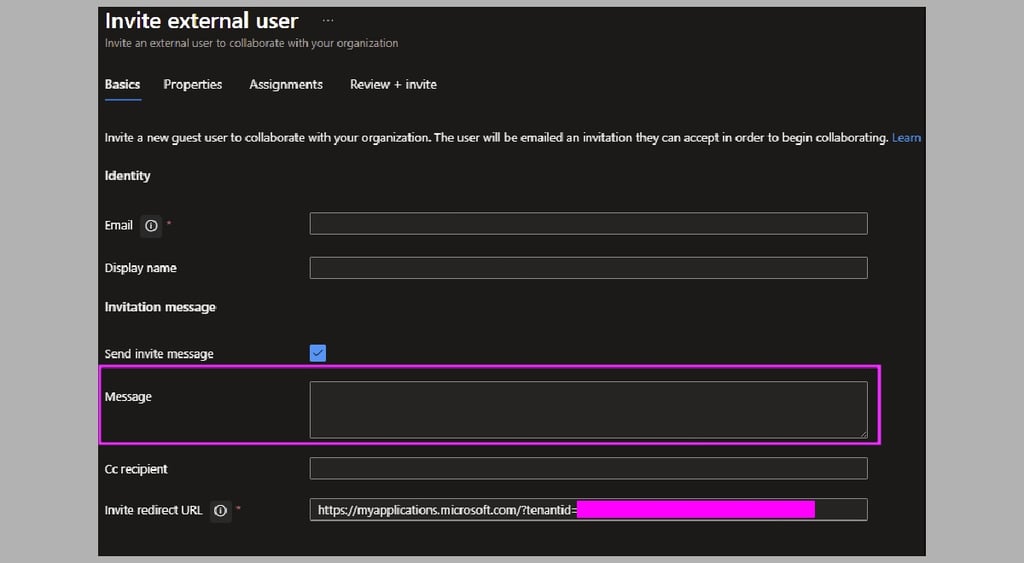
Providing several screenshots, Taggart further notes that “the use of Entra Guest user invitations seems solely to take advantage of the Message field in the Guest User invitation,” as shown below.
Taggart warns that the invites "come from ‘invites@microsoft[.]com,’ which is a legitimate address and likely won't be blocked by email filters" – a known tactic used in similar campaigns in which the scammers will ”use message fields in notifications from trusted services to embed a phishing lure.”
Meantime, Seker stresses that the Microsoft Entra campaign “underlines the need for zero trust policies even within SaaS environments, continuous behavioral monitoring, and adaptive email filtering models that account for intent, not just indicators."
To avoid becoming a victim, Seker says organizations should immediately begin monitoring and auditing their Microsoft Entra guest invitation logs for anomalous behaviors.
This can include looking for “spikes in external invitations, use of unusual messaging language, or repeated invitations to consumer domains.”
Seker says organizations should also be “explicitly” covering TOAD threats as part of their company’s security awareness training, ensuring employees are familiar with the ways hackers can “misuse trusted platforms to initiate phone-based social engineering.”
According to Microsoft, millions of organizations worldwide, including about 95% of Fortune 500 companies, currently use Entra ID. In April, Microsoft said Entra's comprehensive identity-as-a-service (IDaaS) solution holds more than a billion user identities.
Microsoft’s Azure Active Directory was renamed Entra ID in July 2023.
Unlock more exclusive Cybernews content on YouTube.