Here's why you shouldn't ask AI to plan your free time for you
A fake book list in a newspaper could be another wake-up call for how we use artificial intelligence (AI).

Image by Poca Wander Stock | Shutterstock

 Follow us
A fake book list in a newspaper could be another wake-up call for how we use artificial intelligence (AI).
While AI is used by hundreds of millions of people worldwide every day, and recent tech-related announcements paint a picture of its growing importance, every now and then, we hear stories that remind us how careful we should be when using AI.
I’ve already shared my views on AI, giving it a fair chance by employing it as my shopping assistant and taking time to see if ChatGPT could help me make a decision with its comparison tables.
While I remained skeptical about the AI, in some instances, it actually helped users in tricky situations, which sometimes involved a health scare.
However, the recent Chicago Sun-Times newspaper publication of a book list for the summer of 2025 once again raised a question of how AI is used.









Are we too loose with AI use?
Why did such a simple read, found in a newspaper, catch the attention of Internet readers? Because the list included a number of books that don’t exist.
The findings were shared on Substack by Lincoln Michel, the writer of the Counter Craft newsletter. He shared that most of the enlisted books are actually fake, naming a few examples such as Nightshade Market by Min Jin Lee or Boiling Point by Rebecca Makkai.
It was soon discovered that the list was crafted by an AI, most likely ChatGPT. While it’s not a crime to ask AI for help in such cases, one of the most triggering things is the fact that this list wasn’t fact-checked or even edited, and was further released in other publications, such as the Philadelphia Inquirer.
While the fact that something like that has been shared publicly isn’t entirely true shouldn’t surprise readers with all this fake information online, what turned out to be new in this case is the fact that this list was printed in a physical newspaper.
The fake book list in the newspaper also raises questions about how we’re using AI and how much trust is put into it.
The author of the newsletter notices how quickly people shift from using AI to help with their work to asking it to do it for them, without even bothering to go through the provided content.
What else provided by ChatGPT doesn’t exist?
The generated fake book list made me think about instances where I caught ChatGPT giving me false recommendations.
I remember catching it once when I was compiling a calendar of the most important tech events. Since there are many events taking place worldwide, I asked ChatGPT for a list of the most notable ones, and later proceeded with a query for monthly tech events.
It gave me an extensive list of events that, after I reviewed it, included a number of conferences and shows that no longer take place, and didn’t include events that I was certain were still happening. For example, its list didn’t include Viva Technology, an annual conference that takes place in Paris, France.
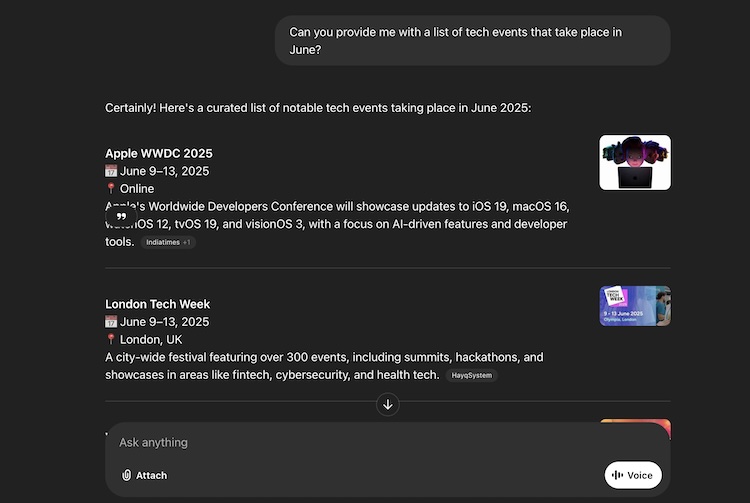
When I asked ChatGPT about this, it assured me that I was right and then shared information about the conference. This made me think that ChatGPT can be a guide when you have no idea where to start, but you can’t trust it completely.
After reading the newsletter about the fake book list, I also got curious to see if AI would provide me with some false information, so I asked it to compile a list of must-see movies and upcoming films to be released this year. To my (luck?), ChatGPT was helpful enough and didn’t provide me with any false recommendations (I checked.)
Why does AI give wrong answers?
While it's not exactly known which artificial intelligence program was used to create that infamous book list, the question remains the same: why do we get these fake replies in the first place?
The same question prompted an online discussion, with one user sharing how they asked ChaGPT questions and received incorrect answers. When the user corrected the AI, it immediately knew it was wrong.
“When I ask why it gave me a wrong answer in the first place, it said [...] that it was due to the speed at which it had been programmed to answer (fast),” shared the user.
However, another user noted that “these models don’t really have a mechanical understanding of why and how they generated an answer,” calling AI’s answer “a hallucination.”
ChatGPT gives wrong answers due to programming that could easily be corrected.
byu/Goodapollo503 inOpenAI
“Try correcting ChatGPT with wrong information when it gives correct information and you'll quickly see that it's not really the case that it knew the right answer all along,” noted another user online, calling it “sugesttible.”
One more netizen reminded that Learning Language Models (LLMs) aren’t actually search engines, so they “predict words based on the context you give them,” making it impossible for them to know that they’re wrong.
While the user’s speculation on the reason AI provides fake answers is questionable, the reason behind this problem could be related to the incomplete, inaccurate, or old data that LLMs are being trained on, the way LLMs are being designed, and providing it with vague or unrealistic prompts.