EU digital sovereignty plan faces reality check: can Europe stand on its own?
The continent still relies heavily on US cloud providers, AI models, and semiconductor tech. What are the chances of it succeeding on its own?
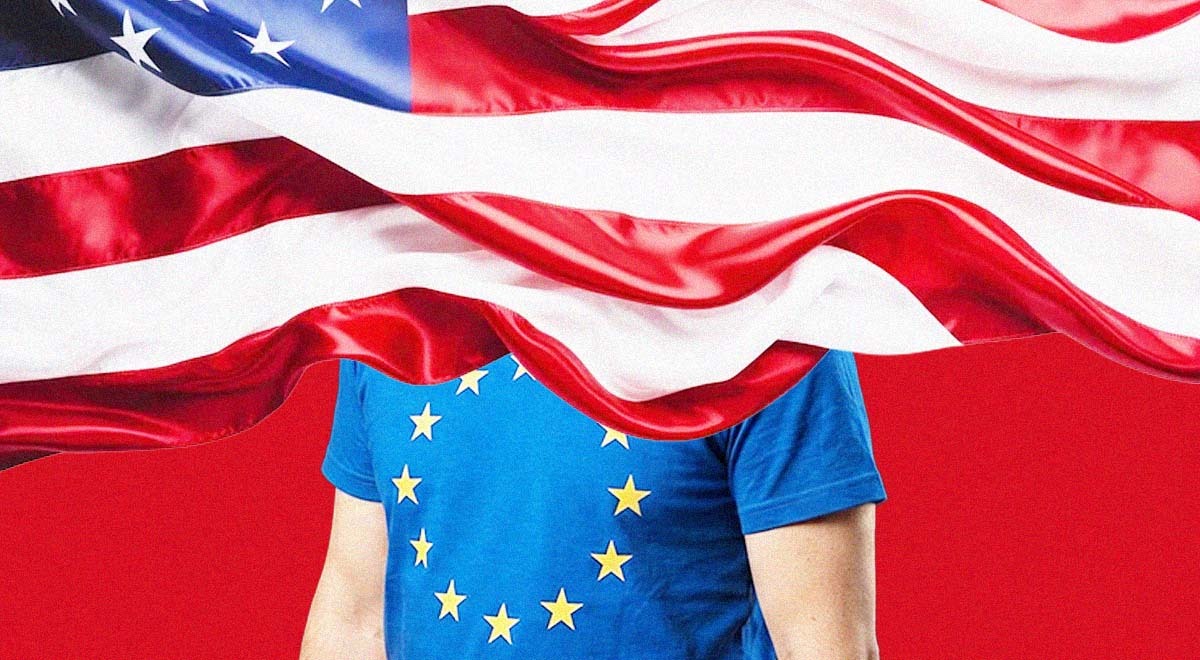
Man with EU t-shirt covered with US flag. Image by Cybernews.

 Follow us
The continent still relies heavily on US cloud providers, AI models, and semiconductor tech. What are the chances of it succeeding on its own?
After years of dithering and delay, and a reputation for not reaching quick consensus, the cogs of European bureaucracy are starting to unlock and move a little more quickly.
Europe’s big gambit – a huge technological sovereignty package, including the Cloud and AI Development Act and Chips Act 2.0 – arrived last week. And it appears designed to bolster European competitiveness while also reducing dependencies on United States-based services and companies.
The package focuses on 4 areas: building semiconductor manufacturing capacity, ensuring that Europe isn’t overreliant on foreign actors for its cloud infrastructure, building open-source champions through a new strategy, and digitalizing the energy sector, in part through AI.





“We cannot afford to depend on others for the technologies that keep our hospitals running, our energy grids stable, and our services secure,” said European Commission President Ursula von der Leyen in a statement announcing the package.
“This is about protecting our citizens, defending our interests, and making our own choices. Europe has the talent, the research excellence, the industrial base, and the Single Market. Together, we must turn these strengths into technological sovereignty.”
That’s been welcomed by those watching how Europe has responded to the increasingly erratic utterances coming out of Donald Trump’s White House and to his reliance on trade threats to try to get his way in geopolitical spaces.
Speaking with one voice?
“It will be essential for regulators to enforce rigorous, EU-wide standards that ensure AI systems are transparent, accountable, and aligned with robust governance principles,” said Bill Conner, president and CEO of Jitterbit, and a former advisor to Interpol and GCHQ.
“A coordinated approach, rather than a patchwork of country-specific rules, can help balance technological progress with responsibility, ensuring that AI delivers value safely and sustainably.”
The problem is that coordination is sorely lacking within the EU at present, even though there is agreement that something needs to change.
“The EU is not speaking with one voice on tech sovereignty’s objectives and feasibility,” said Isabelle Roccia, managing director for Europe at the International Association of Privacy Professionals (IAPP).
Roccia worries that Europe’s inability to speak with a single voice has a material effect on its ability to become sovereign in the face of big tech overreach. And it’s because of the challenges of trying to grapple with such an inscrutable problem.






“This reflects the complex nature of a debate that cuts across political, technological, geopolitical, industrial, and operational layers,” she said.
Putting it all into practice
So how realistic is it to expect Europe to succeed in its grand gambit?
Weaning off big tech’s American-accented control is challenging enough for one country. It’s incredibly difficult to reach a consensus across 27 member states, each with competing interests as well as shared goals.
Take developing a sovereign cloud system, for instance – it requires picking reliable suppliers and then a set of industry and technical standards.
“Building consensus on their design won't be easy politically or technically,” Roccia said.
The trade-off, then, is a simple one but one with no good answers.
“Europe will likely have to concede on autonomy, power, or scale,” said Roccia.
“The key question will be: what risk profile will the European Union be comfortable adopting?”

Check if your data was exposed
Find out if your email and related personal information have appeared in known data breaches.
The current approach seems to be a quickening of the pace compared to Europe's traditionally cautious approach to tech sovereignty. But there are still worries about the realism of changing gears within Europe.
Go too fast, and you could cause the same issues that a sovereign Europe is trying to avoid.
“Faster deployment does not always translate into better outcomes,” cautioned Conner.
“Without strong oversight, innovation may come at the expense of privacy, security, accountability, and public trust.”
Unlock more exclusive Cybernews content on YouTube.