European messaging apps enjoy a revival amid sovereignty push
European messaging apps, which market themselves as anonymity-focused alternatives to WhatsApp and Signal, are reporting increasing interest amid the continent’s efforts to break away from US tech.
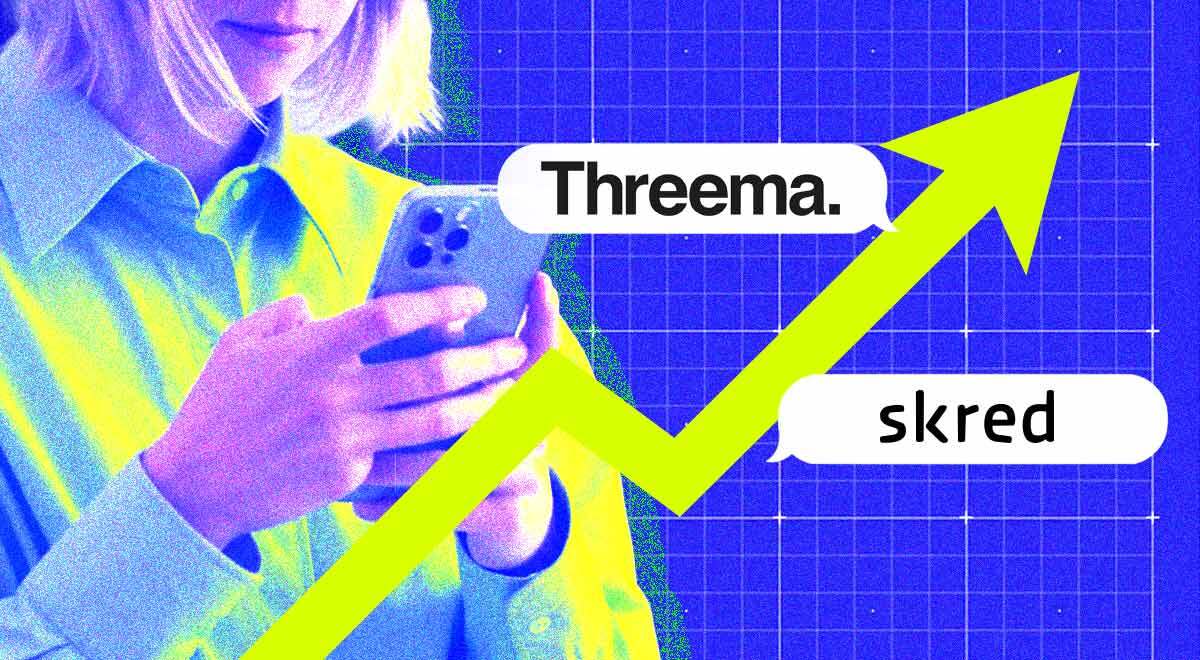
Image by Cybernews

 Follow us
European messaging apps, which market themselves as anonymity-focused alternatives to WhatsApp and Signal, are reporting increasing interest amid the continent’s efforts to break away from US tech.
- The European Commission and individual European governments are phasing out US messaging apps WhatsApp and Signal.
- Developers of European alternatives, Skred and Threema, say the push towards digital sovereignty has coincided with growing user numbers.
- Four in ten Europeans report being concerned about the privacy of their personal data on messaging apps.
From office productivity software to cloud providers, American tech companies in Europe have taken a hit due to the Donald Trump administration’s hostile policy towards its long-standing allies and increasing concerns over data privacy.
Despite intensifying efforts to achieve digital sovereignty, Europe remains largely reliant on American technologies, including messaging apps.
WhatsApp, owned by the US giant Meta, had over 50 million users in the EU as of 2025. Downloads of the open-source app Signal, owned by an American non-profit organization, reportedly spiked in Europe amid geopolitical tensions.









This heavy reliance comes with data privacy concerns. US laws, such as the Cloud Act, compel American companies to provide the US law enforcement agencies with data they request, even of citizens of other countries.
As a result, the European Commission is phasing out WhatsApp for internal staff communications by the end of 2026, transitioning employees to in-house built solutions.
Germany, the Netherlands, Belgium, Luxembourg, and Poland are also transferring their government communications to local alternatives.
While the trend among individual users is much more difficult to capture, creators of local messaging apps report increased interest in their products.
Skyrocketing interest in European apps
Secure messaging app Skred is marketed as focused on anonymity, as it doesn’t require an email address or phone number to sign up. Messages on the app flow directly between devices, bypassing intermediate servers.
Developed by Paris-based company France En Ligne, the app is hosted in Europe and is free to use, but requires €2.99 ($3.41) per month to unlock premium features.
Skred tells Cybernews that, while it does not profile its users, the growing interest in digital sovereignty has coincided with increased use, with the number of monthly active users rising from 399,943 in January 2025 to 808,792 by the end of May 2026.
The company says that while the largest share of users comes from the Gulf region, there is also strong interest in Europe, especially from France, Italy, Spain, Germany, Bulgaria, Romania, Poland, and the United Kingdom.
“This is why, in our view, the digital-sovereignty debate cannot be reduced to the mere nationality of an application. It rests on four indissociable dimensions: technical architecture, applicable jurisdiction, governance, and business model,” the company says in a statement.
Threema, a secure messaging app developed and hosted in Switzerland, also began seeing an increase in new IDs created a year ago, when the movement to choose European alternatives gained momentum.
Thus far, however, statistics from the Apple Store and Google Play Store don’t show a significant increase in user growth in the DACH region, which includes Germany, Austria, and Switzerland.
It could be partly explained by Threema’s required one-time fee of approximately €6.00 ($6.84) for private use.
Nevertheless, Threema says it stands out from American messaging services due to its “complete anonymity,” as the app doesn’t require email or phone number, and “generates only a minimal amount of metadata.
What is a truly sovereign messaging app?
Europeans undoubtedly have an appetite for independent technologies, with 76% of Danish and 73% of Swedish respondents saying they would switch to an EU-based digital service provider, even if it meant higher costs, according to a recent survey.
Nearly half (45%) of Europeans say they are likely to avoid products and services that store their data with US companies due to privacy concerns, a recent Proton survey suggests.
While 4 in 10 (40%) of Europeans are worried about data privacy in messaging apps, the definition of what exactly constitutes sovereign technology is sometimes murky.
The French government’s 2023 decision to promote the local messaging app Olvid for official communication, as a replacement for Signal and WhatsApp, came under fire because the app is hosted on Amazon Web Services (AWS) and is therefore subject to US laws.
In 2025, employees of French public administrations were mandated to switch to the Tchap app, built on the open-source Matrix protocol developed by the UK-based non-profit The Matrix.org Foundation.
Sovereignty concerns may not be the only reason Europeans are turning to local messaging apps.
Meta recently introduced a paid subscription for WhatsApp, offering exclusive stickers, ringtones, and app themes, among other features.
While still optional, the subscription may become a prime example of the phenomenon known as “enshittification,” in which tech companies turn free, widely used services into paid ones.
Unlock more exclusive Cybernews content on YouTube.