The last quiet place on Earth is about to get WiFi
A flight is one of the few places left on earth where you can go offline. But that is all about to change as airlines race to implement Starlink superfast internet to boost your customer experience this summer.
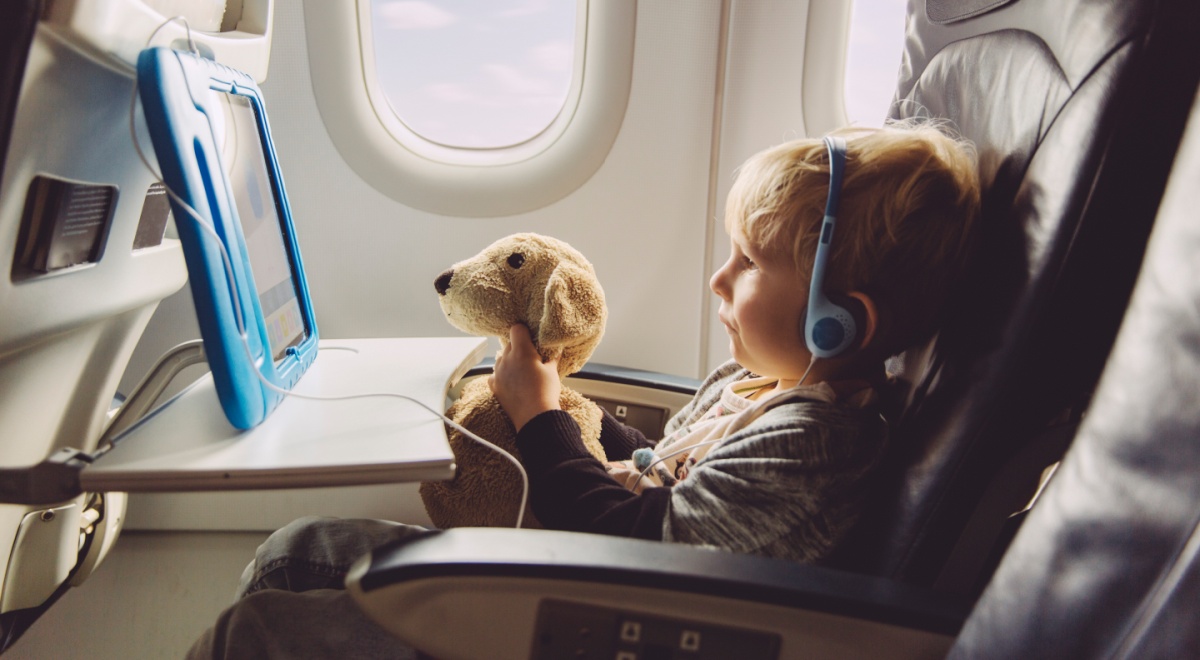
Little boy sitting on an airplane watching something on digital tablet. Westend61/Getty.

 Follow us
A flight is one of the few places left on earth where you can go offline. But that is all about to change as airlines race to implement Starlink superfast internet to boost your customer experience this summer.
- Airlines are rapidly rolling out Starlink-powered WiFi, with United, American Airlines, and others equipping hundreds of aircraft and planning wider adoption.
- The new satellite internet promises speeds far higher than current in-flight WiFi, enabling streaming, downloads, and work in the air.
- Some airlines are also moving toward allowing voice and video calls onboard, raising concerns about noise and passenger etiquette.
- While connectivity improves, frequent flyers and crew worry that quieter flights could disappear as digital noise and constant usage increase.
Key Takeaways by nexos.ai, reviewed by Cybernews staff.
Instead of rawdogging your way through a long-haul flight, staring at the flight map, it's time to prepare your senses for a bombardment of digital noise.
Airlines are racing to put Starlink on every flight






Delta Air Lines is consistently rated among the top airlines and has offered free WiFi to its members for many years. But as expectations rise, Delta is beginning to fall behind its competitors, as United and American Airlines partner with Elon Musk's Starlink, which promises speeds faster than your home connection.
United Airlines began equipping its fleet with Starlink in February and has already installed it on 300 aircraft, aiming to reach 800 by the end of this year. American Airlines has also revealed plans to have 500 of its aircraft with Starlink starting in 2027. The race is officially on this summer.
In Europe, Air Baltic led the way, being one of the first airlines to consider bringing AI and super-fast download speeds to the skies. Emirates is taking fast internet speeds to another level this year by shifting from 1 Mbps to a massive 2 Gbps Starlink internet on its fleet of A380's.
Airlines are racing to add SpaceX's Starlink in-flight internet service to their fleets for free, offering download speeds of at least 100 Mbps. Initially, this feels exciting. Downloading movies, TV shows, and music to your devices in the air, and, if it's a work trip, the ability to make a long flight productive, sounds like a win for everyone. But the policy change allowing users to make in-flight calls is beginning to raise concerns.
Fast WiFi meets bad etiquette.
Unfortunately, as anyone who has traveled on public transport will tell you, there will always be a few (you know who you are) who carry their main-character syndrome on board and somehow think it's their world and we are all just side characters in it.
A refusal to use headphones or earbuds on a thousand-dollar smartphone means a cacophony of noise everywhere, as the beats of music and phone conversations become the soundtrack of our lives.
The trend was labeled 'bare beating' by the UK's Metro, and many fear the sound of passengers flicking through videos every few seconds on YouTube, Instagram, Snapchat, and TikTok at 50%+ volume on phones is about to ruin flights forever.
The big change in travel this summer is that airlines are moving away from banning voice and video calls. Increased bandwidth is one of the reasons British Airways announced that, to enhance its customers' experience, it will now allow passengers to make calls via platforms such as FaceTime, WhatsApp, Zoom, and Teams.
The predicted rise in digital noise from unruly passengers sparked concerns amongst frequent flyers, especially after a passenger was escorted from a flight after infamously refusing to stop playing audio from her smartphone without headphones.
Where is onboard superfast WiFi taking us?
As someone who travels 22 weeks of the year to tech conferences around the world, and the skies are my office, I have a long list of frustrations with airline WiFi. I have lost count of how many times I have spent over $25 on the slowest speeds imaginable that stop working two hours into a Virgin Atlantic flight.
Staring out the window, I tried to manifest something different, thinking, 'One day it won't be like this, and I will have high-speed internet.’ The universe listened, and airlines are actively encouraging in-flight FaceTime calls, while the soundtrack of the Pussycat Dolls overhead ironically reminds me to be careful what you wish for, 'cause you might get it.
As an eternal optimist, 100 Mbps internet connectivity opens up a world of possibilities on long-haul flights. But increases in air rage suggest that adding more annoyance to the skies could further escalate tensions. We should also spare a thought for the cabin crew, who will be challenged to police passenger behavior and enforce usage policies.
For decades, travelers complained about painfully slow in-flight internet. Airlines listened, Starlink arrived, and bandwidth constraints began disappearing. But could the rise of digital noise eventually lead to designated 'quiet zones' on flights? And could silence be a premium feature rather than a standard expectation?






Somewhere over the Nevada desert, I found myself wondering what Rutger Hauer's famous Blade Runner monologue would sound like if Roy Batty had spent a few years flying economy.
I've seen things you people wouldn't believe. I've watched parents play Miss Rachel's "Icky Sticky Bubblegum" on repeat from a phone speaker somewhere off Orlando. Video calls conducted over Greenland without headphones. A man loudly explaining his crypto strategy to six different people at cruising altitude.
I've watched TikTok videos skip every three seconds near Gate 25. I've heard "I'm on the plane" shouted into a phone somewhere over the North Atlantic with a sound blast radius of 5 rows.
The days of silent data consumption, headphones, movies, emails, and the gentle hum of a cabin at 39,000 feet will soon be lost in time, like tears in the rain—time to charge my noise-canceling headphones now.
Unlock more exclusive Cybernews content on YouTube.