Man shocked after a doctor secretly placed a smart implant transmitting data to a corporate cloud
He is now suing a company once promoted by Arnold Schwarzenegger.
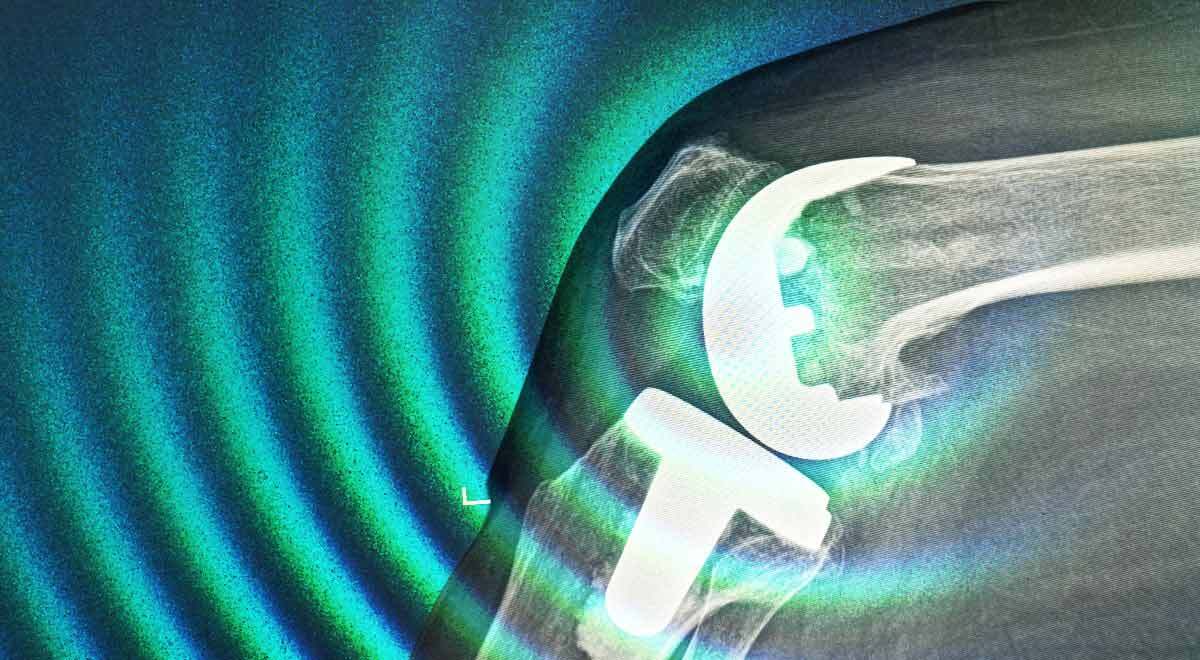
Image by Helmi Arrazi via Shutterstock/Illustration by Cybernews

 Follow us
- Steve Russak says he expected a standard knee replacement, but received a smart Persona IQ implant.
- The implant can collect movement data and transmit it to Zimmer Biomet’s cloud servers.
- Russak alleges the companies skipped required consent steps; Zimmer Biomet and Canary Medical deny the claims.
- The case highlights privacy and cybersecurity risks as more medical implants share patient data remotely.
Key Takeaways by nexos.ai, reviewed by Cybernews staff.
A medtech company behind the device, not a doctor, informed a 70-year-old man that he now has a smart data-transmitting knee implant, to which he never consented.
California man Steve Russak’s case may draw comparisons to the Black Mirror episode in which a server-linked brain implant leaves a woman blurting out ads, while her life depends on increasingly expensive subscriptions.
Russak was expecting a standard mechanical total knee replacement during a surgery on March 11th, 2025.
However, after waking up from the procedure, he received unsolicited text messages and telephone calls from the medtech company Zimmer Biomet, urging him to set up a “Home Base Station” and activate the mobility data-sharing application.





This led to the discovery that instead of a regular implant, the doctor placed a “sophisticated active electronic device containing a lithium-ion battery, a multi-axis sensor array, and a gyroscope,” according to court documents.


Stay updated with our latest stories and follow us on social media
Be the first to discover new stories, ideas, and updates from our team.
Moreover, the implant, called the Persona IQ “Smart Knee” device, is equipped with a radio-frequency wireless transmitter that continuously collects and transmits the patient’s biometric and kinematic data to Zimmer Biomet’s corporate cloud servers.
Russak is now suing Zimmer Biomet and Canary Medical, a health technology company that helped develop the device, over “unauthorized implantation” and privacy concerns.
The lawsuit claims that the companies knowingly bypassed Zimmer’s own pre-operative patient-enrollment protocols, which explicitly require patients to create an account, review disclosure materials, and provide affirmative consent before receiving the implant.
The implant was “activated intraoperatively by a Zimmer Biomet corporate representative present in the operating room,” while Russak laid under general anesthesia, unable to consent, according to the court documents.
Zimmer Biomet, an Indiana-based company whose 2025 ads featured Arnold Schwarzenegger as its “Chief Movement Officer,” and Vancouver-based Canary Medical, denied allegations.
Zimmer spokesperson Troy Kirkpatrick told KFF Health News that the company takes privacy and regulatory compliance “very seriously.”
He added that the vast majority of patients who received the company’s joint replacements report they would choose an orthopedic device with remote monitoring capabilities again in the future.
Questions over collecting movement data
The lawsuit claims that The Persona IQ’s own labeling mandated by the FDA states that collected kinematic data – information about a patient’s movements – is “not intended to support clinical decision” and has “not been shown to provide any clinical benefit” to patients.
In addition, the companies are accused of inducing Russak to serve as “an unwitting, uncompensated data-generating node” for Defendants’ commercial artificial intelligence platform (WalkAI) and corporate research programs.
Zimmer Biomet’s website states that WalkAI uses a proprietary algorithm to analyze a patient’s mobility and generate a personalized daily prediction of gait speed at 90 days post-surgery.
Medical devices are targeted by hackers
Smart implants, such as pacemakers for regulating heart rhythm or cochlear implants for people with significant hearing loss, are growing in popularity, partly because of their ability to transmit health data to providers remotely.
However, they introduce a myriad of privacy and cybersecurity risks.
The FBI said in 2022 that it identified an increasing number of vulnerabilities posed by unpatched medical devices, warning that hackers “can direct them to give inaccurate readings, administer drug overdoses, or otherwise endanger patient health.”
In 2007, doctors modified the heart defibrillator of Vice President Dick Cheney so terrorists wouldn’t be able to hack it and put an end to his life.