Clothes might become so smart, they can tap your shoulder or squeeze your arm
Imagine your favorite shirt squeezing your arm for you to stop at the stop sign. Could this be our new reality in just a few years?

Image by Cybernews

 Follow us
Imagine your favorite shirt squeezing your arm for you to stop at the stop sign. Could this be our new reality in just a few years?
A number of items, gadgets, and things we own nowadays come with a "smart" label, implying that they serve a purpose beyond their initial use. We no longer use phones just to call or text, our watches aren’t there just to tell the time, and we no longer have to follow our vacuum cleaner to get it to collect the dust.
However, not all aspects of our daily lives live up to this “standard.” While technology has been implemented in fashion through innovations such as augmented reality, AI, and 3D printing, it doesn’t seem to have made a significant breakthrough in everyday apparel. We can appreciate the beautiful creations of designers like Iris van Herpen, but they aren’t something we can easily adapt to everyday life.
This could change in a few years, according to Barclay Jumet, the founder of Actile Technologies. This startup has been developing a technology capable of transforming regular fabrics into smart textiles that can send you signals.
We had a chance to learn more from Jumet about the new smart textile technology and the future of smart clothing.






What is a smart textile, and how is it used?
The startup was founded by Jumet, PhD Candidate in Mechanical Engineering at Rice University, and his adviser, Daniel J. Preston, who have been working on a technology that can turn any textile into a smart fabric capable of sending information via touch instead of sound or sight.
While any wearable device typically requires attention from our eyes or ears, smart textiles allow information, such as an upcoming turn, to reach a person through touch via clothing, which sends signals to the person wearing them.
But how does it work?
“We do this through haptics or the language of touch. And so, we can apply any sort of physical stimulus you can imagine to a textile interface. We can communicate through electrical signals, such as electrical stimulation, squeezes, taps, motions, and heat pressure. So, any sort of force, heat, or electricity can be communicated into the body, explains Jumet.
“In that way, people who are wearing our textiles don't have to look at a screen. They don't have to listen to another audio cue or an audio device. They can receive information without taking their eyes or ears off their environment,” he continued.
Such technology has already been in use under pilot testing with the startup, which is now focusing on areas such as combat and athletics.
The reason behind these focus areas is that both athletes and warfighters are in “stressful and physically and cognitively exhausting scenarios,” so they need all the information they can get.
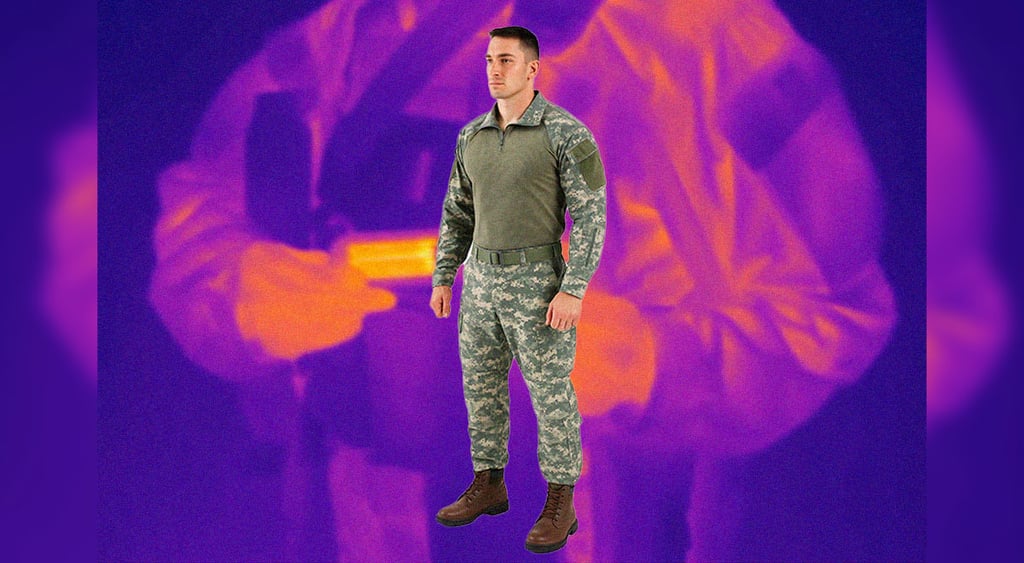
One of the smart textile examples created by Actile Technologies is a haptic sleeve that can transmit motion along the arm. The directions are indicated on the forearm with four cardinal directions for navigation. It can intuitively sense direction and send a signal for a person to either turn left, turn right, continue forward, or, for example, stop at a stop sign.
“We can pick out a shirt that does nothing, or a shirt that does something:” When will we be able to wear smart clothes?
While such technology is being implemented first in sectors where it’s needed the most, the company is now first targeting “high priority markets,” which include combat, athletics, and first responders, such as firefighters, and people with disabilities.
Jumet shared that smart textiles will also enter the “civilian market,” especially in times when numerous devices are competing for our attention, and having smart textiles to take the load from our eyes and ears.
The expert predicted that smart textiles could enter the commercial market in a year or two. While this sounds promising, another important aspect is affordability. Because we already live in a world where we drown in textile waste, it’s easy to mock something that is unnecessary and is out of our price range.
Jumet shared that future smart clothing should be something affordable to consumers, mainly because this smart textile technology takes already available fabrics and modifies them.
The technology can be implemented into any material, whether that’s used to create sweat or flame-resistant clothing, “depending on your occupation or your activity,” making it also a somewhat sustainable choice in apparel creation.
For this reason, the expert believes that the technology will be available in the market within the next few years.
Another interesting aspect is how users will react to this novelty, knowing that we have an opportunity to “pick out a shirt that does nothing, or a shirt that does something.”
Currently, Jumet reports that while those who have already had the opportunity to test smart textiles provide positive feedback, they still require time to become accustomed to them.
He notes that “it's pretty novel to them in the sense that it's something that a lot of people haven't thought about. Haptics has been around for decades. And it's something that we're familiar with.”
Such examples include the vibrations on our phones or gaming controllers.
“Now that we're introducing these other physical stimuli, it’s starting to sort of really click for them, and that's how we can communicate every single type of physical stimulus. It's no longer trying to map this unintuitive vibration signal to some arbitrary meaning,” continued the expert.






Will it be another AI-powered technology?
Considering that artificial intelligence is being implemented in more aspects of our lives, will Actile Technologies jump onto the same bandwagon?
Jumel believes that, while already revolutionary, AI provides us with vast amounts of information that we may struggle to process.
“In some ways, that's adding to our problem. All of this digital information is trying to communicate with us in a way that we're not used to as humans. We're trying our best as a society to communicate that information and the means that make the most sense to humans,” shared Jumel.
Nevertheless, he also believes that there is an opportunity to bring this AI revolution to the physical world, which we perhaps understand better than the digital one.
Unlock more exclusive Cybernews content on YouTube.