AI app downloads and adoption rates across the G7 (2025 study)


 Follow us
Recently, we at Cybernews released an AI Adoption Index — a study that examines which countries use AI apps the most per capita. In this report, we're zooming in on the G7.
Here’s our methodology: we pulled download data for the 100 most popular AI apps from both the Google Play Store and the Apple App Store through a third-party provider, then compared those numbers against each country's population to estimate adoption rates. More details on methodology and limitations are available at the end of the article.
- The United Kingdom leads the G7 in AI adoption by a wide margin, ranking 8 positions ahead of the next G7 country, France.
- The United States is ahead of all G7 nations in raw download volume with 140 million AI app downloads in 2025, yet ranks only 5th among the seven in adoption rate.
- Japan ranks last among G7 countries by a significant margin, although it's catching up.
- France recorded the second strongest growth among G7 nations at 104% year-over-year, fueled by more than €109 billion in government-backed AI investments.
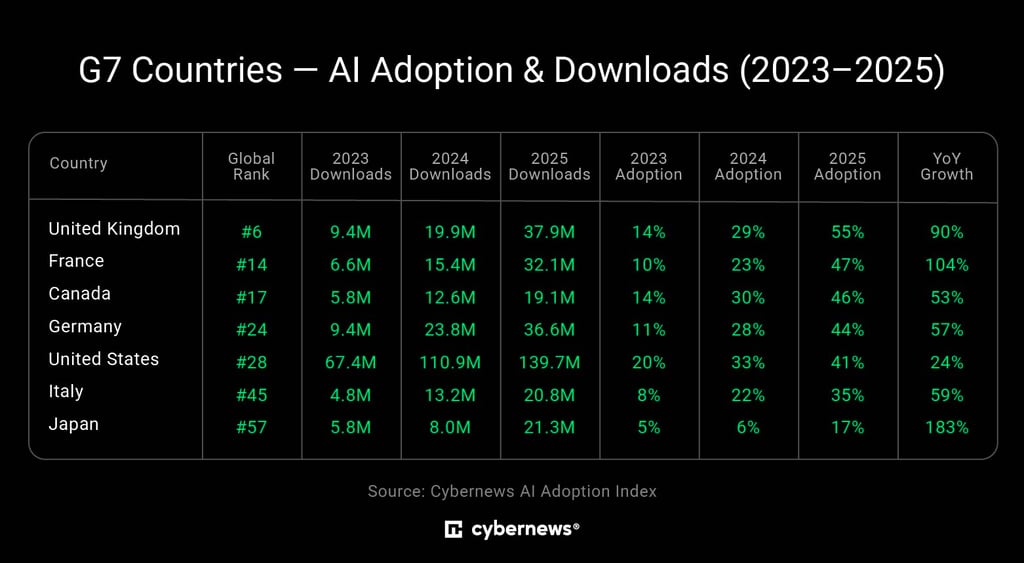






Overview of AI adoption in the G7
Back in 2022, the US was the clear leader in AI adoption — it was (and still is) the home of innovation, and a lot of people were eager to try this new technology. But as time has gone on, countries with smaller, more agile populations have started pulling ahead. Still, the US leads the G7 in raw download volume and sits second globally on that measure.
Outside of Japan, every G7 country is adopting the technology at an unprecedented pace, with adoption rates in 2025 ranging from 35% to 55%.
Japan is the clear outlier here. Low English proficiency, an older population, tighter regulations, and a narrower selection of available tools are likely what's holding it back.
That aside, regular consumers across all these major economies are picking up artificial intelligence tools remarkably quickly.
United Kingdom
Adoption in the United Kingdom grew from 14% in 2023 to 29% in 2024 and 55% in 2025.
Downloads rose from 9.4 million (2023) to 19.9 million (2024) and 37.9 million (2025), reflecting roughly 90% year-over-year growth.
The UK leads the G7 in AI adoption and ranks 6th globally.
Several factors work in the UK's favour. As a native English-speaking country, Britain has virtually no language barrier when using AI tools, since most are built in English first.
London's position as one of the world's largest tech hubs also helps: the UK ranks second globally in startup ecosystems, and London's AI startups alone raised a record $3.5 billion in VC funding in 2024. Combine that with high internet penetration — 95% of adults are online — and new technology spreads quickly.
France
Adoption in France rose from 10% in 2023 to 23% in 2024 and 47% in 2025.
Downloads grew from 6.6 million (2023) to 15.4 million (2024) and 32.1 million (2025), representing 104% year-over-year growth — the strongest among G7 countries excluding Japan.
Part of this can be traced to deliberate government action. France's National Strategy for AI, part of the broader France 2030 investment plan, has mobilized more than €109 billion in AI-related investments, as announced by President Macron at the AI Action Summit in Paris in February 2025.
The strategy also includes a focus on talent: by 2030, France intends to double the number of AI specialists in the country, which supports both business and consumer-level adoption.
Canada
Adoption in Canada grew from 14% in 2023 to 30% in 2024 and 46% in 2025.
Downloads rose from 5.8 million (2023) to 12.6 million (2024) and 19.1 million (2025), reflecting 53% year-over-year growth.
Canada ranks 17th globally, placing it third among G7 nations. The country was actually one of the first in the world to launch a national AI strategy, introducing the Pan-Canadian Artificial Intelligence Strategy back in 2017, backed by CIFAR and funding three national AI institutes.
Since then, government investment has scaled significantly. In 2024, the federal government announced a C$2.4 billion package to support the AI sector, and in 2025, an additional C$925.6 million was committed over five years for AI compute infrastructure and research.
Germany
Adoption in Germany grew from 11% in 2023 to 28% in 2024 and 44% in 2025.
Downloads rose from 9.4 million (2023) to 23.8 million (2024) and 36.6 million (2025), with 57% year-over-year growth.
Germany ranks 24th globally, which might feel underwhelming for Europe's largest economy. But there's some context worth noting. Germany's industrial, manufacturing-heavy economy presents a challenge: integrating AI into physical production lines requires longer validation cycles and higher capital expenditure than adoption in service-sector-dominant economies like France or the UK.
Still, despite these challenges, Germany generated the second-highest raw download volume in Europe at 36.6 million.
United States
Adoption in the United States grew from 20% in 2023 to 33% in 2024 and 41% in 2025.
Downloads rose from 67.4 million (2023) to 110.9 million (2024) and 139.7 million (2025), reflecting just 24% year-over-year growth, which is by far the slowest in the G7.
This is probably the most counterintuitive result in the entire dataset. The country that dominates global AI development — home to OpenAI, Google, Meta, Anthropic, and virtually every frontier lab — ranks only 28th globally in per-capita consumer adoption and 5th among G7 nations.
But the low growth rate is partly a base effect. The US entered 2023 with the highest adoption rate among G7 countries at 20%, meaning it simply had less room for explosive percentage growth. In absolute terms, the US added nearly 29 million downloads between 2024 and 2025, which is more than the total downloads of half the other G7 countries.
In short, early adopters in the US moved fast. Broader population-level uptake has been slower to follow.
Italy
Adoption in Italy rose from 8% in 2023 to 22% in 2024 and 35% in 2025.
Downloads grew from 4.8 million (2023) to 13.2 million (2024) and 20.8 million (2025), reflecting 59% year-over-year growth.
Italy ranks 45th globally and last among G7 nations in Europe, trailing Germany by 9 percentage points and France by 12.
Italy also has the oldest median age in the EU, and lower English proficiency compared to most European peers. Both of these factors create friction when adopting AI tools primarily designed for younger, English-speaking users.
Japan
Adoption in Japan grew from 5% in 2023 to 6% in 2024 and 17% in 2025.
Downloads rose from 5.8 million (2023) to 8.0 million (2024) and 21.3 million (2025), reflecting 183% year-over-year growth — the highest in the G7.
Japan ranks 57th globally and last among G7 nations overall. For a country synonymous with technological innovation, that's a surprising result.
On the consumer side, a survey shows that only about 20% of adult internet users in Japan have used AI in the past year, which aligns very closely with our study.
Japan's aging population adds significant friction. With 40 million people aged 60 to 80, the country has a demographic profile that is slower to adopt new digital tools. Low English proficiency — Japan ranked 92nd out of 116 countries in the 2024 EF English Proficiency Index — compounds the challenge. Even so, the growth numbers suggest that things are starting to change.
On the positive side, the government has earmarked ¥340 billion in digital transformation subsidies to support AI adoption.
_________
Methodology
Our research team used Worldometers.info and the United Nations statistics to determine countries' annual population from 2023 to 2025. It was then compared to Google Play Store and Apple App Store download volumes for the 100 most popular AI apps. Population and AI app download metrics were then contrasted to calculate annual AI adoption rates.
Limitations
- The dataset is exclusively composed of download statistics from the Google Play Store and Apple App Store. This scope inherently excludes other significant distribution channels, such as desktop-based software installations, side-loaded Android application packages (APKs), browser tools, and direct downloads from provider websites.
- The primary metric is the number of download events, which may not directly equate to the number of unique users. A single user may contribute multiple downloads through device changes, reinstallations, or updates, potentially inflating adoption estimates. As such, the data reflects the volume of download activity rather than the size of the active user base.
- Geographic data is based on the user's app store region setting, which may not correspond to their physical location. This discrepancy is particularly noteworthy in regions with internet restrictions, where users may register their accounts in foreign countries to circumvent censorship.
- Adoption rates are derived by normalizing downloads against the total population of each country. This method does not control country-specific variables that influence technology adoption, such as internet penetration rates, smartphone ownership, or demographic distributions. Therefore, direct comparisons of per capita adoption rates between countries with different technological infrastructures should be made with caution.
- The study's sample is limited to 100 pre-selected AI apps. This introduces a potential selection bias, as the dataset does not account for downloads from smaller, niche, or region-specific providers that constitute a portion of the overall market.
- One major global player missing from the study is China. However, Google Play Store is blocked in China, and Apple's App Store accounts for only around 20% of China's app market. Given these constraints, China was excluded from the study.