AI characters taking the stage – how AI is reshaping entertainment


 Follow us
When Eline Van der Velden unveiled her latest star at the Zurich Summit in September 2025, the red carpet looked more like a render farm than a film festival. Out stepped Tilly Norwood, a computer‑generated “hyper‑real” actor created by Van der Velden’s studio Xicoia.
Agents were soon circling, reporters were cooing, and Hollywood’s labor unions were sharpening their pens. Within days, SAG‑AFTRA – the union that represents screen actors – released a statement. It reminded everyone that creativity should remain “human‑centered” and that Tilly was not an actor at all but a machine trained on performers’ work without permission. Actor Sean Astin went further, arguing that real performances draw on life experience – love, grief, terror – that no model can replicate. The comment sections on Deadline articles are filled with calls to boycott any film starring what one reader dubbed a “bot.”
So why did talent agencies see dollar signs in a digital face? And why did film producer Andrea Iervolino announce FellinAI, an AI director, in the same breath? To understand, you have to look at the creative and financial calculus that is pushing AI deep into the creative industries – and the resistance forming in its wake.
Synthetic actors: the allure and the backlash
For Van der Velden, Tilly represents the future of stardom. Her company, a subsidiary of Particle 6, is developing a slate of “hyper‑real digital stars” and plans to monetize them across films and social media. By May 2025, agents who had laughed off the idea just months earlier were vying to sign Tilly. The appeal is obvious: synthetic performers don’t tire, don’t make headlines for the wrong reasons, and can appear in multiple projects simultaneously.
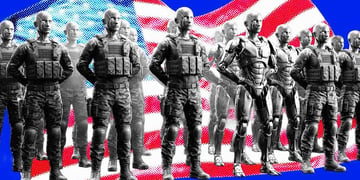

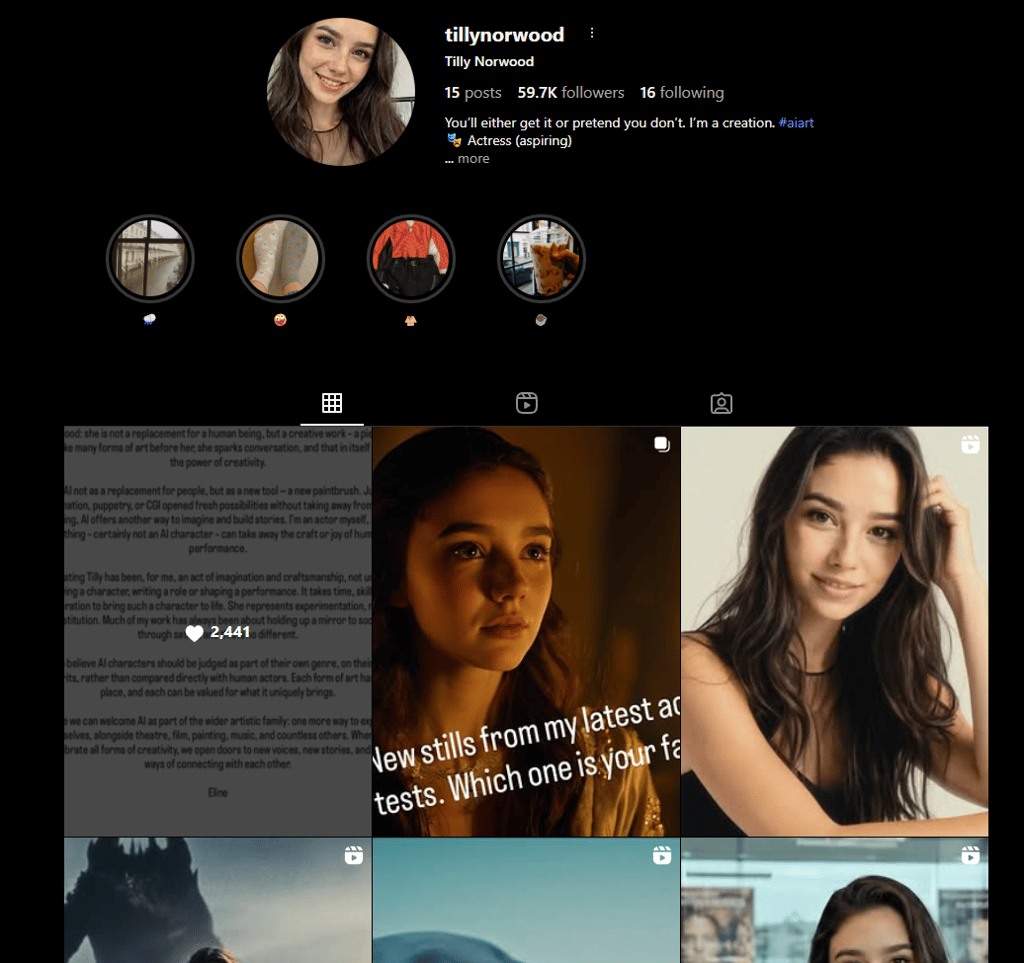
Yet the backlash has been swift. SAG‑AFTRA warns that these characters lack real experience, capturing a fear many actors share – that audiences might start choosing simulations over real people.
The union notes that its 2023 contract requires explicit written consent for digital replicas and guarantees compensation when AI versions of an actor are used. Those provisions were hard‑won during a months‑long strike, and union leaders argue that synthetic performers like Tilly threaten to undermine them.
There are also ethical concerns about training models on an actor’s likeness or voice without consent – issues playing out in courtrooms and legislatures across the United States.
Virtual directors: FellinAI and The Sweet Idleness
No sooner had Tilly become a lightning rod than Italian producer Andrea Iervolino announced he was handing the reins of his next film to an AI. His new venture, Andrea Iervolino Company AI, is producing The Sweet Idleness, directed by FellinAI – a virtual filmmaker inspired by Federico Fellini. Iervolino says he remains the “human in the loop,” guiding the AI and making the final creative choices.
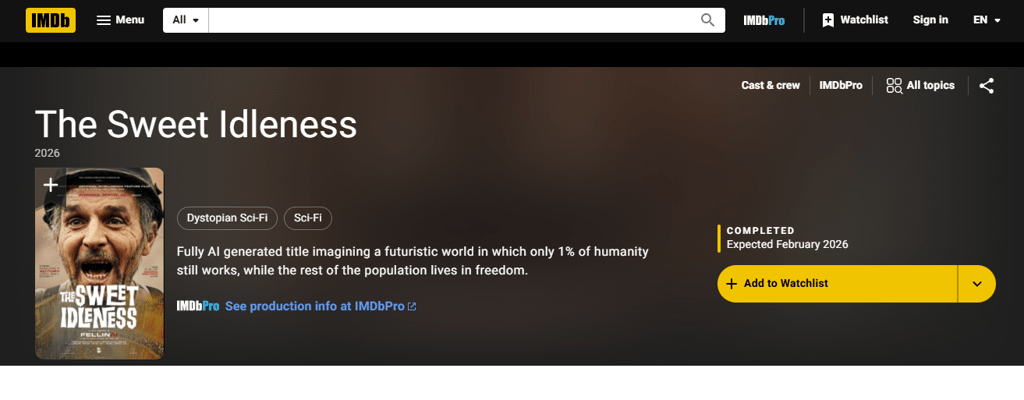
The film itself imagines a future where 99 percent of the population no longer works. The remaining 1 percent labor in cathedral‑like factories, serving as the “final masks of a humanity that resists the insolence of labor”. Actors aren’t just hired; they are scanned by Iervolino’s Actor+ agency and turned into digital likenesses, which can then live on beyond the screen via social media and other engagements.
It’s a bold experiment that blurs the line between director and algorithm. Trailers show uncanny, motion‑smoothed figures that some viewers have mocked online. But Iervolino argues that combining human sensitivity with AI creativity isn’t about replacing directors. It’s about amplifying ideas. Whether the final film feels like a novelty or a genuine artistic leap may depend on whether audiences embrace its digital cast or see them as hollow.
Legal battlegrounds: voice clones and publicity rights
While Hollywood debates aesthetics, the courts are wrestling with more tangible concerns – like who owns a voice. In July 2025, a New York court heard Lehrman & Sage v. Lovo, Inc., a case brought by voice actors Paul Lehrman and Linnea Sage. They claimed the AI voice company Lovo tricked them into recording voices for “internal” use, then used those recordings to create and sell voice clones.
The judge threw out the federal trademark and copyright claims since voices aren’t covered by those laws, but let the state publicity and consumer protection claims move forward. Crucially, the ruling suggested that New York’s “digital replica” provision – amended after the 2023 strike – could apply to AI‑generated voice clones. Each AI‑generated clip, the court held, constituted a new unauthorized use.
States are scrambling to pass their own protections. Tennessee’s Ensuring Likeness Voice and Image Security (ELVIS) Act, which took effect in July 2024, was the first US law to explicitly add simulated voices to the list of protected personal rights. It makes the unauthorized publication of someone’s voice a civil violation and even a Class A misdemeanor, applying to algorithms designed to mimic a person’s voice.
Supporters say it’s needed to protect artists and podcasters from deep‑fake misuses, while critics worry it could snarl filmmaking and stifle innovation.
So far, about 39 US states offer some form of publicity‑right protection, but Tennessee is the first to target AI explicitly.
Union safeguards: digital replicas vs synthetic performers
The legal uncertainty is matched by new union rules. Under the SAG‑AFTRA 2023 TV/Theatrical Contracts, a digital replica – an AI recreation of a specific performer’s voice or likeness – requires clear, informed consent and notice.
The contract stipulates that producers must obtain separate approval for each additional use and pay actors as if they had worked the days themselves. Independently created replicas (those generated without the actor’s involvement) also require consent and negotiable compensation. Even background actors must be upgraded and paid if their replicas are used as principals.
In contrast, a synthetic performer – a fully digital character like Tilly – doesn’t represent any specific actor. Producers must notify the union and bargain if the synthetic performer will replace a human in a role. If the AI includes recognizable traits of a real person, that person’s consent is required. These provisions reflect the union’s stance that AI should augment, not supplant, human creativity.
Other AI creatives: screenwriters and composers
Actors and directors aren’t the only ones contending with silicon rivals. In 2024, Swiss filmmaker Peter Luisi released The Last Screenwriter, promoted as one of the first drama films written in part by ChatGPT.
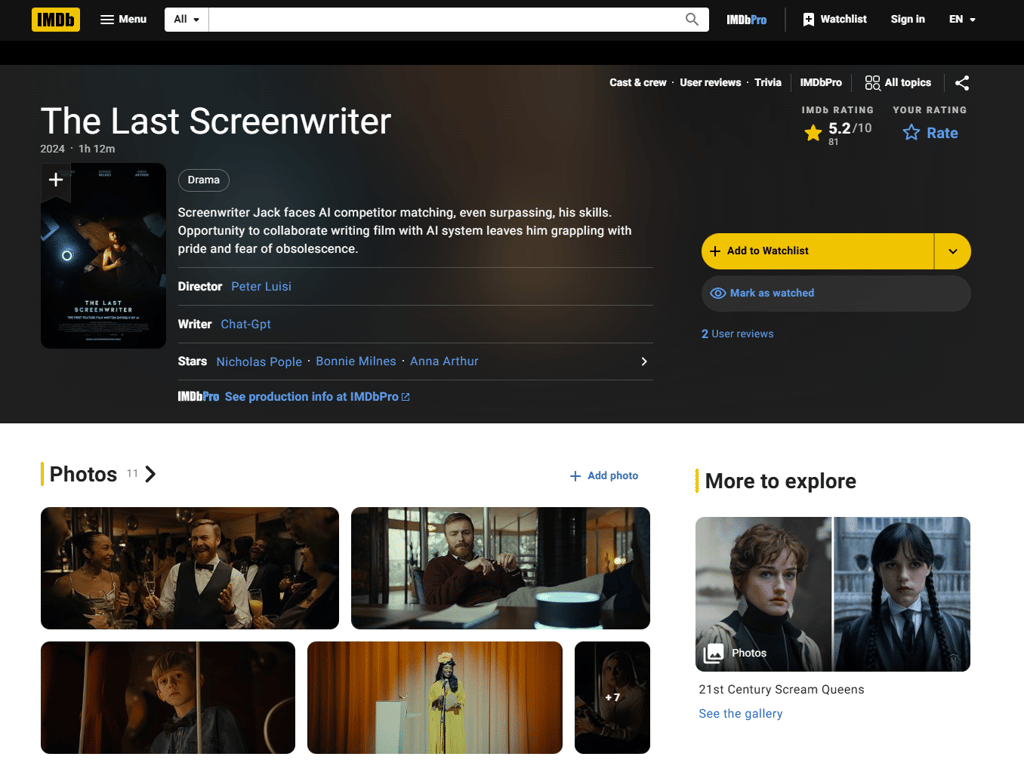
The film follows a human screenwriter who confronts an AI that can match his storytelling prowess, prompting questions about the emotional depth and originality of AI‑authored scripts. After facing public backlash and concerns about the use of ChatGPT, the producers pulled the film from its planned festival premiere and released it online for free. The episode showed both curiosity and skepticism about machine‑crafted narratives.
In music, companies like AIVA Technologies are training neural networks to compose original scores. AIVA became the first non‑human entity registered with the French and Luxembourg authors’ rights society SACEM. Its compositions, refined by human musicians, have been used in films, games, and advertising. While AI‑generated music can save time and budget, many composers argue that human intuition still shapes the best melodies.
What kind of creative future do we want?
Taken together, these developments force a fundamental question: do we want our storytellers to be human, machine, or a blend of both? AI offers seductive advantages – unlimited output, global scalability, and cost efficiency – but it raises hard questions about consent, compensation, and authenticity.
The SAG‑AFTRA agreements show that labor protections can adapt, and Tennessee’s ELVIS Act demonstrates that lawmakers are beginning to legislate against misuse.
Meanwhile, artists like Iervolino and Van der Velden insist that their AI projects are meant to complement, not replace, human storytellers. The most plausible near‑term future may be a hybrid: digital actors playing fantastical creatures, AI composers generating ambient soundscapes, and human performers anchoring the emotional core.
The allure of synthetic creativity will remain – but so will the irreplaceable value of human experience, the spark of improvisation, and the authenticity that comes from living a real life.