AI mostly copies Wes Anderson, WLOP, and Alphonse Mucha, Midjourney data reveals
A new study has analyzed almost five million prompts submitted to the AI image generator Midjourney. The results listed the artists, directors, and brands that are most often mentioned in users' prompts.

 Follow us
A new study has analyzed almost five million prompts submitted to the AI image generator Midjourney. The results listed the artists, directors, and brands that are most often mentioned in users' prompts.
Artificial intelligence doesn’t go out of its way to create original content when generating images or videos. This isn’t only because it was trained on art humans have already created in the past, but also because users don’t expect it – many include familiar names and styles in their prompt to get exactly what they want.
The research authors used the Midlibrary database to track how often each name appeared in user prompts on the Midjourney Discord server.
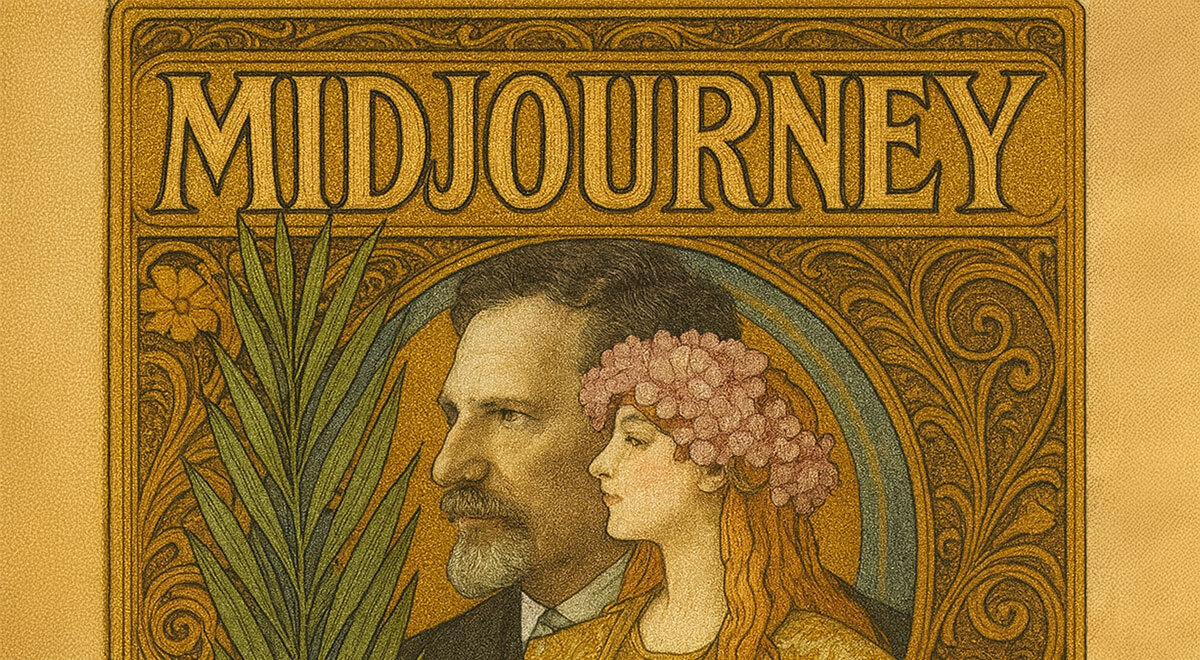
The first is the “Most prompted artist” list, which is topped by the Czech artist Alphonse Mucha, who is well known for his Art Nouveau posters.

The artist’s career zenith dates back to the 1890s, when this art wave was the most popular. The artist's aesthetics is reflected in images of idealized women surrounded by floral pastel ornaments. Now, this style is making a comeback, and it’s reflected in more than 230,000 prompts on Midjourney.
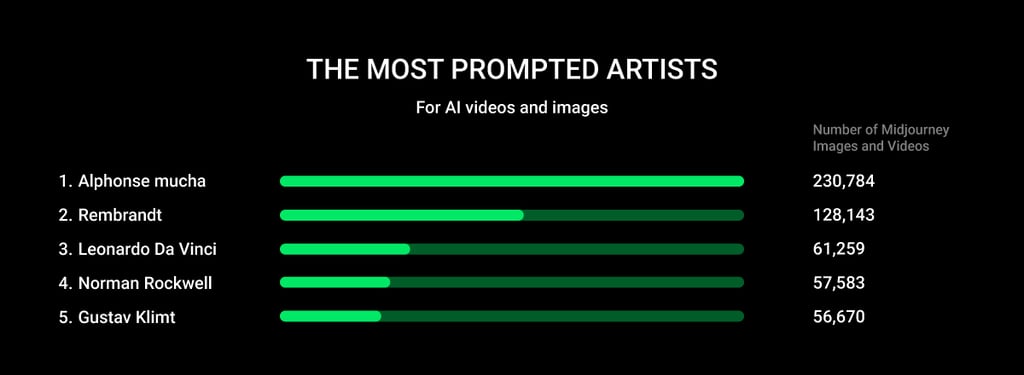
”Mucha’s work is in the public domain – although this hardly sets him apart from Rembrandt, Da Vinci, or Gustav Klimt (who was Mucha’s contemporary), each of whom appears in far fewer prompts than Mucha,” researchers from content platform Kapwing explain.
The above-mentioned artists, including Norman Rockwell, made it to the top 5 of the list, with Rembrandt coming in second with 128 prompts, including his name – twice as few as Mucha.
What about illustrators?
Midjourney users expect their visuals to mimic the art of illustrators. The one topping this list, digital fantasy creator WLOP, is the most copied among illustrators with 166,415 mentions.
This artist is famous for his cinematic, dreamy artwork, where he depicts beautiful heroines in dramatic or fantastic environments.
WLOP’s nearest competitor on the list is Greg Rutkowski, another fantasy art creator who you might recognise from images often depicting epic battle scenes, dragons, and magical landscapes. Fans of both Dungeons and Dragons and Dragons and Magic: The Gathering should be familiar with Rutkowski’s work, which is featured in the games.
He is the only artist on this list and in the research who has sued Midjourney over the use of his work, although it was done a couple of years ago. He is one of the plaintiffs in a group of artists who have filed a class action lawsuit against three AI companies: Midjourney, DeviantArt, and Stability AI, for using their art to train AI.
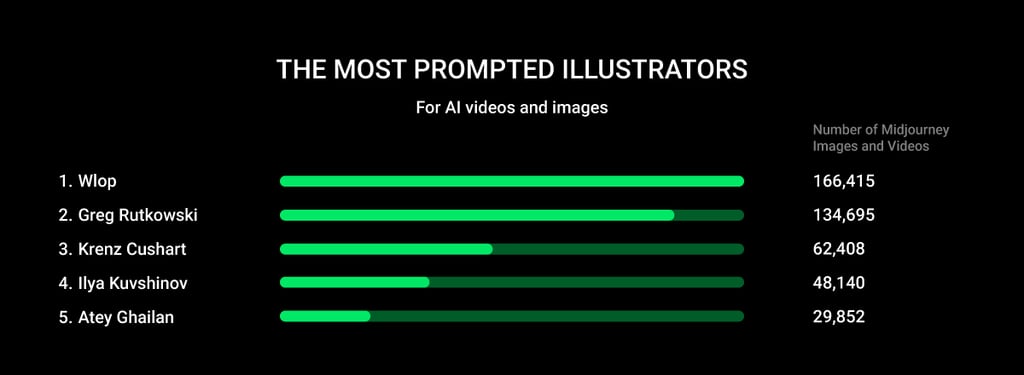
Before that, he was reported to have become the artist copied more times than Pablo Picasso.
"The first month that I discovered it, I realised that it will clearly affect my career and I won't be able to recognise and find my own works on the internet,” Rutkowski told the BBC in 2022.
Midjourney copies film directors, too
Film directors are also high on users’ lists. Wes Anderson’s distinct pastel palette and symmetry have inspired more than 92,000 prompts, making him the most-copied filmmaker in this research.
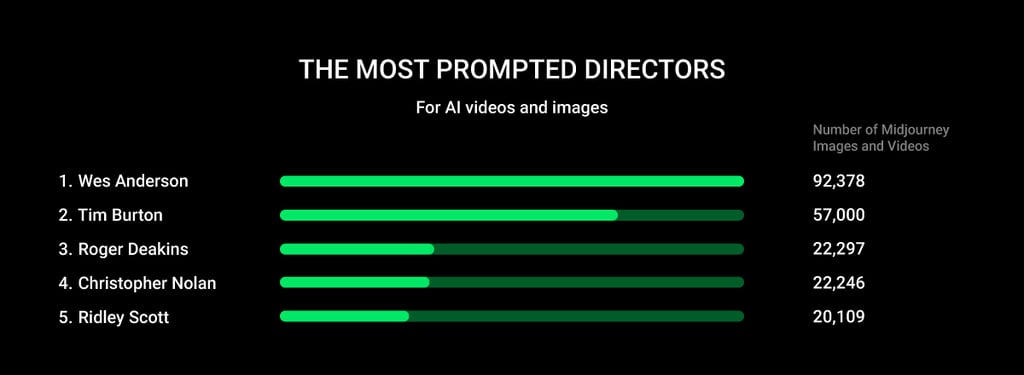
Even though he has not been openly outspoken about specific AI companies that use artists' work to generate AI art, Wes Anderson did address the couple-of-years-old social media trend when AI-generated videos such as “Star Wars by Wes Anderson” became viral hits.
However, they’ve all been created using tools such as Midjourney, Runway, and ChatGPT to imitate his cinematic tone – perfectly symmetrical shots, vintage outfits, and whimsical narration.
“I am not a meme,” Anderson once told Inverse when asked about this trend.
“If somebody sends me something like that, I’ll immediately erase it … I do not want to look at it, thinking, ‘Is that what I do? Is that what I mean?” he explained to Entertainment Weekly.






New York is the capital of most-prompted cities
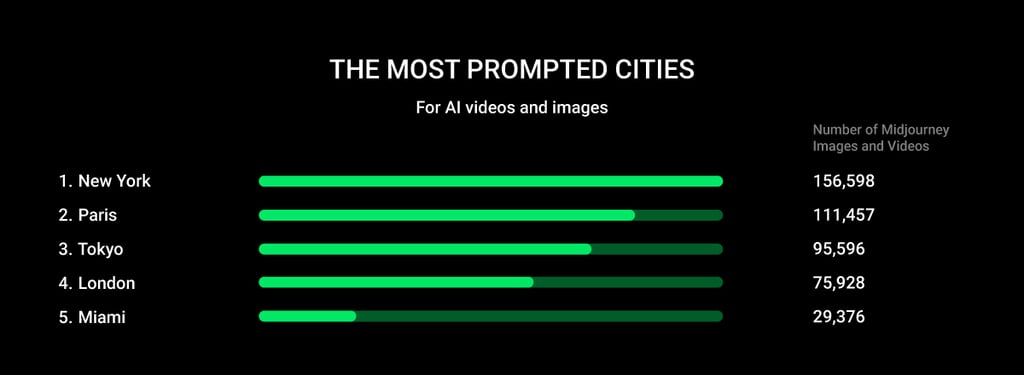
The list of the most prompted cities on Midjourney is crowned by New York. Researchers suggest that this result is based on the cities’ “self-perpetuating position as the archetypal city, which is reinforced by its frequent depiction in movies, which in turn diversifies the city’s profile (as a city of crime, of romance, of politics, of everyday stories, of elite enclaves, etc.).”
New York appeared in more than 156,000 images and videos – 1.4 times more often than second-placed Paris. Tokyo is third, followed by London and Miami, which are fourth and fifth, respectively.
Unlock more exclusive Cybernews content on YouTube.