AI-related anxiety is rising in the U.S. – regulation and privacy top the list


 Follow us
A new study conducted by Cybernews and nexos.ai reveals that Americans are becoming increasingly anxious about artificial intelligence in 2025. The study examined which AI-related categories evoked the most anxiety in the U.S. using Google Trends data from January to October 2025.
The study analyzed five key categories: Control & Regulation, Data & Privacy, Bias & Ethics, Misinformation & Trust, and Job Displacement & Workforce Impact.
To measure public anxiety in each category, researchers analyzed the relative search interest of three keywords from each category on Google Trends, focusing on keywords that represent a person’s anxiety on a given topic, such as “is ai legal” for Control & Regulation and “is ai private” for Data & Privacy. They then calculated the average relative interest of each category’s keywords to determine the relative anxiety levels of each AI-related category.
How AI anxiety evolved in 2025:
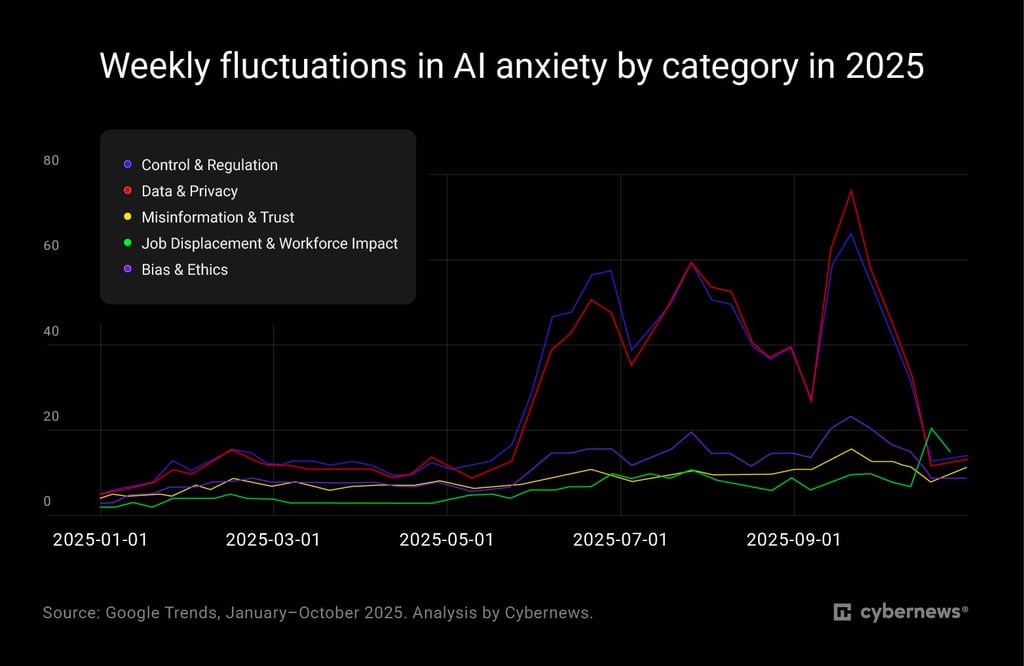





Interest in all AI anxiety categories went up in 2025, although some spiked dramatically, while others increased gradually. Control & Regulation was the top anxiety-invoking category, followed closely by Data & Privacy. The two categories had very similar interest levels, and both experienced a spike in interest in the second part of the year. The remaining three categories remained somewhat stable, although all three experienced gradual increases throughout the year.
“The increase in AI anxiety means that people aren’t just blindly using AI and hoping for the best – they’re actually starting to understand the risks associated with AI tools and want to know more about it. We hope that most people who are searching for the terms included in the study don’t just worry about the negative effects of AI, but use that information to make more informed, responsible decisions about how they engage with these technologies,” Cybernews researchers say.
Control & Regulation increased by 256%, and Data & Privacy by 325%, between the weeks of May 25 and June 22.
Several events may have caused this surge: for instance, in June, 260 lawmakers called on Congress to remove a moratorium on state-level AI regulations. The Texas Responsible AI Governance Act was also signed into law around that time. California also released a policy that highlighted the potential harms of AI, especially relating to privacy.
Control & Regulation had the highest interest until about August, at which point Data & Privacy began to lead the way. Around that time, major AI companies released reports about AI security threats. For example, Microsoft released a report about prompt injection attacks, and Anthropic released a report about how their model was used to conduct a large-scale data theft campaign. As AI companies began to talk about the potential security issues of their tools, users may have grown more aware of the threats, explaining why AI Data & Privacy anxiety may have slightly surpassed the Control & Regulation category.
Control & Regulation topped the list
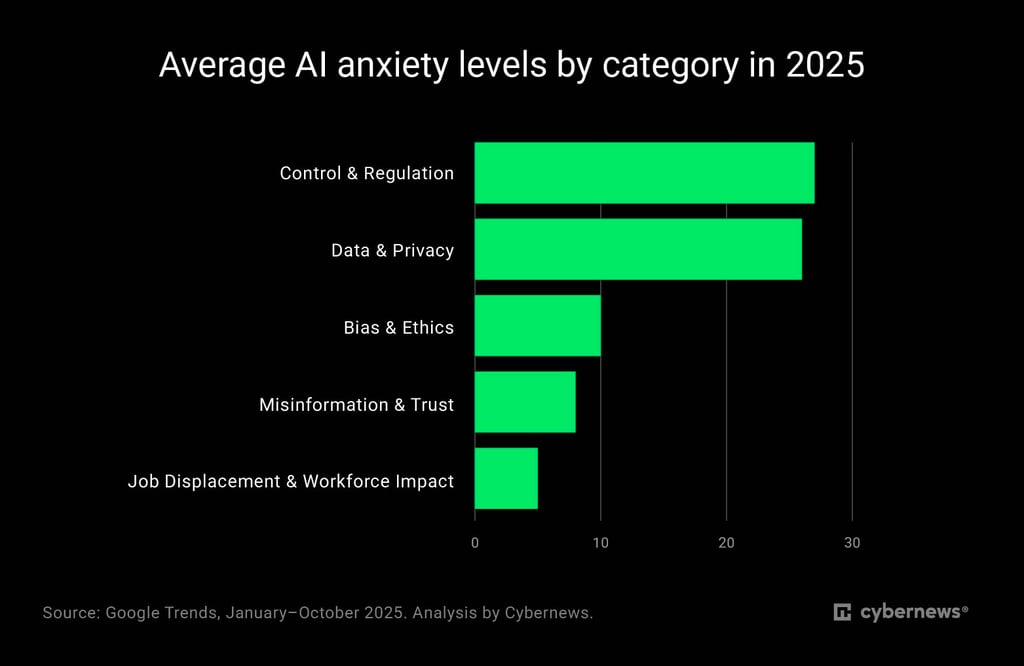
Search terms related to AI Control & Regulation had the highest average relative interest (27) in 2025. This category included the keywords “is ai legal”, “ai regulations”, and “ai laws”. People searching for these keywords were likely seeking clarity about how AI is governed and what rules apply to them
While the European Union has already passed the world’s first comprehensive AI Law – the EU AI Act – the United States has yet to introduce a federal framework for artificial intelligence. The growing anxiety related to AI Control & Regulation may suggest that Americans are becoming aware of this gap and increasingly curious – or concerned – about how AI may be regulated in the future.
Data & Privacy came as a close second
The Data & Privacy category was in second place in terms of AI anxiety. This category included the keywords “ai privacy”, “is ai private”, and “ai and privacy”. It had an average relative interest level of 26, just one point less than Control & Regulation. This category followed a nearly identical interest pattern as Control & Regulation, showing that worries about the two often go hand in hand.
“As people learn how much of their personal and business data is used by AI tools, they are becoming more concerned about privacy,” says Emanuelis Norbutas, chief technology officer at nexos.ai. “We are entering a time when curiosity about AI meets the reality of how it handles information. Many users are unaware that every file they upload, every chat log, and every API call can share sensitive details with systems that they cannot fully control.
“As these tools become more powerful, it gets harder to track where that data goes. While being interested in AI is a good start, protecting your privacy requires action. This means setting clear data policies, limiting what you share with AI models, and asking service providers for transparency,” Norbutas adds.
Job displacement: the paradox of low concern
Despite the wave of tech layoffs throughout 2025, anxiety related to Job Displacement & Workforce Impact was low. The category consisted of the keywords “ai job loss”, “ai taking jobs”, and “ai layoffs”. It was the lowest-ranking category out of all 5.
Even in May, when it was reported that Microsoft will lay off 3% of its global workforce due to AI adoption, interest in this category had no noticeable increase.
Despite low interest throughout most of the year, there was a noticeable spike in this category at the end of October, which happens to be when talks about major Amazon layoffs broke out. During the week of October 19th, interest in AI Job displacement & Workforce impact was highest of all analyzed categories, even those that dominated all year. Compared to the week prior, interest in this category increased by 233%. This may suggest a shift in the level of public awareness related to AI job loss.
Bottom line
The AI Anxiety study shows that Americans are becoming increasingly aware of the risks and issues related to AI adoption. Although questions about regulation and privacy dominated most of the year, anxiety related to all analyzed categories increased. This shows that people are starting to look at AI more critically – not just as a new tool, but as something that’s already affecting their data, their work, and their daily lives.
Methodology: The AI Anxiety Index measures public concern about artificial intelligence across five categories – Control & Regulation, Data & Privacy, Bias & Ethics, Misinformation & Trust, and Job Displacement & Workforce Impact – using Google Trends search data as a proxy for collective sentiment. The study analyzed search activity in the United States from January 1st, 2025 to October 31st, 2025. Each category included three keyword queries expressing fear or uncertainty related to that category. Each keyword’s search interest was indexed on a 0–100 scale by Google Trends, with “is ai legal” used as the anchor term to ensure comparability across all categories. The scores represent average relative search interest rather than raw volume, offering a clear picture of which AI-related issues evoke the most public anxiety over time. Average values of each category’s keywords were calculated to provide category-level insights and comparisons. The keywords and exact calculations can be found in this sheet.