Anthropic’s email asking Pentagon to reconsider blacklist lost in Department of War official’s inbox
Anthropic did appeal the Department of War’s decision to blacklist the AI company’s technology after all, but it ended up in the wrong inbox.
Image by Getty/Nur Photo

 Follow us
Anthropic did appeal the Department of War’s decision to blacklist the AI company’s technology after all, but it ended up in the wrong inbox.
Anthropic’s email to the Department of War (DoW) asking the government to reconsider blacklisting the AI company seemingly got lost in the inboxes of two DoW officials.
Instead of following the proper procedures, the head of Anthropic’s legal team, Kelly P. Dunbar, sent a letter of reconsideration directly to Colonel Anthony Fuscellaro via email.
The email addressed to Fuscellaro and Earl G. Matthews at the DoW mentioned that “Anthropic’s opposition to the March 3rd determination” could be found in the attachment.






The DoW had given Anthropic 30 days to respond to its designation, and while the email was sent on April 17th, the department said that the Claude maker had decided not to respond.
Seeing as Anthropic seemingly didn’t want to argue its case, the DoW provided Anthropic’s lawyers with the declaration on April 20th, which was later added as supporting evidence in court documents.
When Anthropic discovered that the DoW had filed evidence stating that the AI company hadn’t bothered to appeal the blacklisting of its tools, the company promptly notified the DoW.
The document on the legal research website Court Listener says that Anthropic’s lawyers told the DoW that the company’s head of legal had “emailed a request for reconsideration…and provided a copy of the email, which is attached to this letter.”
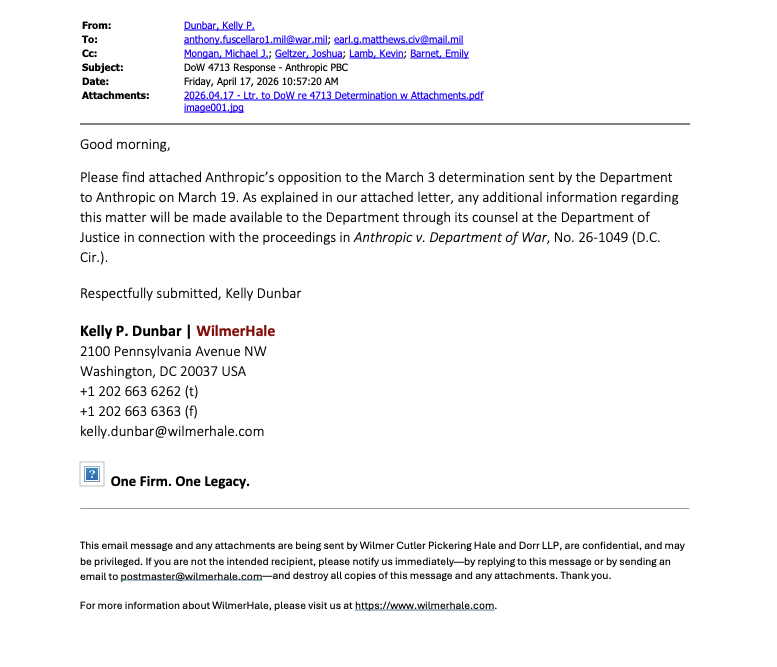
The email had gotten misplaced as Anthropic’s legal team had sent the notice to two senior officials rather than “following the procedures outlined in the Secretary’s notice for seeking reconsideration.”
All notices and written information must be submitted to a specific mailbox, the DoW said, hence why the department was “unaware of the email until (Anthropic’s) counsel contacted the government on May 8th.”
Although the email wasn’t submitted correctly, the Department has said it will treat the reconsideration as a timely request.
Anthropic refused to bend its rules
This comes after Anthropic refused to adjust or remove its guardrail so that the DoW could use its tools to power autonomous weapons or for domestic surveillance in military operations in Iran.
The Pentagon asked Anthropic to bend its rules, and the company refused.
Anthropic was later classified as a “supply chain risk,” which is the first time an American company has been branded with this title.
President Donald Trump then directed all federal agencies to stop using Anthropic’s technology.
This supply chain risk designation came into effect shortly after and was applied to all Anthropic products and services, according to international law firm Mayer Brown.
This meant that Anthropic’s technology would no longer be used in the US federal ecosystem, and the AI company would be cut off from profitable government contracts.
Anthropic’s CEO, Dario Amodei, said that the company is “very proud of the work (we) have done together with the Department,” including “supporting frontline warfighters with applications such as intelligence analysis, modeling and simulation, operational planning, cyber operations, and more.”
However, the company doesn’t believe that this “action is legally sound,” and Anthropic has “no choice but to challenge it in court.”
Is Palantir actually to blame?
Amodei went on to say that the company does not believe and has never believed that it is “the role of Anthropic or any private company to be involved in operational decision making…(in) the role of the military.”
“Our only concerns have been our exceptions on fully autonomous weapons and mass domestic surveillance, which relate to high-level usage areas, and not operational decision-making.”
Amodei’s comments came after a missile hit an Iranian primary school, killing 168 people, including around 110 children, according to the BBC, which cited Iranian officials.
The Pentagon failed to acknowledge the US’s involvement in the bombing and simply said that the situation is under investigation.
Anthropic’s Claude was later criticized in the media as being responsible for the bombing of the primary school.
However, the targeting for Operation Epic Fury was run by a system called Maven, powered by the US spy-tech company Palantir.
For 8 years, Palantir’s technology was one of Silicon Valley’s most contentious projects, prompting engineers to quit because they didn’t believe in building AI for the Pentagon’s targeting systems, according to The Guardian.
Despite Palantir’s technology potentially providing outdated data that may or may not have caused the mass casualty event, Anthropic seemingly got the blame and has been punished ever since.






Unlock more exclusive Cybernews content on YouTube.