AI clones of former employees spark workplace ethics debate in China
Companies in China are beginning to turn former employees into software, and that isn’t sitting well with some people.
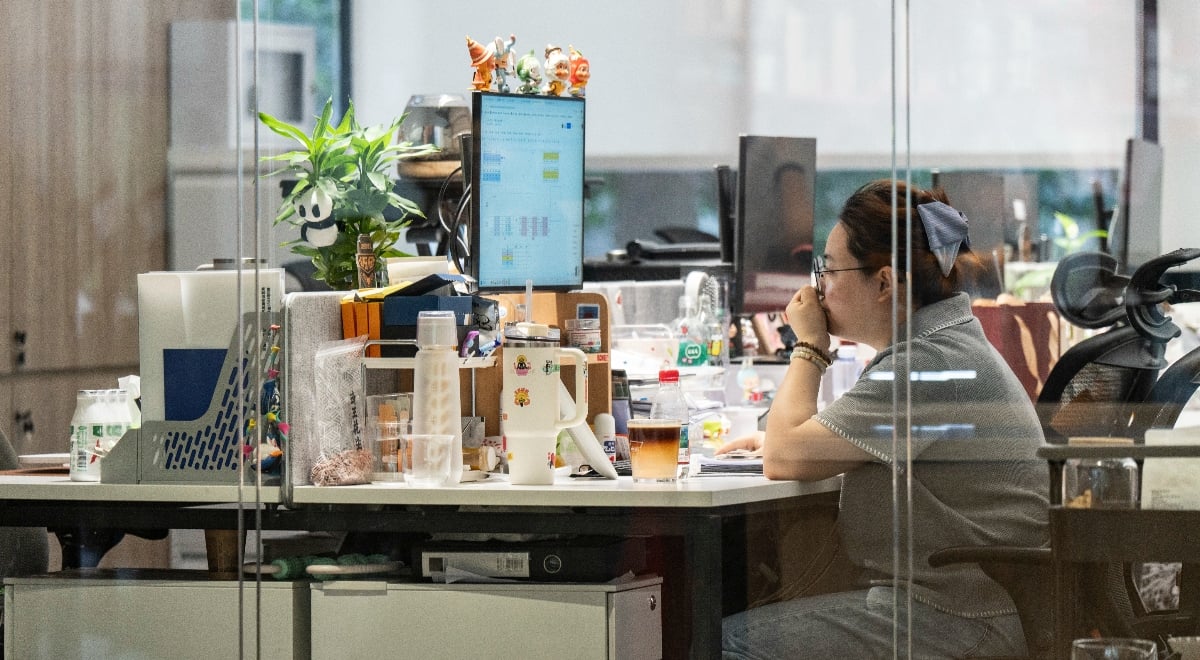
Image by Qilai Shen/Bloomberg via Getty Images

 Follow us
Companies in China are beginning to turn former employees into software, and that isn’t sitting well with some people.
Fueling the trend of turning real individuals into digital entities is an AI agent framework, dubbed colleague-skill, which packages a worker’s know-how into autonomous agents trained on emails, chat logs, and workflows.
These agents can continue handling routine tasks after an employee leaves. The project, hosted on GitHub, has attracted significant attention, garnering over 13,000 stars in a short time, indicating strong developer interest and rapid adoption.
Developed by Zhou Tianyi, the tool positions itself as a way to “distill” colleagues into an AI skill. The project describes its goal as turning “cold farewells into warm skills,” effectively preserving a worker’s presence inside an organization even after they leave.
The rise of colleague-skill comes on the heels of the OpenClaw boom in China, which has seen the open-source AI agent turn into a nationwide phenomenon, despite warnings and cautionary tales from cybersecurity experts.





Growing backlash
Just like with OpenClaw, the rapid adoption of colleague-skill has also fueled a broader debate in China about the boundaries of AI in the workplace.
Reports cited by South Korean media point to criticism from Chinese outlets, including The Chinese Economic Daily, where commentators argue that employee expertise and job-specific skills should be treated as personal assets, not corporate data that can be freely repurposed for AI training.
Has your password leaked?
That argument has gained traction as examples of AI “colleagues” circulate online. In demonstrations described in the reporting, a trained agent based on a former employee introduces itself in first person, presenting as a digital continuation of the individual while handling tasks in their style.
Zhou, however, argues that the AI agents it creates are far from real people.
The conversation on this topic is live. Join in the discussion.
“They can only handle repetitive tasks – real human judgment, creativity, and adaptability remain beyond their reach,” says Zhou.
But that hasn’t pacified critics who warn that tools like colleague-skill do enough to reshape labor dynamics. They argue that by converting human expertise into persistent software, companies may reduce reliance on human workers.






In fact, the debate is now moving toward policy. Commentators and labor advocates are using the rise of colleague-skill as a test case for future regulation. They argue that employees’ expertise is a uniquely human asset and should not be used for AI training without their consent or compensation.
For now, however, adoption continues to outpace oversight. GitHub is flooded with a slew of projects inspired by Zhou’s project, such as boss.skill and teacher.skill. In an update yesterday, Zhou shared that colleague.skill itself is now evolving into dot-skill to clone any individual.
Unlock more exclusive Cybernews content on YouTube.